 WORKPLACE SIGNALS
 How to Actually Resolve Conflict as a Manager (9-Step Framework That Works)
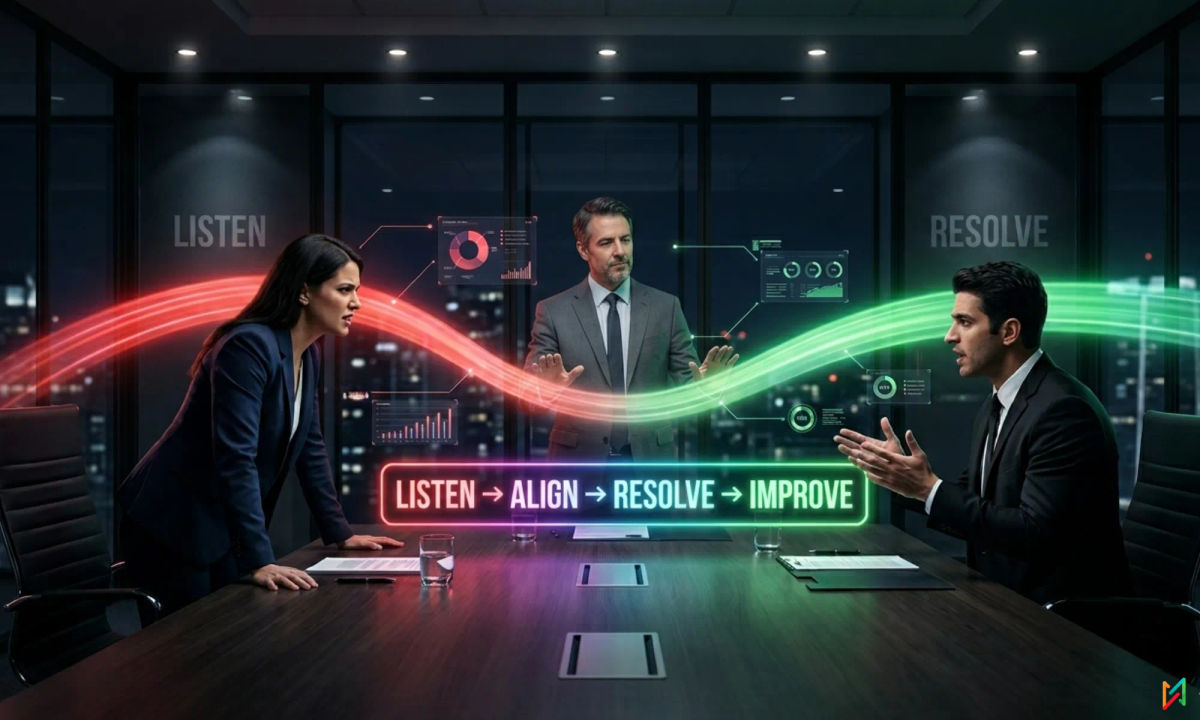
Conflict is uncomfortable for most managers, who prefer to believe it will resolve itself. Yet the subtle tensions and passive-aggressive behaviors that creep into daily interactions rarely dissipate on their own. Instead of confronting these issues early, many managers wait until problems escalate.
Avoiding conflict can be damaging in the long run, as unresolved disagreements fester and spread like a virus through team dynamics. This phenomenon isn’t just theoretical; it’s something I’ve observed firsthand over years of management. Early in my career, I often hesitated to intervene for fear of making things worse.
However, ignoring conflict is not neutral—it’s a decision that can lead to significant problems down the line. Experienced managers learn through hard experience that addressing issues promptly and effectively strengthens teams rather than undermines them. A structured approach to conflict resolution, rather than relying solely on instinct, is crucial for maintaining healthy team dynamics.
Start Before Conflict Even Begins: Build the Right Culture
The most effective approach to conflict resolution begins by cultivating a culture that values idea integrity over personal egos. In such an environment, individuals engage in open dialogue without letting emotions dictate the conversation. Leaders must discourage behaviors driven by personal ambition and establish clear guidelines for constructive challenges while maintaining respect for others' perspectives. Without this groundwork, any framework aimed at resolving conflicts will struggle to deliver consistent results across different scenarios and personalities.
Actively build a culture where focus is on what’s right, not who’s right. Set expectations for respectful challenge and open communication. Avoid ego-driven behavior by focusing on idea quality over personal gain. In a recent tech startup case study, leaders implemented these principles after noticing unproductive conflicts. By prioritizing collaborative discussions and valuing diverse perspectives equally regardless of position or tenure, they saw marked improvement in team dynamics and innovation.
Step 1: Recognize the Early Signals
Conflict rarely appears suddenly. It builds. You'll notice subtle signs of tension, like conversations becoming shorter or more defensive, emails carrying subtle frustration, team members avoiding each other, and misalignment increasing on small decisions. These are signals—not noise.
The earlier you act, the easier the resolution. The longer you wait, the more emotional the conflict becomes. And emotional conflicts are harder to untangle because they're no longer about the original issue.
- Conversations becoming shorter or more defensive
- Emails carrying subtle frustration
- Team members avoiding each other
- Misalignment increasing on small decisions
Step 2: Decide Whether to Step In
Not every disagreement needs intervention. Healthy teams debate. They challenge each other. They disagree. That's not conflict—that's collaboration. Your role is to identify when disagreement turns into something unproductive. The moment it becomes personal, repetitive, or starts affecting delivery, that's your signal.
| Characteristics |
|---|
| The moment it becomes personal, repetitive, or starts affecting delivery, that's your signal. |
At that point, stepping in is not optional. It's your responsibility.
- When you're called upon to step in, do so with empathy and understanding.
- Acknowledge the emotions behind the disagreement and work towards finding a resolution that respects everyone involved.
Not every disagreement needs intervention. Healthy teams debate. They challenge each other. They disagree. That's not conflict—that's collaboration.
| Resolution |
|---|
| Acknowledge the emotions behind the disagreement and work towards finding a resolution that respects everyone involved. |
By intervening in a productive manner, you can help turn a potentially toxic situation into an opportunity for growth and understanding.
| Outcome |
|---|
| A healthy team will emerge stronger from the experience, with a deeper understanding of each other's perspectives and a greater sense of trust. |
Step 3: Address It Early and Directly
Timing matters. Delaying intervention sends the wrong message—that the behavior is acceptable or not important enough to address. Approach the situation directly, but without accusation. Frame it around observation, not judgment. Something as simple as:
"I've noticed some tension between both of you, and I want to make sure we address it before it impacts the team."
This keeps the conversation neutral and focused.
Step 4: Listen Before You Fix
This is where most managers get it wrong. They jump to solutions too quickly. People want to be heard first. Each person involved needs space to explain their perspective without interruption. Your role is not to correct or challenge immediately but to understand fully. Ask open-ended questions, encourage deeper exploration, and reflect back what you’re hearing to confirm understanding. When people feel genuinely heard, their defensiveness drops, making resolution possible.
- Ask open-ended questions.
- Encourage them to go deeper.
- Reflect back what you’re hearing to confirm understanding.
This approach builds trust and establishes a foundation for meaningful dialogue. It requires patience, empathy, and effective communication skills. The payoff is well worth the effort: greater collaboration, better decision-making, and improved relationships.
Open-ended questions can be simple: "What's been going on that’s causing concern?" "How do you think we could resolve this issue?" "What would need to happen for us to move forward?" The key is a growth mindset, acknowledging unique perspectives and insights from everyone involved.
Step 5: Separate Facts from Emotions
Conflict conversations often mix two things: what actually happened and how people feel about what happened. Both matter—but they need to be handled differently.
- What was said?
- What was done?
- What was the impact?
As a manager, you need to gently separate the two. Acknowledge emotions without letting them control the conversation. Then guide the discussion toward facts. What was said: The team discussed the project timeline and budget. What was done: The team agreed on a revised timeline and allocated resources accordingly.
What was the impact: The team's morale improved, and they felt more confident in their ability to deliver the project. This shift helps move the conversation from emotional reaction to structured problem-solving. By focusing on facts, you can create a clearer understanding of what happened, identify the root causes, and develop effective solutions.
Step 6: Use a 24-Hour Ceasefire if Needed
Sometimes, emotions run too high. In those moments, forcing a resolution is counterproductive. People say things they don’t mean. They become defensive, and the situation escalates. Recognizing this is a leadership skill. If needed, pause the conversation. Call for a 24-hour reset. This gives everyone space to process, reflect, and return with a clearer mindset. Time doesn’t solve conflict—but it can create the conditions for better conversations.
Step 7: Be the Objective Voice
Your role is not to take sides. It's to guide. Stay neutral. Stay calm. Stay focused. When conversations drift toward blame, redirect them. Instead of asking "Who caused this?" shift the focus to "What's the actual problem we need to solve?" This subtle shift changes everything. It moves the conversation from past-focused to future-focused, from blame to resolution.
By asking better questions, you empower your team to focus on solutions rather than who caused the problem. A simple mindset adjustment unlocks a more constructive dialogue and leads to real progress. Remember, your goal is not to assign blame or defend individuals but to uncover underlying issues and work together to find a way forward. This approach creates an environment where people feel safe sharing their concerns and ideas, encouraging collaboration and fostering trust.
Step 8: Align on a Clear Way Forward
To resolve the conflict, it's essential to define what will change going forward, clarify expectations, and outline how both individuals will collaborate differently. This clarity prevents repeated conflicts by ensuring all parties are aligned on the way forward.
The goal is not to compromise for the sake of peace but to find a solution that addresses the root issue. Define:
- What changes need to occur
- Which expectations must be clarified
- How both individuals will collaborate effectively
A specific agreement is more effective than a vague one, as it sets clear boundaries and prevents misunderstandings.
Step 9: Identify the Root Cause
This step is often skipped by managers and leads to recurring conflicts. Every conflict has a root cause, such as process issues, misaligned expectations, unclear roles, or communication gaps.
Understanding the underlying cause before resolving it moves management from reactive to proactive. This requires addressing deeper issues rather than quick fixes.
- Misaligned expectations
- Lack of clarity in roles
- Communication gaps
- Process issues
This step identifies the root causes and underlying patterns, enabling targeted solutions that address core issues.
| Attribute | Description |
|---|---|
| Misaligned expectations | Different ideas about what's expected or will be received. |
| Lack of clarity in roles | Uncertainty about job responsibilities and how they fit into the bigger picture. |
The Real Role of a Manager in Conflict
Conflict resolution is not about keeping everyone happy. It's about keeping the team effective. Sometimes that means having uncomfortable conversations. Sometimes that means challenging behavior. And sometimes that means stepping in when it would be easier to stay silent.
But that's the role. Because strong teams are not conflict-free. They are conflict-capable. They know how to disagree, resolve, and move forward without damage.
- Sometimes that means having uncomfortable conversations.
- Sometimes that means challenging behavior.
- And sometimes that means stepping in when it would be easier to stay silent.
| Conflict | Resolution |
|---|---|
| Uncomfortable conversations | Have the conversation, but do it with empathy and understanding. |
| Challenging behavior | Address the behavior directly, while still showing respect for the individual. |
| Stepping in when it would be easier to stay silent | Sometimes you have to take a stand and address the issue head-on. |
Final Thought
Avoiding conflict feels easier in the moment, but it creates bigger problems over time. Addressing it early, with structure and clarity, transforms it into something valuable, something productive.
Because when handled correctly, conflict doesn’t break teams; it strengthens them. This transformation is crucial for building strong relationships within a team or organization. By embracing conflict in a constructive manner, individuals can grow personally and professionally while fostering a culture of open communication and trust.
This approach also encourages self-reflection, active listening, and empathy – essential skills for navigating complex conflicts. By acknowledging the value of conflict, teams can turn potential roadblocks into opportunities for growth and improvement. Ultimately, embracing conflict can lead to more effective collaboration, increased creativity, and a stronger sense of community.
By prioritizing constructive conflict resolution, individuals can build resilience and develop a deeper understanding of themselves and others. This capacity for healthy conflict can become a powerful tool for driving innovation, fostering meaningful connections, and achieving shared goals.