 WORKPLACE SIGNALS
 The Superpower of Taking Action (Why Momentum Beats Motivation)
Action Is the Real Differentiator
The notion that success is solely dependent on having innovative ideas, exceptional talent, or fortunate timing is a widespread misconception. In fact, what truly sets high achievers apart from the rest is their willingness to take action. Ideas without execution remain mere concepts, whereas action transforms potential into tangible progress.
While it's easy to get caught up in brainstorming and conceptualizing, the real challenge lies not in figuring out what to do, but rather in getting started. And even more crucially, persevering through initial struggles to build momentum. Think of it like taking the first step on a hike – it's often the steepest and most daunting part, but once you've broken through that initial barrier, the rest of the journey becomes significantly easier.
The importance of action cannot be overstated. It's what separates those who merely talk about change from those who actually drive it. By taking consistent, deliberate steps towards your goals, you'll not only make meaningful progress but also develop the resilience and determination needed to overcome obstacles and stay on track.
It Always Starts with a Decision
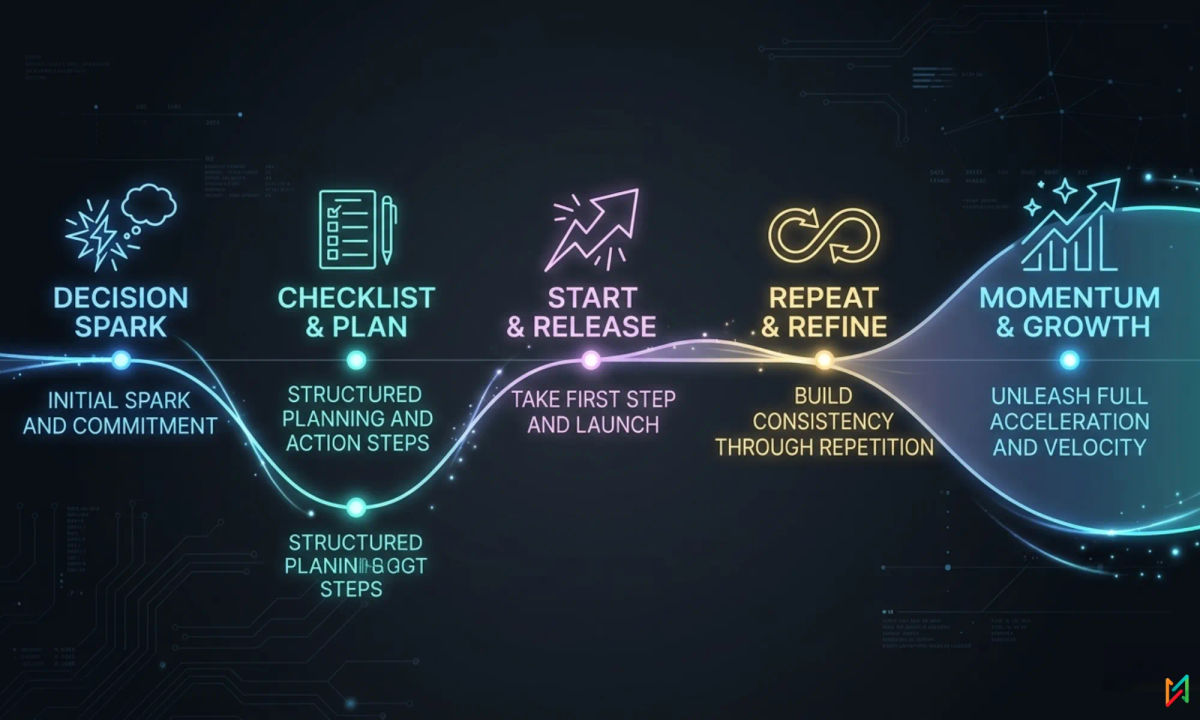
In many cases, meaningful change begins with a deliberate decision to take action. This is not just about having good intentions or vague aspirations; it's about making a conscious choice to move forward. When you make a decision, you're essentially saying, "I'm done thinking, and I'm ready to start doing." This pivotal moment sets the stage for all that follows.
To illustrate this point, consider a friend who wants to start their own business but keeps putting off the initial step – drafting a business plan. They may think about it, discuss it with others, or even attend seminars on entrepreneurship, but ultimately, they fail to make a decision. As a result, their plans remain stuck in the planning phase, and progress is hindered. On the other hand, someone who decides to start small, takes the leap, and begins creating a plan – that's when real progress begins.
The beauty of making decisions lies in its simplicity: it doesn't need to be perfect; it just needs to be firm. Once you've made up your mind, you gain direction, clarity, and momentum. Without this initial commitment, even the most well-thought-out plans remain dormant, waiting for someone or something to spark action. So, the next time you're faced with a crossroads, remember that every meaningful change starts with a decision – not just any decision, but one that propels you forward.
Planning Turns Ideas into Direction
The planning phase is where ideas take shape and direction is established. It's the moment when you break down your goal into manageable, bite-sized chunks. This doesn't mean obsessing over every minute detail; rather, it's about creating just enough structure to get started.
A well-planned approach can be a game-changer, making progress feel achievable and reducing feelings of overwhelm. Without a plan, even the smallest tasks can seem daunting or scattered. For instance, imagine trying to write a book without outlining the chapters – you'd likely end up with a jumbled mess rather than a cohesive story. By planning your approach, you're setting yourself up for success and paving the way for meaningful progress.
The beauty of planning lies in its ability to provide clarity and focus. It's not about creating an exhaustive plan that covers every eventuality; it's about having a clear direction and being adaptable as you navigate the process. With a solid plan in place, you'll be better equipped to handle unexpected twists and turns, knowing that you have a foundation to build upon.
Starting Is the Hardest Step
The notion that starting something is the most challenging part of the process is a common myth. Many people get stuck in the initiation phase, not because they lack the necessary skills or abilities, but because they overestimate the effort required to begin. This perceived barrier can be overwhelming, leading individuals to procrastinate and delay their goals indefinitely.
However, the truth is that starting small is often enough. The first step rarely requires perfection; it's about overcoming inertia. Once you've taken that initial step, resistance starts to fade, and momentum begins to build. A small, consistent effort can go a long way in achieving success. It's not about being perfect; it's about making progress.
Action creates clarity. You don't need to see the entire path ahead of time—you just need to take the first step. As you start moving forward, the next steps will become clearer. The key is to focus on making progress, not perfection. By breaking down large goals into smaller, manageable tasks, you'll be amazed at how quickly you can make headway and overcome the initial hurdles.
Consistency Builds Momentum
The power of consistency lies not in a single, fleeting moment of brilliance, but rather in the cumulative effect of repeated effort over time. One action does not create results; it's the consistent application of that action that truly yields meaningful outcomes.
A great example of this principle is the habit-forming process. Let's say you want to start exercising regularly. You don't need to commit to an hour-long workout every day, but rather show up consistently with small efforts – a 15-minute walk in the morning, a quick yoga routine after dinner, or even just a few push-ups during commercial breaks. These small actions may not seem like much on their own, but they add up over time and lay the groundwork for more significant progress.
When you prioritize consistency, you're building momentum – the inertia that propels you forward without needing constant motivation. This is where the magic happens. Consistency turns effort into habit, and habits reduce the need for constant motivation. As you continue to show up day in and day out, you'll find yourself making progress without even realizing it. The key is to be patient, persistent, and committed to your goals, knowing that consistency will ultimately lead to momentum.
Momentum Leads to Acceleration
The concept of momentum is often misunderstood. People tend to think that it's just a matter of getting started or pushing through the initial hurdles. However, true momentum is more than just sheer willpower – it's about creating a snowball effect where every small gain builds upon the last.
Take, for instance, the example of an athlete training for a marathon. At first, every step feels like a chore, and progress seems slow. But as they start to make steady improvements in their endurance, every subsequent workout becomes easier and more enjoyable. They begin to crave that rush of accomplishment that comes with pushing themselves just a little bit further. This is the essence of momentum – where the effort required to achieve a goal becomes exponentially less as you gain traction.
So what does this mean for us? It means that once we've established a rhythm, we should keep going – even when things get easy. Because it's precisely at this point that we can start to refine our skills, experiment with new approaches, and truly accelerate towards our goals. By embracing the power of momentum, we can turn what initially felt like a struggle into a thrilling ride.
Systems Make Action Sustainable
In today's fast-paced world, it's effortless to take action once. However, sustaining that momentum is where the real challenge lies. Without a solid foundation, our efforts often fizzle out, leaving us wondering what went wrong. This is where systems come into play – they provide the necessary structure for maintaining consistency and achieving long-term success.
Effective systems are built on frameworks like structured prioritization, clear goals, and simple workflows. These components work together to reduce decision fatigue, minimize procrastination, and keep us moving forward with purpose. By streamlining our approach, we can overcome obstacles and stay focused on our objectives. For instance, setting a specific goal for the day or week helps us maintain direction and avoid distractions.
The key to successful systems is not complexity but reliability. We don't need intricate processes; we need ones that are easy to understand, implement, and maintain. By establishing reliable systems, we can create a sense of stability and confidence in our abilities, allowing us to tackle new challenges head-on. In essence, having the right systems in place enables us to turn sporadic action into sustained momentum.
Small Actions Create Big Outcomes
The concept of progress being a gradual process is often overlooked in today's fast-paced world. We're conditioned to crave instant gratification, and it's easy to get discouraged when we don't see immediate results. However, the truth is that small actions taken consistently over time can lead to significant outcomes.
A classic example of this is exercise. Let's say you commit to a 10-minute daily walk for three months. At first, it may seem like a negligible habit, but as the weeks go by, your body begins to adapt and improve. You might notice subtle changes in your energy levels, posture, or even weight loss. It's only when you look back on those early days that you realize how far you've come. This is precisely what I mean by a compounding effect – one action builds upon another, creating momentum.
The key takeaway here is that patience is essential in achieving significant results. We often get caught up in the hype surrounding overnight success stories and forget that true progress takes time to develop. By focusing on small, consistent actions and letting them compound over time, we can create a snowball effect that propels us toward our goals. So, instead of waiting for the perfect moment or seeking shortcuts, let's cultivate a mindset that celebrates incremental progress – it might just be the secret to achieving big outcomes.
Final Thought
The most common misconception about achieving success or making significant progress towards our goals is that we need more motivation. We think that if only we could find that extra push, that spark of inspiration, then we'd finally be able to take action and start making progress. But the truth is, motivation is fleeting and unreliable. It's like trying to grasp a handful of sand - just when you think you've got it, it slips right through your fingers.
This is why I always say that what we really need isn't more motivation, but rather more action. We don't need to feel inspired or enthusiastic every time we take a step towards our goals; we just need to start moving. And the best part? Action builds momentum. When we start small and stay consistent, we create a snowball effect that carries us forward even when we don't feel like it.
Start small, stay consistent, and let momentum build. It's a simple yet powerful formula for achieving success. Because once you experience the power of momentum, you'll realize something important - action is not just a step in the process; it is the process. The moment you start taking consistent action towards your goals, everything changes. You begin to feel more confident, more capable, and more in control. And that's when the real progress starts to happen.