 WORKPLACE SIGNALS
 Daily Routine of High Performers: Build a Schedule That Actually Works
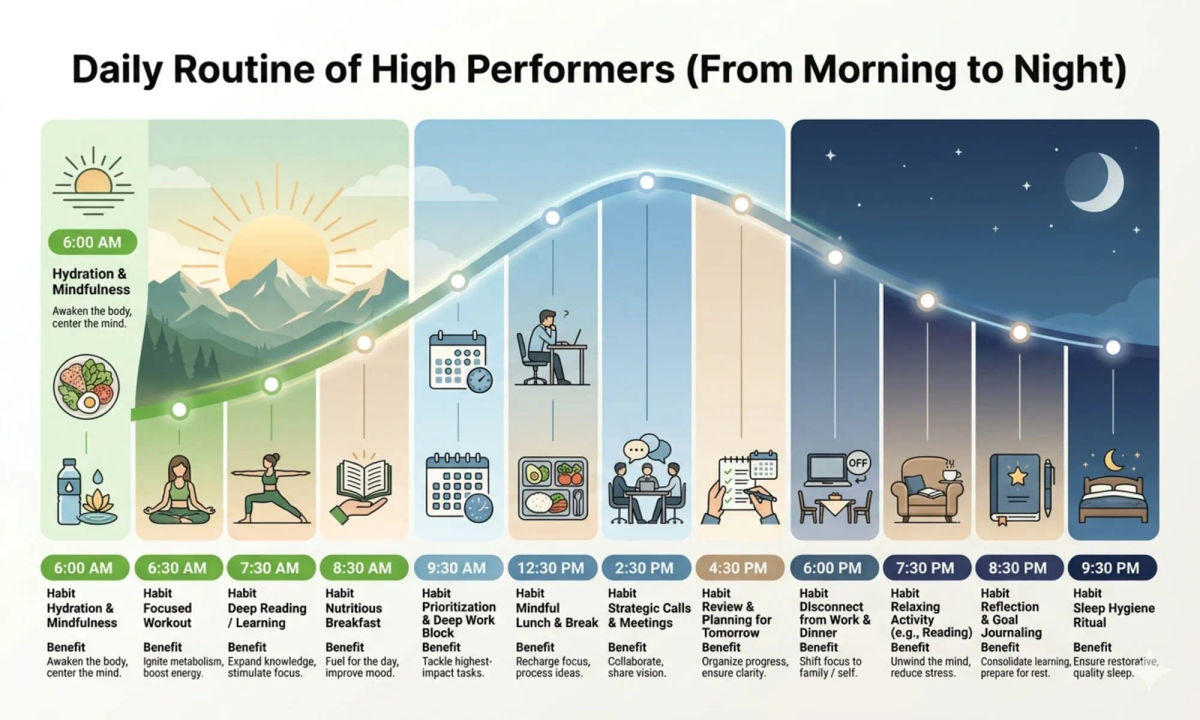
Success is not about isolated breakthroughs but rather consistent daily habits that build over time. High achievers create adaptable routines to protect their energy and maximize productivity, ensuring sustained performance without burnout. Simply copying someone else’s schedule isn’t effective; understanding what works personally is key.
For instance, a developer might prefer late-night coding for focus, while an early riser benefits from morning exercise and meditation. High performers also benefit from structured, data-driven work patterns — a randomized controlled trial by Stanford economist Nicholas Bloom, published in Nature, found that structured hybrid schedules maintained full productivity and promotion rates while cutting employee resignations by roughly 33%. Flexibility within established routines is crucial, as core principles like regular sleep or daily exercise are universally beneficial but the specific times and methods can vary.
🌅 Morning: Set the Direction, Not Just the Alarm
The way you begin your day sets the tone for everything that follows. High achievers don’t just set alarms; they start their mornings with purpose and intention, shaping how the rest of the day will proceed.
What They Do:
High performers avoid instant distractions in those crucial morning minutes to maintain focus and productivity. Instead of checking emails or social media, they opt for a focused period to settle into the day’s rhythm without interruption.
- Avoid instant distractions: No emails or social media in the first 30–60 minutes, allowing for a calm start.
- Focus on clarity: They identify the top 1-3 priorities for the day to stay grounded and focused on what truly matters.
- Create a mental reset: Light movement like stretching or yoga, journaling about the day ahead, or quiet thinking time helps clear the mind and sets a positive tone for tackling challenges.
Starting your day without these initial distractions gives your brain space to think clearly and creatively. Executives who intentionally start their day with non-work activities — exercise, reading, family time — often report feeling more in control and less reactive once the workday begins. If you are looking for more ways to improve your productivity while starting your day, explore on How to Improve Productivity (Micro-Habits That Actually Work).
🧠 Deep Work Hours: Protect Your Best Energy
High performers understand that productivity hinges on effective utilization of peak energy periods, not just the number of hours worked. They prioritize critical tasks during times when their mental stamina is highest to maximize efficiency and creativity.
What They Do
- Block 60–90 minutes for focused work: High performers designate this time as sacred, free from interruptions, ideal for tackling complex challenges that require intense focus.
- Eliminate notifications and meetings: To protect their deep work sessions, they turn off phones and avoid scheduling meetings during these periods to maintain concentration.
- Focus on high-impact tasks only: Instead of wasting time on low-priority activities, they concentrate solely on initiatives that significantly contribute to their goals, ensuring each minute yields substantial results.
Why It Works
Deep work minimizes cognitive switching costs and enhances the quality of output in a shorter timeframe. A small 2005 study by psychiatrist Glenn Wilson (King's College London), commissioned by Hewlett-Packard, found that being distracted by emails and calls could temporarily lower IQ test performance by around 10 points — though Wilson himself later cautioned the study's tiny sample size and its comparisons to other effects were overstated by media coverage. When you dive deeply into work without interruptions, your mind enters a state where innovative solutions naturally arise and complex problems are more easily resolved, enhancing both productivity and satisfaction.
📅 Midday: Manage Energy, Not Just Tasks
By midday, many professionals find themselves feeling mentally drained and less focused than they were earlier in the day. This is when high performers don't merely soldier on through tasks—they reset their approach to maintain peak productivity levels.
What High Performers Do
High achievers understand that taking proactive steps can significantly impact their afternoon effectiveness. One such step involves intentionally stepping away from the workspace and taking a break, which helps clear mental clutter and rejuvenates concentration levels. This could mean walking around for a few minutes or simply closing one's eyes and practicing deep breathing exercises.
- Take Intentional Breaks: Step away from screens and engage in activities that recharge your batteries. Research shows that short breaks can enhance mental agility, making subsequent tasks feel easier and more manageable — a systematic review and meta-analysis published in PLOS ONE found that microbreaks significantly boost vigor and reduce fatigue. Instead of checking emails or social media during this break, try focusing on a physical activity like stretching or walking.
- Simplify Decision-Making: With reduced energy levels in the afternoon, tackling complex decision-making processes becomes increasingly challenging. Streamline your to-do list by prioritizing fewer tasks that are clearer and more straightforward. This not only conserves mental resources but also ensures you're making impactful contributions rather than getting bogged down in minutiae.
- Avoid Unnecessary Meetings
🤝 Meetings & Communication: Be Intentional
High performers recognize that effective communication is not just about talking but about preparing meticulously for every interaction. They spend time before meetings outlining specific objectives and reviewing all relevant materials to ensure they are well-informed and ready to contribute meaningfully.
This preparation involves more than just reading up on the agenda; it includes anticipating potential questions or objections from others, which allows them to address these issues preemptively during discussions. By doing so, high performers maintain a focused dialogue that drives the conversation towards tangible outcomes rather than getting sidetracked by tangential issues. Explore more on Work Conversations: Do’s and Don’ts That Instantly Improve Your Communication.
Strategies for Success
- Come Prepared: High performers review materials in advance and anticipate potential questions or concerns. They practice their points to ensure they can communicate clearly and concisely during the meeting, enhancing overall productivity.
- Maintain Focus: During discussions, they actively steer conversations back to key points whenever necessary, ensuring that all team members stay aligned with the objectives at hand.
- Capture Action Items Immediately: To avoid confusion and ensure accountability, high performers document action items, responsibilities, and deadlines right after a meeting. This practice reduces the likelihood of misunderstandings down the line.
Effective communication is undeniably vital for project success; teams with strong communication skills see a 30% increase in success rates compared to those struggling with miscommunication. However, it's important not to overlook the value of flexibility within structure—allowing some room for creative thinking and spontaneity can actually enhance innovation without compromising on clarity.
⚡ Afternoon: Execute, Don’t Overload
The afternoon typically marks a dip in cognitive acuity for most individuals. Instead of tackling complex tasks, it's better to focus on simpler routines that don't strain your mental resources too heavily. By this time, you're familiar with your daily work rhythms and can efficiently complete lingering tasks.
What They Do
- Complete low-demand tasks: Responding to emails, finishing less mentally taxing reports, or addressing routine duties postponed earlier are good options. These activities keep productivity up without overexertion.
- Follow up on morning work: Revisiting projects started in the morning helps tie up loose ends and ensures a smooth transition into your evening routine, preventing tasks from getting lost or delayed.
- Avoid complex new tasks: Starting intricate and demanding projects late in the day risks overwhelming you. Schedule such tasks for times when your mind is sharper instead.
Making afternoon productivity about execution rather than innovation or problem-solving aligns well with daily cognitive fluctuations. For example, studies suggest that early mornings are ideal for complex tasks due to peak alertness and concentration. By contrast, handling less demanding chores in the afternoon preserves mental stamina and avoids burnout. Explore 15 Simple Steps to Get More Done (Without Burning Out) to avoid burout.
🌆 Evening: Shut Down to Recharge
High performers see recovery as essential, not optional. They value downtime to prepare for the next day's challenges.
The Ritual of Recovery
A shutdown ritual aids in transitioning smoothly from work to personal life. This could mean finishing tasks before leaving or planning ahead at home. Reflecting on achievements and preparing for tomorrow reduces anxiety about unfinished business.
- Close Tasks and Reflect: End each day by reviewing accomplishments and noting down tasks for the next day. This sets clear expectations without overthinking during downtime.
- Disconnect from Work Completely: Avoid checking emails or messages late at night as it can disrupt sleep, according to Sleepio. Disconnecting fully helps in better recovery.
- Embrace Personal Time for Renewal: Engage in activities like spending time with family, pursuing hobbies, or simply resting. These activities allow the brain to process information and rejuvenate, preparing you for challenges ahead. If you are not quite feeling the need to other activites, read The Superpower of Taking Action (Why Momentum Beats Motivation) to get started on your passion.
The Importance of Consistent Recovery
Maintaining long-term performance requires consistent recovery. High performers recognize that good sleep and quality personal time are not luxuries but crucial elements of their success.
🌙 Night: Prepare for the Next Day
Your next day starts the night before – a concept that is both practical and transformative. By setting yourself up properly in the evening, you can wake up refreshed and ready for any challenges ahead.
Maintaining Consistent Sleep Timing
A consistent sleep schedule helps you prepare effectively for tomorrow. Going to bed at the same time each night trains your body to wind down naturally, improving both the quality and quantity of your rest. If you commit to being in bed by 10 PM every evening, you'll likely fall asleep faster and wake up feeling rejuvenated.
Avoiding Screens Before Bed
Avoid screens an hour before bedtime as blue light disrupts your sleep-wake cycle, making it harder to achieve deep rest. Opt for calming activities like reading a book or meditating instead of scrolling through social media or watching TV.
Mentally Offloading Thoughts
Before sleeping, take time to clear your mind by writing down lingering thoughts in a journal. This practice helps you process the day's events and prevents worries from keeping you awake at night. By offloading these concerns onto paper, you create mental space for restful sleep.
High performance relies on proper recovery, with sleep being crucial. Adequate sleep supports sharper focus, better decision-making, and stronger memory consolidation, while chronic sleep deprivation is linked to measurable declines in attention and executive function. Prioritizing rest tonight is often the best way to ensure peak performance tomorrow. Learn more on why Prioritization Is Not About Saying Yes to Everything — It’s About Choosing What Matters Most.
🔁 The Real Secret: Consistency Over Intensity
The most common pitfall in pursuing performance improvement is striving for perfection through drastic changes. High achievers focus on consistent routines rather than seeking overnight transformations to build sustainable habits leading to long-term success.
Starting small and gradually expanding your routine can be highly effective; committing to just 15 minutes of reading daily instead of several hours at once lays a foundation upon which other practices can grow over time. Consistency is the real secret to unlocking your potential, as making small steps every day eventually leads to significant progress.
Consistency is the real secret to unlocking your potential. It’s about making small steps every day that eventually lead to significant progress.
The power of compounding habits cannot be overstated. Consistently engaging in manageable actions over time builds a system tailored specifically for your needs and goals. For example, an athlete might start with one additional training session per week, gradually increasing the duration or intensity as their body adapts. This method ensures long-term adherence to fitness goals without causing burnout. Read more on how to Stop Burning Yourself Out: 10 Habits That Are Quietly Draining You.
Small, consistent daily improvements compound over time — a principle popularized by James Clear's '1% better every day' framework, where daily 1% gains can add up to being roughly 37 times better after a year. By adopting an incremental approach, you set yourself up for success by allowing your habits to grow organically and sustainably, challenging the conventional wisdom of making radical changes for immediate results.
💡 Final Thought
A high-performance routine focuses on prioritizing tasks and executing them at optimal times, rather than squeezing more activities into a schedule. By aligning your work with your natural energy peaks, you foster productivity. For example, tackling complex problems early in the day can lead to breakthroughs that might not occur later.
A study found that employees who scheduled demanding tasks for morning hours experienced a 20% increase in productivity compared to those who did so during afternoon slumps. Understanding and tailoring your schedule to these rhythms transforms success into a consistent outcome.
Dedication of just one hour each morning to strategic planning can yield more results than several scattered efforts later, challenging the notion that longer work hours equal higher productivity.