 WORKPLACE SIGNALS
 Top 7 Scrum Master Interview Questions and How to Answer Them Like a Leader
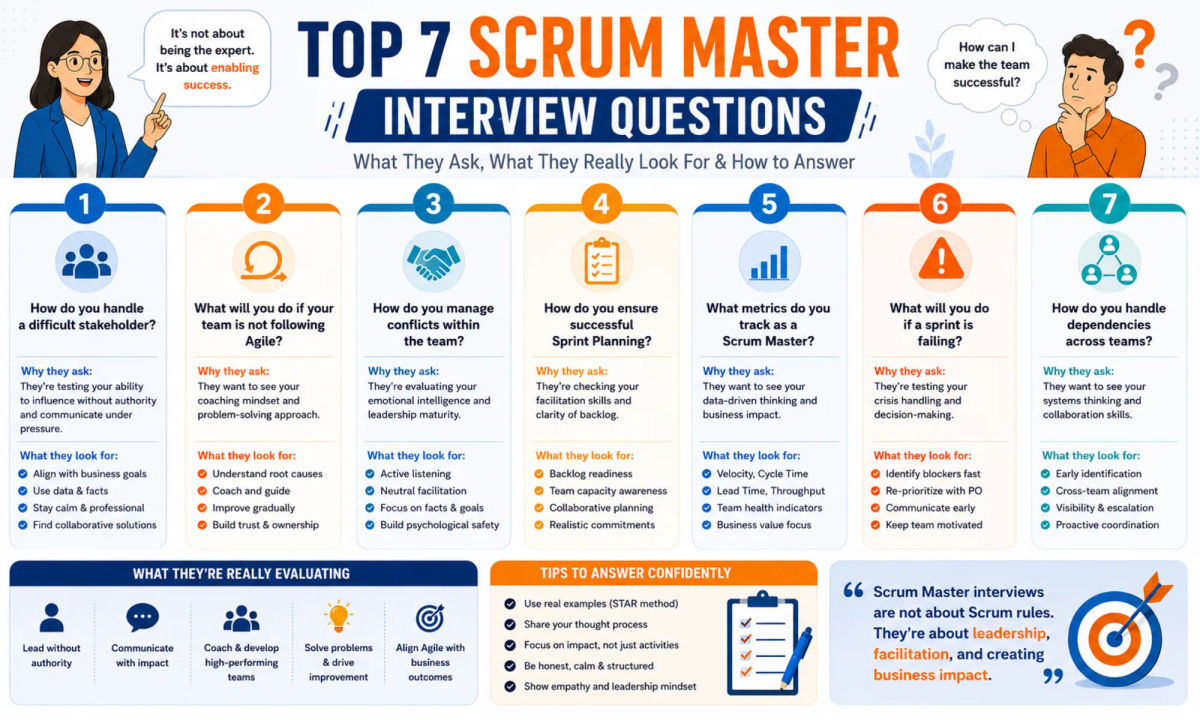
Scrum Master interviews have evolved significantly over the last few years. Organizations are no longer looking for someone who simply memorized the Scrum Guide or can recite Agile ceremonies from memory. Modern enterprises want facilitators, problem-solvers, servant leaders, and communication experts who can drive delivery while maintaining healthy team dynamics.
Whether you are interviewing at a consulting giant, a product company, or a fast-growing startup, you will notice a pattern in Scrum Master interviews. The questions often focus less on textbook definitions and more on real-world leadership behavior. Companies want to understand how you handle difficult situations, influence teams without authority, resolve conflicts, improve delivery predictability, and align Agile practices with business goals.
The seven interview questions covered in this article are among the most frequently asked across enterprise Agile environments. More importantly, they reveal what interviewers are actually evaluating behind the scenes. If you understand the intent behind these questions and learn how to structure strong answers, you can immediately stand out from most candidates. Explore few more Job Interview Answers That Actually Work (With Real Examples).
How to Approach Scrum Master Interview Questions
Before diving into the individual questions, it is important to understand one core principle. Scrum Master interviews are rarely about “correct” answers. Interviewers are evaluating your mindset, communication style, facilitation skills, and leadership maturity.
A strong Scrum Master answer typically includes:
- Context of the situation
- Your thought process
- Actions you took
- Collaboration methods used
- Outcome achieved
- Lessons learned
Using real examples from your experience makes your answers significantly more impactful than theoretical explanations. Interviewers also appreciate candidates who balance Agile principles with practical business realities. Blindly enforcing Scrum rules without understanding organizational context is often seen as a weakness rather than a strength.
1. How Do You Handle Difficult Stakeholders?
This is one of the most common Scrum Master interview questions because stakeholder management directly affects delivery success.
Difficult stakeholders may include senior managers demanding unrealistic timelines, product owners changing priorities frequently, or business leaders pushing teams into unsustainable workloads. Interviewers ask this question to evaluate your ability to influence without formal authority.
A strong answer should demonstrate calm communication, active listening, negotiation skills, and data-driven decision-making. Instead of framing stakeholders as “difficult people,” strong candidates focus on understanding underlying business concerns. Often, pressure comes from deadlines, customer commitments, revenue goals, or organizational uncertainty.
An effective response could include:
- Listening carefully to stakeholder concerns
- Understanding business drivers
- Using delivery metrics and data
- Creating transparency around capacity and risks
- Facilitating collaborative decision-making
- Maintaining professionalism under pressure
For example, you might explain how a stakeholder demanded additional scope mid-sprint. Instead of rejecting the request immediately, you facilitated a discussion around sprint goals, team capacity, trade-offs, and delivery impact. By making the impact visible, the stakeholder aligned with a more sustainable plan. Read more on Scope Creep in Agile: Why Projects Lose Control and How Smart Teams Prevent It.
This demonstrates maturity, emotional intelligence, and business alignment.
2. What Would You Do If Your Team Is Not Following Agile Practices?
Interviewers ask this question because many Agile transformations fail due to resistance, confusion, or superficial adoption. Organizations do not want Scrum Masters who act like process police. They want coaches who understand human behavior and can guide teams through change effectively. A weak answer would involve forcing Agile compliance. A strong answer focuses on understanding why the team is struggling.
Common reasons include:
- Lack of psychological safety
- Previous bad Agile experiences
- Unclear processes
- Leadership pressure
- Overloaded workloads
- Misunderstanding Agile principles
- Excessive meetings without value
A mature Scrum Master investigates root causes before introducing solutions.
You could explain how you would observe team interactions, gather feedback during retrospectives, identify pain points, and introduce improvements incrementally instead of forcing dramatic changes.
For example, if daily standups become status-reporting meetings, you might coach the team on collaborative planning and blocker identification rather than simply enforcing a format. The key message interviewers want to hear is that you enable Agile adoption through coaching, trust, and facilitation rather than authority.
3. How Do You Manage Conflicts Within the Team?
Conflict management is a critical Scrum Master skill because high-performing teams naturally experience disagreements. Interviewers want to know whether you can handle tension professionally without escalating issues or damaging trust. Strong Scrum Masters understand that conflict itself is not always negative. Healthy disagreements often lead to better solutions, innovation, and improved collaboration.
Your answer should highlight:
- Active listening
- Neutral facilitation
- Emotional intelligence
- Psychological safety
- Structured conflict resolution
- Focus on shared goals
One effective strategy is facilitating conversations around facts, impact, and outcomes rather than personalities. For example, if two developers disagree on technical implementation, you could explain how you encourage collaborative evaluation of trade-offs, risks, maintainability, and business value instead of allowing personal opinions to dominate.
Interviewers also appreciate candidates who know when to escalate issues appropriately, especially when conflicts become persistent or impact delivery significantly. The goal is not to eliminate all conflict but to create a safe environment where disagreements become productive discussions. Explore on How to Actually Resolve Conflict as a Manager (9-Step Framework That Works).
4. How Do You Ensure Successful Sprint Planning?
Sprint Planning is one of the most important Scrum events because it establishes team alignment and delivery clarity. Interviewers ask this question to evaluate your facilitation skills, backlog readiness awareness, and understanding of delivery predictability. A strong answer should focus on preparation rather than just the meeting itself.
Successful Sprint Planning typically depends on:
- A refined backlog
- Clear priorities
- Well-defined acceptance criteria
- Team capacity awareness
- Dependency visibility
- Realistic commitment discussions
You can explain how you collaborate with Product Owners before Sprint Planning to ensure backlog items are ready and prioritized properly. You should also mention that Sprint Planning is a collaborative exercise rather than management assigning tasks to individuals.
Strong Scrum Masters encourage healthy discussions around feasibility, risks, dependencies, and team confidence levels. You may also discuss balancing predictability with flexibility. Teams should commit realistically instead of overcommitting due to external pressure.
Interviewers want evidence that you understand how preparation, clarity, and collaboration contribute to sprint success.
5. What Metrics Do You Track as a Scrum Master?
This question tests whether you understand Agile measurement beyond vanity metrics. Strong Scrum Masters avoid using metrics to micromanage teams. Instead, they use metrics to identify improvement opportunities and delivery patterns.
Important Agile metrics often include:
- Velocity trends
- Cycle time
- Lead time
- Sprint predictability
- Escaped defects
- Blocker frequency
- Team happiness indicators
- Throughput
- Deployment frequency
Interviewers are particularly interested in whether you connect metrics to business outcomes rather than reporting numbers in isolation. For example, instead of saying “velocity increased,” explain how improved flow efficiency reduced delivery delays and improved stakeholder confidence.
You should also acknowledge that metrics can become harmful if used incorrectly. Velocity comparisons across teams, for example, often create unhealthy competition and distort behavior. A mature Scrum Master uses metrics for continuous improvement rather than performance policing.
This answer demonstrates analytical thinking, systems awareness, and leadership maturity.
Checkout Why Agile Teams Use Fibonacci Sequence for Story Points (And Not Normal Numbers).
6. What Would You Do If a Sprint Is Failing?
This question evaluates crisis management and leadership under pressure. Sprint failure situations may involve unexpected production issues, missed dependencies, unclear requirements, or major technical blockers. Interviewers want to know whether you panic, blame others, or respond with structured problem-solving.
A strong answer includes:
- Assessing current reality quickly
- Identifying blockers
- Re-aligning priorities
- Facilitating communication
- Managing stakeholder expectations
- Protecting team focus
- Encouraging transparency
For example, if a major dependency breaks mid-sprint, you could explain how you facilitate discussions with stakeholders and Product Owners to adjust scope while protecting the sprint goal as much as possible. Strong candidates also emphasize early risk visibility. Preventing surprises through transparency is often more important than reacting after failure occurs. Interviewers appreciate Scrum Masters who remain calm, solution-oriented, and collaborative during delivery challenges.
7. How Do You Handle Dependencies Across Teams?
Large organizations often struggle with cross-team coordination. This question is especially common in scaled Agile environments. Interviewers want to evaluate your systems thinking and collaboration capabilities. Cross-team dependencies can create delays, confusion, and delivery risks if not managed proactively.
Your answer should demonstrate:
- Early dependency identification
- Cross-team communication
- Planning alignment
- Risk visibility
- Facilitation skills
- Collaboration with leadership and Product Owners
You can discuss practices such as dependency mapping, Scrum of Scrums participation, shared planning sessions, and proactive escalation when necessary. A strong Scrum Master reduces dependency surprises before they become delivery blockers. You should also mention balancing coordination with team autonomy. Excessive dependency management can create bureaucracy, while insufficient coordination creates chaos.
The best Scrum Masters create visibility and collaboration without slowing teams down unnecessarily.
What Interviewers Are Really Evaluating
Across all these questions, interviewers are usually evaluating a deeper set of competencies.
They want to understand whether you can:
- Lead without authority
- Coach teams effectively
- Communicate under pressure
- Facilitate collaboration
- Resolve conflicts professionally
- Align Agile delivery with business outcomes
- Drive continuous improvement
- Maintain calm during uncertainty
Technical Scrum knowledge is important, but leadership maturity often determines hiring decisions. Many candidates fail interviews because they answer questions theoretically without demonstrating real-world thinking. Using practical examples, measurable outcomes, and reflective learning significantly strengthens your responses.
Common Scrum Master Interview Mistakes
Many candidates unintentionally create weak impressions during interviews.
Some of the most common mistakes include:
- Speaking only about ceremonies and frameworks
- Overusing Agile jargon
- Blaming management or stakeholders
- Treating Scrum as rigid rules
- Ignoring business realities
- Giving generic textbook answers
- Focusing only on process instead of people
- Using metrics as performance weapons
Strong Scrum Masters balance Agile principles with empathy, adaptability, and organizational awareness. Interviewers want facilitators who can improve delivery while maintaining healthy relationships and sustainable work environments. Read more on the 10 Things NOT to Say in a Job Interview (And What to Say Instead) to make sure you are not making the same mistakes again.
Final Thoughts
Scrum Master interviews are fundamentally leadership interviews disguised as Agile conversations. Organizations are searching for professionals who can improve collaboration, delivery predictability, team health, and stakeholder alignment in complex environments. If you approach these questions with practical thinking, emotional intelligence, business awareness, and coaching maturity, you immediately separate yourself from most candidates.
The strongest answers are rarely perfect textbook responses. They are thoughtful, experience-driven conversations that demonstrate how you handle real workplace challenges. Preparing stories from your own experience around conflict management, stakeholder alignment, delivery recovery, Agile coaching, and cross-team collaboration will help you answer these questions with confidence and authenticity. As Agile continues evolving across enterprises, Scrum Masters who combine facilitation skills with strategic thinking will remain highly valuable in modern workplaces.