 WORKPLACE SIGNALS
 Scope Creep in Agile: Why Projects Lose Control and How Smart Teams Prevent It
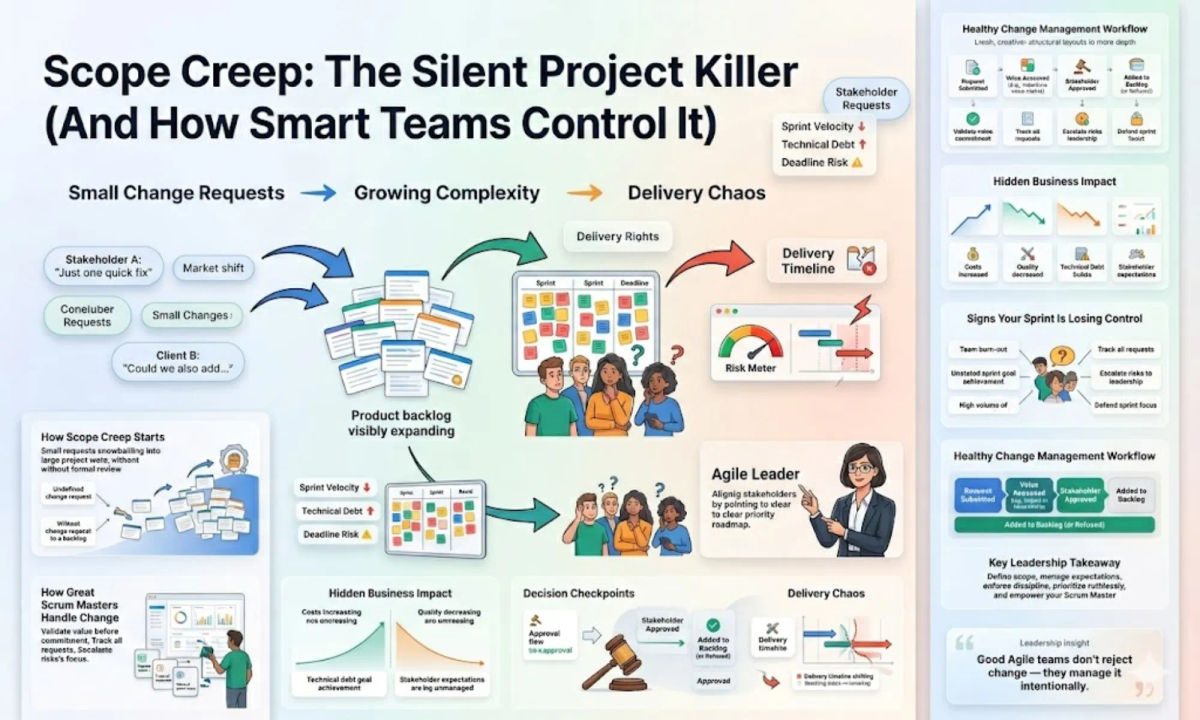
Scope creep is a pervasive issue in Agile projects that gradually undermines their success, infiltrating through minor additions like extra features or urgent requests from stakeholders. These small alterations accumulate over time, leading to significant challenges. A typical example involves accepting what seems like a simple request—a small improvement to enhance user experience—that sets a precedent for further requests.
Over several sprints, these incremental changes pile up, causing the original scope to expand uncontrollably. Teams struggle to meet deadlines and maintain quality standards as predictability in sprint planning deteriorates, leaving both teams and stakeholders confused about why progress appears slower despite increased effort. Understanding the difference between adaptive planning and uncontrolled expansion is crucial for Agile teams aiming to deliver high-quality products sustainably.
What Scope Creep Actually Means
Scope creep is the insidious growth of project requirements that often goes unchecked, leading to increased complexity without proportionate adjustments in timelines, resources, or delivery expectations. In traditional project management, scope creep typically manifests through formal change requests that steadily add more work and detail, pushing projects off track. However, in Agile environments, this expansion can be less obvious but equally damaging.
Agile teams often face a unique challenge where stakeholders bypass the usual prioritization discussions or teams reluctantly accept frequent mid-sprint additions. This pattern is exacerbated when sprint goals are altered repeatedly, and product backlogs become overloaded with tasks that seem urgent at the moment but lack clear value. Another common issue is the accumulation of "quick fixes" that are supposed to be minor changes but often evolve into significant additions over time.
Moreover, teams may struggle to set boundaries when requirements remain vague or unstable. This can lead to a vicious cycle where more work gets added without sufficient planning or reflection on the overall project goals. According to PMI's Pulse of the Profession report, 52% of projects experience scope creep or uncontrolled changes to scope. Agile's emphasis on flexibility and adaptability is not an invitation for unchecked change but rather a framework that thrives when prioritization is intentional.
Agile succeeds through deliberate prioritization—never through endless expansion.
Why Scope Creep Happens So Often
Scope creep stems from legitimate business needs, not malicious intent. Stakeholders may reveal new opportunities, request enhancements, or leadership might respond to market changes. Product teams often find potential improvements during development but introducing changes without assessing their impact causes problems.
Organizational habits like ambiguous requirements lead to continuous revisions and delays, while weak prioritization treats all tasks as urgent, reducing focus and delivery quality. Fear of confrontation leads team members to accept every request, causing overload.
Unclear Requirements: Ambiguous guidelines cause ongoing reinterpretations that disrupt project timelines.
Weak Prioritization: Lack of clear priorities turns every request into an urgent matter, diluting focus and compromising delivery quality.
Fear of Saying No: Avoiding difficult conversations overwhelms teams with tasks. Mature Agile teams balance adaptability with disciplined practices.
For instance, a tech startup I worked for reduced scope creep by implementing a robust change management process, improving project timelines and ensuring changes were thoroughly evaluated.
The Hidden Cost of Scope Creep
Scope creep threatens project success by gradually accumulating minor changes into significant issues, causing sprint delays and reduced predictability. Teams face frequent interruptions, losing focus on original objectives and experiencing burnout due to an expanding workload.
- Sprint delays disrupt timelines, eroding stakeholder trust in the team's ability to meet commitments.
- Reduced predictability leaves stakeholders guessing about project progress.
- Team members feel overwhelmed by constant interruptions, leading to burnout.
Scope creep also leads to long-term problems such as increased technical debt and lower product quality. Hasty coding practices degrade system quality, making future maintenance more difficult and expensive. Teams repeatedly patch features instead of refactoring them properly, creating a tangled codebase that is harder to manage.
- Lower product quality results from shifting focus away from thorough testing and refinement towards merely completing tasks.
- Frustrated stakeholders lose faith in project management when promises are broken or delivery dates slip.
- The need for constant reprioritization disrupts workflow, creating chaos that hampers productivity and morale.
Scope creep damages team morale by eroding confidence in leadership. Constantly shifting goals and unreliable sprint commitments leave developers feeling unsupported, leading to burnout and exacerbating issues. For more insights, explore Stop Burning Yourself Out: 10 Habits That Are Quietly Draining You.
Scope Creep vs Healthy Agile Adaptation
In Agile environments, teams are expected to be flexible and responsive to changes. Yet, it’s crucial for strong Agile organizations to assess modifications thoughtfully rather than reacting spontaneously. A mature team navigates change with intentionality, ensuring that adjustments benefit the project as a whole.
Characteristics of Healthy Adaptation:
- Transparent prioritization where all stakeholders understand and agree upon what tasks take precedence.
- Stakeholder alignment to ensure everyone is on the same page regarding project goals and priorities.
- A thorough delivery impact assessment that evaluates how changes will affect upcoming milestones.
- Open trade-off discussions, allowing teams to weigh potential benefits against the costs of altering their plans.
- Sprint Goal protection, which involves safeguarding established sprint objectives from unnecessary disruptions.
- Clear communication channels that keep all team members and stakeholders informed about progress and changes.
On the flip side, unhealthy scope creep often manifests through constant interruptions and mid-sprint priority shifts. Teams might also face hidden additions to their workload and undefined requirements, complicating decision-making processes further. Emotional urgency can drive poor decisions when there’s a lack of awareness about how these changes will affect delivery timelines.
The real test of Agile maturity lies not in the volume of change but in the team's ability to manage it effectively. A disciplined approach ensures that each adjustment enhances, rather than hinders, the project’s success.
How Scrum Masters Help Prevent Scope Creep
A skilled Scrum Master acts as a guardian of focus and clarity, ensuring that the team remains dedicated to its Sprint Goals without being derailed by excessive changes. Rather than resisting all modifications outright, they facilitate informed discussions about trade-offs between current commitments and new demands.
Key Roles in Maintaining Focus:
Effective Scrum Masters perform several critical functions:
- They reinforce the importance of sticking to the Sprint Goal by reminding team members of their overarching objectives, ensuring everyone stays aligned with the project's primary goals.
- Through skilled facilitation, they help teams prioritize tasks and address stakeholder requests in a structured manner that respects time constraints and resource availability.
- To enhance transparency, Scrum Masters encourage stakeholders to openly discuss the impact of potential changes, fostering a culture where everyone understands the consequences of altering the project scope.
Another essential skill is their ability to protect the team's concentration during sprints by managing external interruptions and focusing on realistic planning. This includes coaching teams on sustainable delivery practices that balance ambition with feasibility. By doing so, they prevent burnout and maintain a steady pace of work without compromising quality or morale. Read more on Why Agile Teams Use Fibonacci Sequence for Story Points (And Not Normal Numbers) to understand why this helps scrum masters control scoe creep.
"Making the cost of each interruption visible to stakeholders greatly improves decision-making. Each new request comes with downstream impacts that can be significant but are often invisible until it's too late."
Why Product Owners Matter in Scope Control
In the realm of software development and agile project management, Product Owners are pivotal figures when it comes to scope control. They wield significant influence over a team's direction by owning the backlog prioritization process, which ensures that resources are allocated efficiently towards high-impact tasks rather than scattered across trivial or low-value items.
Effective Product Owners maintain clarity around several critical areas such as business value and delivery sequencing. For instance, they must constantly assess which features provide the most significant return on investment for their stakeholders while also determining the optimal sequence in which these features should be delivered to maximize impact and user satisfaction. This requires a deep understanding of strategic priorities that align with long-term goals alongside managing stakeholder expectations and planning releases carefully.
However, when prioritization weakens, teams face an avalanche of competing demands without clear guidance on what takes precedence. A healthy Product Owner understands that true prioritization involves making tough decisions about what not to do at the moment. For example, a Product Owner might have to veto a seemingly beneficial but ultimately low-impact feature in favor of something more crucial for immediate business objectives. This discipline is vital because without it, backlogs can become cluttered with low-value work items that dilute focus and degrade sprint efficiency.
Warning Signs Your Team Has a Scope Creep Problem
Many Agile teams find themselves in chaotic delivery environments without fully grasping that scope creep is often at the root of their challenges. One common symptom is the frequent alteration of sprint goals, leading to a sense of unpredictability and instability within the team.
- Sprint Goals changing frequently
- Teams constantly carrying over work from one sprint to another
- Mid-sprint additions becoming routine rather than exceptional occurrences
- A noticeable rise in technical debt due to rushed or incomplete tasks
- A decline in planning confidence as the team struggles to predict outcomes accurately
- The need for continuous reprioritization, reflecting a lack of clear priorities
- Stakeholder confusion over project direction and progress
- Burnout symptoms among team members due to the constant pressure to adapt
- Increased delivery delays as the project loses momentum and focus
When these signs persist, it often indicates that scope control is out of hand. For instance, a team might start with ambitious goals but end up struggling to complete even basic tasks due to constant interruptions and shifting priorities. Addressing this issue early can save significant time and resources in the long run. Explore why Prioritization Is Not About Saying Yes to Everything — It’s About Choosing What Matters Most and how it can help us in identfiying when scope creep might happen.
Practical Ways to Control Scope Creep
Preventing scope creep relies on an organization’s ability to balance discipline and flexibility. One approach is strengthening alignment between sprint goals and project objectives, ensuring new work aligns with current aims. Implementing a clear change evaluation process for each request—discussing impacts on timelines, quality, interdependencies, team capacity, and delivery—is crucial.
This helps teams make informed decisions that balance scope additions against existing commitments. Improving backlog refinement practices minimizes ambiguity and hidden expansion during implementation phases. A well-defined backlog with detailed user stories and acceptance criteria allows developers to anticipate challenges early and plan accordingly. Transparent prioritization is key; stakeholders must understand adding new work means removing or delaying existing tasks, maintaining a realistic view of project timelines and resources.
Protecting team focus is crucial for delivering high-quality results consistently. Constant interruptions can significantly reduce delivery quality. Creating protected focus periods where teams are shielded from unnecessary distractions enhances execution consistency. While strict isolation might seem counterintuitive in collaborative environments, short intervals of focused work without disruptions can dramatically improve productivity and morale.
Why Leadership Communication Is Critical
Scope creep is a symptom of poor communication rather than inadequate planning, often causing disconnects between stakeholders' expectations and the reality on the ground. This misalignment can lead to project delays and budget overruns, making clear communication essential for effective management.
The Role of Agile Leaders
Agile leaders must navigate complex organizational dynamics by outlining trade-offs in product delivery and setting realistic expectations about capacity. For instance, a leader might explain that while there is enthusiasm for launching new features quickly, doing so without addressing existing technical debt could lead to costly rework later on.
- They must communicate capacity limits transparently.
- Roadmap impacts should be clearly communicated; decisions made today affect future projects and product directions.
- Business priorities should be defined so every team member understands their role in achieving company goals.
- The potential consequences of change must be communicated upfront to manage stakeholders' expectations.
Robust communication keeps teams aligned with organizational objectives, enhancing productivity and building trust among all parties involved, ultimately leading to more successful outcomes.
Final Thoughts
Scope creep is a profound challenge in leadership, prioritization, and organizational alignment. Agile teams evaluate change critically while maintaining quality, focus, and sustainability. For example, a mature Scrum team might face additional features mid-sprint but assess impact, communicate with stakeholders, and decide whether to include the change without compromising quality.
Effective delivery requires balancing rigidity and flexibility; unchecked adaptability leads to chaos. Mature teams enhance prioritization discipline, improve communication, align with Sprint Goals, and increase transparency around changes. Industry reports show up to 40% improvement in managing scope creep over six months.
Adapting intelligently without losing control is the essence of Agile leadership.