 WORKPLACE SIGNALS
 The OODA Loop: Make Faster Decisions in a Changing World
Why Fast Decisions Often Beat Perfect Decisions
Imagine two companies launching similar products. One spends months gathering more data, seeking approvals, and refining every detail before launch. The other releases a solid but imperfect product, closely monitors customer feedback, and improves it through rapid updates. A year later, the company that learned and adapted fastest is often the one leading the market.
Today's business environment changes too quickly for perfect planning. Customer expectations evolve, competitors innovate, and technology advances constantly. By the time every risk has been analyzed, the opportunity may already have passed. The challenge isn't making reckless decisions—it's making well-informed decisions with incomplete information, learning from the results, and adapting quickly.
Many organizations fall into analysis paralysis, delaying action while searching for complete certainty. High-performing teams take the opposite approach. They make informed decisions, gather feedback, and continuously improve instead of expecting the first decision to be perfect.
This mindset is at the heart of the OODA Loop, a decision-making framework developed by U.S. Air Force Colonel John Boyd. Rather than treating decisions as one-time events, the OODA Loop encourages a continuous cycle of observing, learning, deciding, and adapting. Organizations that complete this cycle faster often outperform competitors because they learn from change instead of resisting it.
What Is the OODA Loop?
The OODA Loop is a continuous decision-making framework developed by Colonel John Boyd, a military strategist who studied why some fighter pilots consistently outperformed others—even when flying aircraft that were technically inferior. Boyd discovered that victory wasn't determined solely by speed, firepower, or technology. Instead, it depended on how quickly pilots could observe changing conditions, interpret what was happening, make decisions, and act before their opponents could react.
That insight eventually evolved into the OODA Loop, a framework that has since been adopted far beyond military aviation. Today it helps business leaders respond to changing markets, enables software teams to manage production incidents, supports product managers in making customer-driven decisions, and gives organizations a practical way to remain adaptable in uncertain environments.
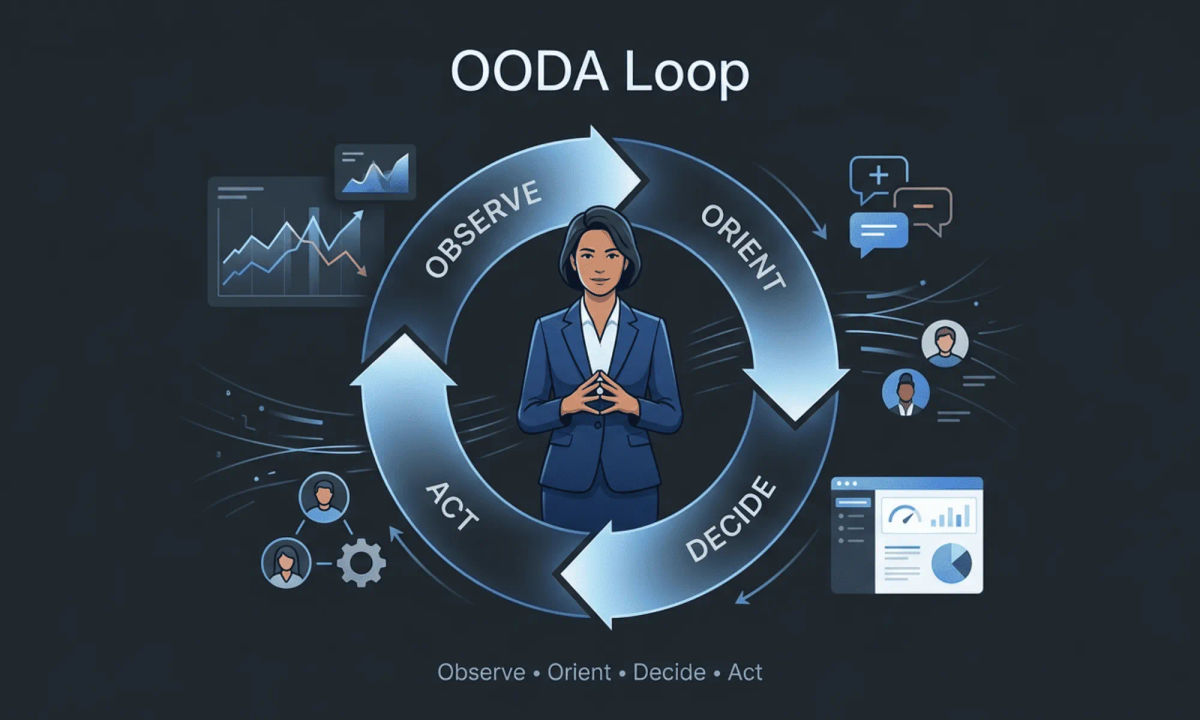
The OODA Loop consists of four continuous stages:
- Observe — Gather information about the current situation.
- Orient — Interpret the information using context, experience, and available data.
- Decide — Select the most appropriate course of action.
- Act — Execute the decision and immediately begin learning from the results.
Unlike traditional planning models, the OODA Loop never truly ends. Every action changes the environment, creating new information that feeds directly back into the observation stage. This continuous feedback cycle allows teams to improve their decisions over time instead of assuming the original plan will always remain correct.
Understanding the Four Stages of the OODA Loop
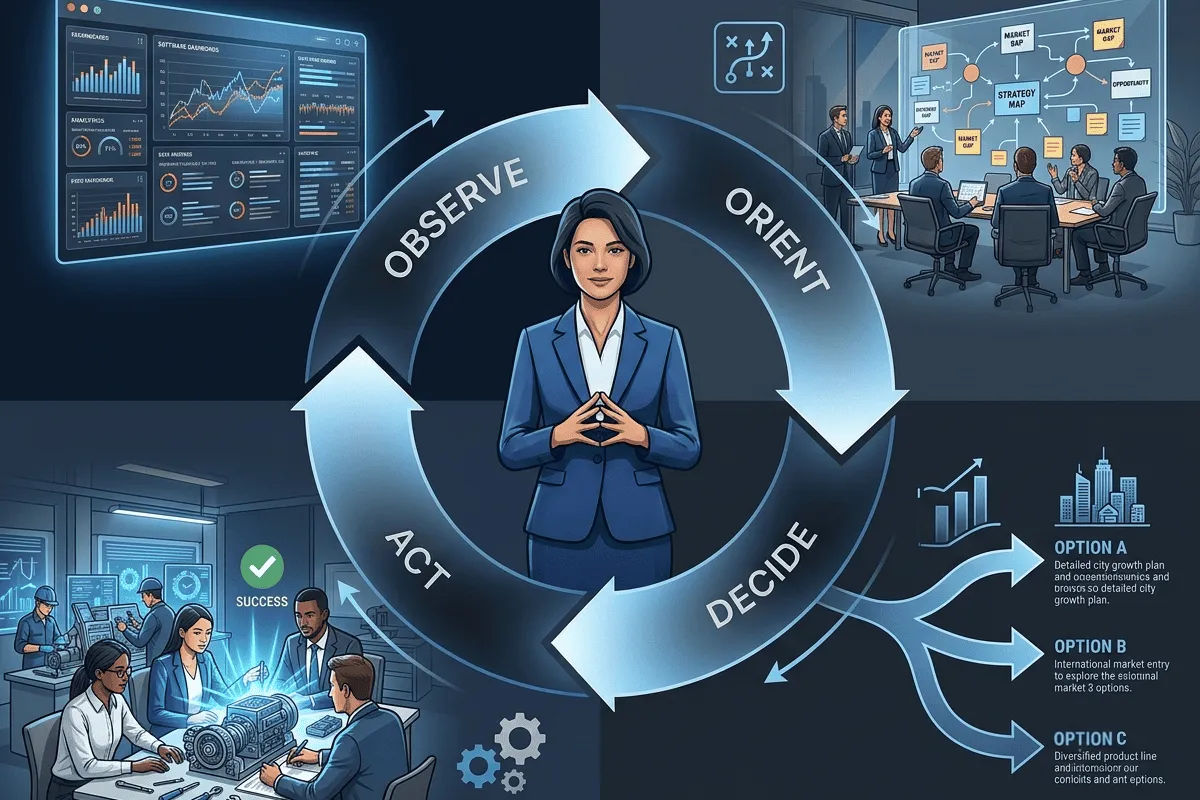
1. Observe
Every effective decision begins with understanding reality. During the observation stage, leaders gather information from as many reliable sources as possible. This might include customer feedback, financial reports, production dashboards, competitor announcements, employee input, or market trends.
Strong observers resist the temptation to confirm their existing beliefs. Instead, they remain curious and objective, focusing on what the evidence actually shows rather than what they expect to see. Better observations almost always lead to better decisions.
2. Orient
Observation provides information, but orientation gives that information meaning. During this stage, leaders interpret what they've learned by considering experience, business goals, customer needs, organizational culture, and external market conditions.
Two managers may observe exactly the same facts yet reach completely different conclusions because they interpret the information differently. This is why orientation is often considered the most important stage of the OODA Loop. Better interpretation leads to better judgment.
3. Decide
Once the situation is understood, it's time to choose a direction. The goal isn't to identify the perfect decision—it is to identify the best decision based on the information currently available.
Many organizations delay action while waiting for certainty that never arrives. OODA encourages thoughtful action instead. Decisions can always be refined as new evidence emerges, but opportunities lost through indecision are often impossible to recover.
4. Act
Action transforms decisions into learning. Once a decision is implemented, teams immediately begin monitoring the results. Did customers respond positively? Did system performance improve? Did employee engagement increase? Every outcome generates valuable feedback.
Rather than considering action the final step, the OODA Loop treats it as the beginning of the next cycle. Each action creates new observations, which lead to better orientation, stronger decisions, and even more effective actions. This continuous learning process is what makes the framework so powerful in rapidly changing environments.
Why the OODA Loop Works Better Than Traditional Planning
Traditional planning assumes that the environment will remain relatively stable after a decision is made. Teams spend weeks or even months gathering requirements, creating detailed roadmaps, estimating risks, and building comprehensive plans before taking action. This approach works well when change is predictable, but today's business environment rarely stays still for long.
Customer expectations evolve, competitors release new products, regulations change, and technology advances continuously. A carefully designed plan can become outdated before it's fully implemented. Organizations that refuse to adapt often find themselves executing yesterday's strategy while competitors respond to today's reality.
The OODA Loop takes a different approach. Instead of treating planning as a one-time activity, it views decision-making as a continuous cycle of learning. Every action creates new information, which immediately becomes input for the next decision. Rather than asking, "Did we follow the plan?", high-performing teams ask, "What have we learned, and what should we do next?"
This mindset reduces the fear of making imperfect decisions. Leaders understand they don't need complete certainty before acting because every decision can be refined as more information becomes available. The faster an organization completes the OODA cycle, the faster it learns, adapts, and improves.
Ultimately, the competitive advantage isn't simply making decisions faster—it's learning faster than everyone else.
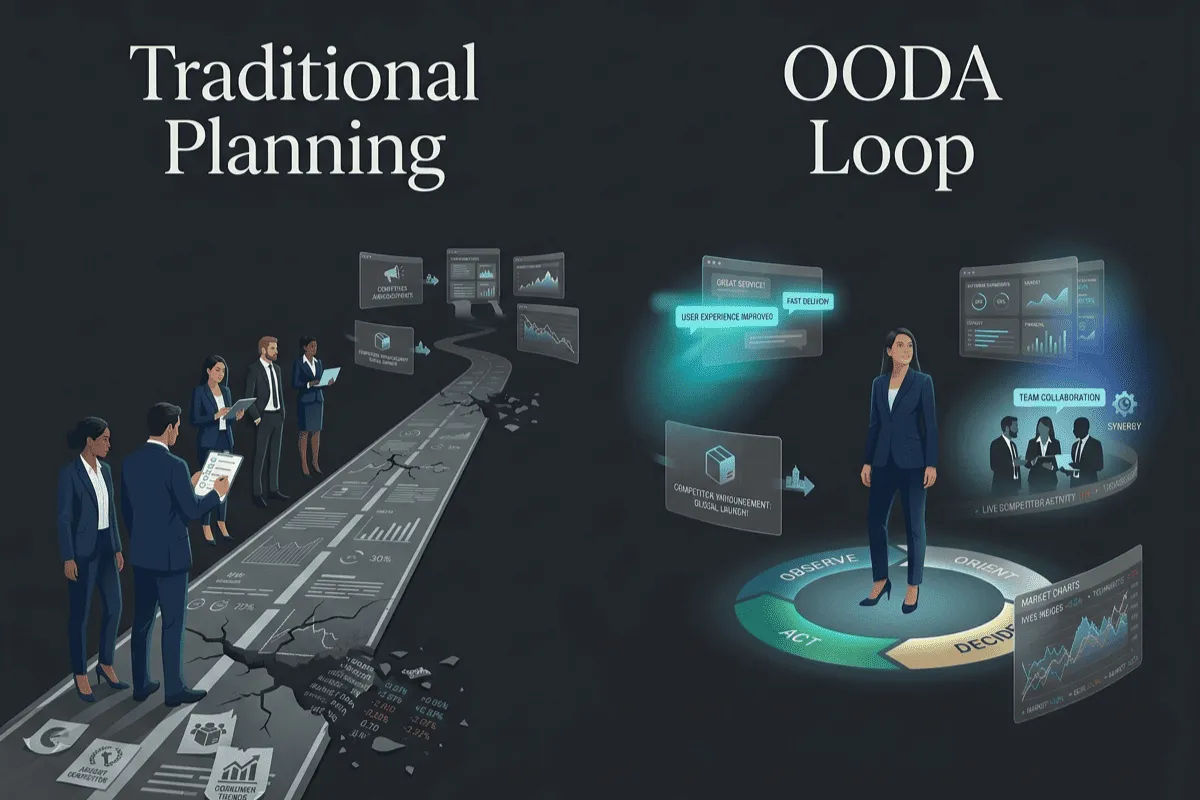
Traditional Planning vs. the OODA Loop
| Traditional Planning | OODA Loop |
|---|---|
| Creates a fixed plan | Continuously adapts the plan |
| Waits for complete information | Acts on the best available information |
| Reviews progress periodically | Learns after every action |
| Reacts slowly to change | Adapts continuously |
| Measures success by following the plan | Measures success by achieving better outcomes |
Neither approach is universally better. Long-term strategic planning remains essential for major initiatives, but when conditions change rapidly, the OODA Loop provides the flexibility needed to stay competitive.
Applying the OODA Loop in the Real World
The OODA Loop is valuable because it works across almost every profession where decisions must be made under changing conditions. Whether you're leading people, building software, running a business, or making personal decisions, the same four-step cycle helps you remain flexible instead of becoming locked into outdated assumptions.
In Leadership
Leaders rarely have complete information before making important decisions. Team dynamics change, business priorities shift, and unexpected challenges appear without warning. Effective leaders continuously observe what's happening within their teams, interpret new information, decide on the next course of action, and monitor the results before adjusting again.
Instead of viewing decisions as permanent, they treat leadership as an ongoing learning process. This approach builds resilient teams that can respond confidently when circumstances change.
In Software Engineering
Modern software development naturally follows the OODA Loop. During a production incident, engineers first observe monitoring alerts, application logs, and user reports. They then interpret the data to identify likely causes, decide on the safest corrective action, deploy the fix, and immediately monitor the system to confirm whether the issue has been resolved.
If new information appears, the team simply begins another OODA cycle. This iterative approach is one of the reasons high-performing engineering teams recover from incidents more quickly.
In Business Strategy
Markets rarely remain stable for long. Successful organizations continuously monitor customer behavior, competitor activity, emerging technologies, and industry trends rather than relying solely on annual planning exercises.
Instead of assuming the original business strategy will remain effective, leaders continuously refine pricing, products, marketing campaigns, and operational priorities as new information becomes available. Companies that adapt faster often outperform larger competitors that struggle to change direction.
In Everyday Life
The OODA Loop is equally useful for personal decision-making. Whether you're changing careers, learning a new skill, improving your health, or managing finances, waiting for perfect certainty often delays progress.
By observing results, learning from experience, adjusting your approach, and repeating the cycle, you build steady improvement over time. Small adjustments made consistently often produce far better outcomes than searching endlessly for the perfect plan.
Three Real-World Examples of the OODA Loop in Action
The best way to understand the OODA Loop is to see how it works in real situations. Whether responding to a production incident, leading organizational change, or adapting to market competition, the same four-step cycle helps teams make better decisions while continuously learning from results.
Example 1: Software Engineering Incident
During a major sales event, an e-commerce platform experiences a surge in failed payment transactions. Engineers observe rising error rates and database timeouts, then orient themselves by analyzing recent deployments and infrastructure metrics. They identify a newly released reporting feature as the source of excessive database load, decide to disable it temporarily, and act by deploying the change and monitoring system health. Service quickly stabilizes, and the team begins another OODA cycle to implement a permanent solution.
Example 2: Leadership During Organizational Change
A manager notices declining employee engagement and increasing resignations. After observing survey results, workloads, and employee feedback, they orient by identifying constantly shifting priorities—not compensation—as the underlying issue. The manager decides to simplify objectives, reduce unnecessary meetings, and improve communication before acting and monitoring engagement and retention. Continuous feedback allows further improvements over time.
Example 3: Business Strategy
A competitor launches a similar product at a lower price. Rather than reacting with immediate discounts, leadership observes customer feedback, sales trends, and competitor messaging before orienting around what customers truly value: quality, reliability, and support. They decide to strengthen premium features instead of cutting prices and act by launching the updated strategy while tracking customer retention and product adoption. Each result feeds into the next OODA cycle, allowing the company to adapt as the market evolves.
These examples highlight the real strength of the OODA Loop: success comes not from making perfect decisions, but from learning, adapting, and improving faster than the environment changes.
When the OODA Loop Isn't the Best Choice
Although the OODA Loop is an excellent framework for environments that change rapidly, it isn't appropriate for every situation. Some decisions require deliberate planning, strict compliance, or extensive analysis before any action is taken.
For example, industries such as healthcare, aviation, nuclear energy, and construction often operate under rigorous safety regulations where acting too quickly can introduce unacceptable risks. In these environments, careful procedures, formal approvals, and detailed verification are just as important as adaptability.
The OODA Loop works best when learning quickly creates a competitive advantage. It is less suitable when mistakes carry severe safety, legal, or regulatory consequences. Effective leaders understand when rapid adaptation is beneficial and when slowing down leads to better outcomes.
OODA Loop vs. Agile: Why They Work So Well Together
Teams practicing Agile are often using the principles of the OODA Loop without realizing it. Both frameworks emphasize short feedback cycles, continuous learning, and frequent adaptation instead of rigid long-term planning.
During a Scrum Sprint, teams continuously observe customer feedback, product metrics, and team progress. Sprint Reviews and Retrospectives help interpret that information, Sprint Planning determines the next priorities, and Sprint Execution puts those decisions into action. At the end of every Sprint, the cycle begins again with new observations and new learning.
| OODA Loop | Agile / Scrum |
|---|---|
| Observe | Sprint Review, customer feedback, metrics |
| Orient | Sprint Retrospective, analysis, backlog refinement |
| Decide | Sprint Planning and prioritization |
| Act | Sprint execution and product delivery |
This shared mindset explains why Agile organizations often respond to change more effectively than teams following rigid project plans. Rather than assuming the original roadmap is perfect, they continuously inspect, adapt, and improve as new information becomes available.
The OODA Loop provides the thinking framework, while Agile offers practical ceremonies that help teams execute that mindset consistently.