 WORKPLACE SIGNALS
 First Principles Thinking: The 5 Questions That Simplify Any Complex Problem
Why the Smartest Problem Solvers Start by Questioning Everything
Imagine your team has been trying to solve the same problem for months. Every meeting produces more action items, more approvals, and more documentation, yet nothing truly improves.
The reason is simple: most people focus on improving existing solutions instead of questioning whether they're solving the right problem. Over time, this approach makes organizations slower, more expensive, and unnecessarily complex.
The world's best innovators think differently. Before searching for answers, they challenge assumptions, identify what is fundamentally true, and rebuild solutions from the ground up. This approach is known as First Principles Thinking.
Popularized in modern business by leaders like Elon Musk, First Principles Thinking isn't just for engineers or entrepreneurs. Whether you're leading a team, building software, improving a business process, or making personal decisions, it helps you cut through assumptions and solve problems more effectively.
In this guide, you'll learn the five questions that form the foundation of First Principles Thinking and how to apply them to almost any challenge.

What Is First Principles Thinking?
Most people solve problems by asking, "How has this been solved before?" First Principles Thinking takes a different approach by asking a more fundamental question:
"What do I know to be absolutely true?"
Instead of copying existing solutions, it breaks a problem down into its core facts, separates facts from assumptions, and rebuilds the solution from the ground up. Facts remain true regardless of opinion, while assumptions often exist simply because they've been accepted over time.
A well-known example comes from SpaceX. Rather than accepting that rockets were inherently expensive, Elon Musk's team analyzed the raw materials, manufacturing processes, and engineering constraints involved. By challenging long-held assumptions, they found entirely new ways to reduce costs and transform the industry.
The power of First Principles Thinking isn't limited to rockets. Every complex problem contains assumptions waiting to be questioned, and better solutions often emerge once those assumptions are removed.
Why Most People Never Reach Breakthrough Ideas
Our brains naturally rely on analogy thinking—using previous experiences to solve new problems. It's efficient because it saves time, but it also encourages us to improve existing solutions instead of questioning whether they're the right solutions in the first place.
Imagine a company trying to speed up customer onboarding. Most teams would suggest hiring more staff, buying new software, or adding more documentation. These ideas improve the current process, but they rarely challenge its foundation.
A First Principles Thinker asks a different question:
"Why does onboarding require so many steps in the first place?"
That single question shifts the focus from optimizing the existing process to redesigning it entirely. And that's where genuine innovation begins.
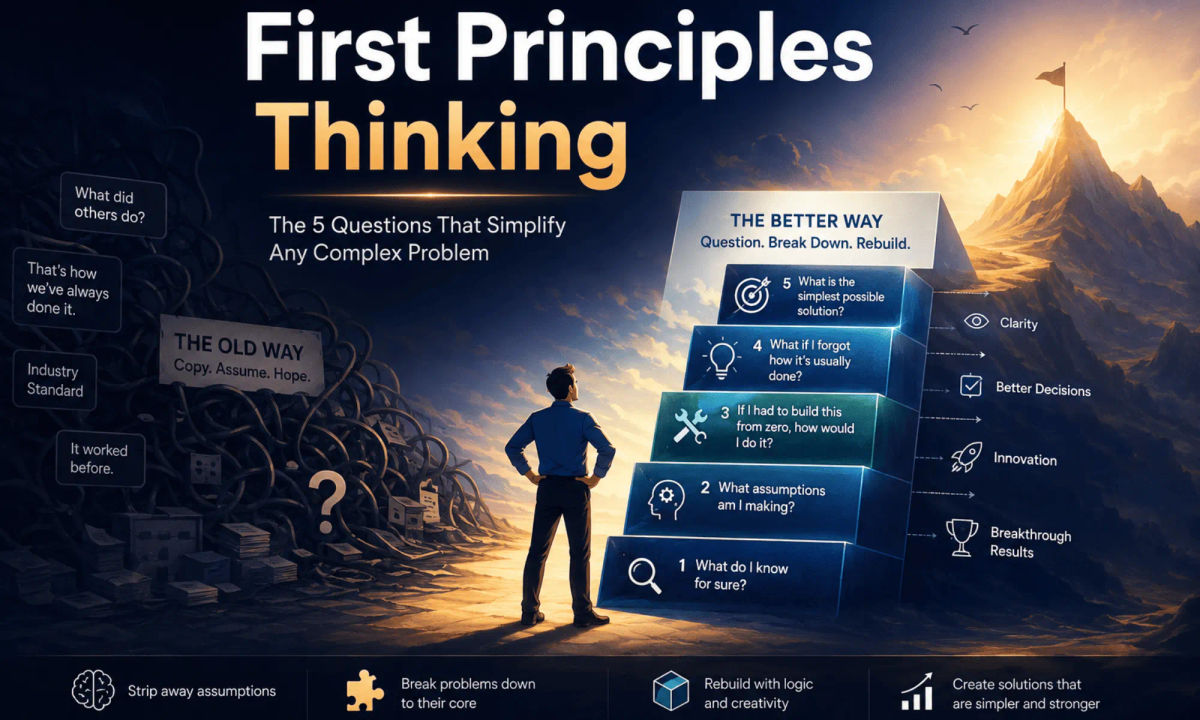
The 5 Questions That Simplify Any Complex Problem
Every breakthrough begins with better questions, not better answers.
When faced with a difficult decision, most people rush toward finding a solution. First Principles Thinkers slow down. They ask questions that strip away assumptions and expose the true nature of the problem.
The following five questions provide a practical framework you can use whether you're leading a team, designing software, starting a business, or making an important life decision.
1. What Do I Know to Be Absolutely True?
The first step in First Principles Thinking is separating facts from assumptions. While this sounds simple, we often mistake habits, opinions, and industry norms for facts.
Imagine your software team believes an application is slow because "the backend API is too slow." Instead of accepting that assumption, gather evidence. Measure response times, profile database queries, and analyze network performance. You may discover the real issue is an inefficient frontend or oversized JavaScript bundle.
The same principle applies to leadership. If a manager assumes employees are disengaged because of remote work, surveys and one-on-one conversations may reveal that unclear priorities are the real problem.
Facts create strong solutions. Assumptions create weak ones. Before solving any problem, identify what is objectively true.
2. What Assumptions Am I Making?
Every organization operates with assumptions, many of which survive simply because no one questions them.
For example, a company may insist every senior engineer needs ten years of experience and a computer science degree. But are those requirements truly essential, or are problem-solving ability, collaboration, and system design skills more important?
Many successful companies grew by challenging accepted beliefs. Airbnb questioned whether travelers needed hotels. Netflix questioned video rental stores. Spotify questioned music ownership.
Innovation often begins with one simple question:
"What assumption has everyone accepted without questioning?"

3. If I Had to Build This From Scratch, What Would I Do?
Imagine redesigning your customer onboarding process as if it didn't already exist. Forget the current workflow, legacy systems, and company policies. How would you design it today?
This exercise shifts your focus from improving outdated processes to creating better ones. Software engineers, product managers, and business leaders use this mindset to rethink products, services, and customer experiences.
The goal isn't to rebuild everything. It's to compare your ideal solution with your current one. The gap between the two often reveals the improvements that matter most.
4. What If I Forgot How It's Usually Done?
Experience helps us solve problems faster, but it can also limit creativity. The more familiar we become with existing solutions, the harder it becomes to imagine new ones.
Ask yourself how you would solve the problem if you'd never seen the current approach. Would online meetings still look the same? Would hiring follow the same process? Would your software architecture be designed differently?
Companies like Uber, Amazon, and SpaceX succeeded because they questioned long-standing conventions instead of accepting them.
Sometimes innovation begins by forgetting what "normal" looks like.
5. What Is the Simplest Solution That Solves the Real Problem?
Complex solutions often feel impressive, but they're rarely the most effective. Every additional feature, approval, meeting, or process adds friction and makes systems harder to maintain.
When solving a problem, ask yourself:
"If I removed half of this solution, what would still be essential?"
This question helps you focus on what truly creates value. As the saying often attributed to Albert Einstein reminds us:
"Everything should be made as simple as possible, but not simpler."
The goal isn't oversimplification—it's eliminating unnecessary complexity so the solution becomes easier to understand, maintain, and improve.
Applying First Principles Thinking in the Real World
The real value of First Principles Thinking lies in applying it consistently. Whether you're writing code, leading a team, running a business, or making personal decisions, the same five questions help you challenge assumptions and find better solutions.
In Software Engineering
Software teams often inherit architectures, frameworks, and processes without questioning whether they still make sense. Instead of asking, "How can we improve this?", a First Principles Thinker asks, "If we built this today, what would it look like?" This mindset helps simplify systems, reduce technical debt, improve user experiences, and eliminate unnecessary complexity.
In Leadership and Management
Leaders frequently inherit meetings, approval chains, and reporting processes that no longer serve a purpose. By asking, "What problem was this originally designed to solve?", they can remove unnecessary friction, simplify workflows, and give teams more time to focus on meaningful work.
In Business Strategy
Markets, customers, and technology evolve constantly. Rather than relying on yesterday's strategies, successful leaders revisit the fundamentals by asking: What problem are we solving? Why do customers choose us? If we started today, would we build the business the same way? These questions often uncover new opportunities for innovation and growth.
In Everyday Life
First Principles Thinking also improves personal decision-making. Whether you're building healthier habits, managing finances, or planning your career, focus on the fundamental principles instead of following trends. Understanding what truly drives results helps you make better decisions and avoid unnecessary complexity.

Five Common Mistakes When Using First Principles Thinking
Like any powerful framework, First Principles Thinking can be misunderstood. People often become so focused on questioning assumptions that they overlook practical constraints. To use this approach effectively, avoid these common mistakes:
- Questioning everything, every time. Not every problem needs to be rebuilt from scratch. Routine tasks often benefit from proven processes. Save deep analysis for important decisions.
- Ignoring experience. Challenging assumptions doesn't mean dismissing expertise. Existing knowledge provides valuable context—you simply shouldn't accept it without examination.
- Confusing simplicity with oversimplification. The goal is elegant solutions, not incomplete ones. Good simplification removes unnecessary complexity while preserving essential functionality.
- Falling into analysis paralysis. Some people spend so much time questioning assumptions that they never make a decision. First Principles Thinking should accelerate better action, not delay it.
- Forgetting real-world constraints. Budget, regulations, time, customer expectations, and technical limitations still matter. The framework helps you challenge assumptions—not ignore reality.
A Practical Five-Step Framework You Can Use Today
Whenever you face a difficult decision, work through these five steps:
Step 1: Clearly define the problem. Avoid jumping to solutions before understanding what actually needs to be solved.
Step 2: Separate facts from assumptions. List everything you know with certainty, then identify everything you're merely assuming.
Step 3: Break the problem into its smallest components. Ask what fundamental truths remain after removing traditions, habits, and existing processes.
Step 4: Rebuild the solution from those truths. Imagine you were solving this problem for the very first time with today's knowledge.
Step 5: Simplify relentlessly. Remove unnecessary complexity until only the elements that genuinely create value remain.
This framework can be completed in minutes for small decisions or expanded into workshops for complex organizational challenges. Either way, it creates a disciplined way of thinking that consistently leads to better outcomes.
Key Takeaways
Before you tackle your next complex challenge, remember these First Principles Thinking lessons:
- Start with facts, not assumptions. Separate what you know with certainty from what you simply believe to be true before searching for solutions.
- Question conventional wisdom. Just because a process, rule, or approach has existed for years doesn't mean it's still the best way to solve today's problem.
- Break problems down to their fundamentals. Reduce complex situations into their smallest components, then rebuild the solution from the ground up.
- Focus on simplicity, not complexity. The best solutions are often the ones that remove unnecessary steps rather than adding new ones.
- Think independently before copying others. Benchmarking competitors can improve existing ideas, but breakthrough innovation comes from understanding the problem itself.
- Apply the framework everywhere. Whether you're leading a team, designing software, improving a business process, or making personal decisions, First Principles Thinking helps you make clearer, more effective choices.
- Ask better questions to get better answers. Every major innovation begins with someone challenging an assumption that everyone else accepted without question.
Try It Yourself
Use these five questions the next time you're faced with a difficult decision:
- What do I know to be absolutely true?
- What assumptions am I making?
- If I built this from scratch today, what would I do differently?
- What if I forgot how it's usually done?
- What is the simplest solution that solves the real problem?
Challenge: Pick one real problem you're facing this week and spend 10 minutes answering these questions. You'll often discover that the biggest obstacle isn't the problem itself—it's the assumptions you've been carrying about it.
Final Thoughts
The greatest breakthroughs rarely come from working harder on existing solutions. They come from asking better questions.
That is why First Principles Thinking remains one of the most valuable problem-solving frameworks used by engineers, entrepreneurs, scientists, and leaders around the world. It challenges assumptions, exposes unnecessary complexity, and helps you focus on what is fundamentally true before searching for answers.
You don't need to be building rockets or leading a global company to benefit from this mindset. Every project, meeting, product, and decision contains assumptions waiting to be challenged. The next time you encounter a difficult problem, resist the urge to ask how it has always been solved.
Instead, ask what must be true, strip the problem down to its essentials, and rebuild from there.
That single shift in thinking could completely change the quality of your decisions.