 WORKPLACE SIGNALS
 Root Cause Analysis: Stop Treating Symptoms and Fix the Real Problem
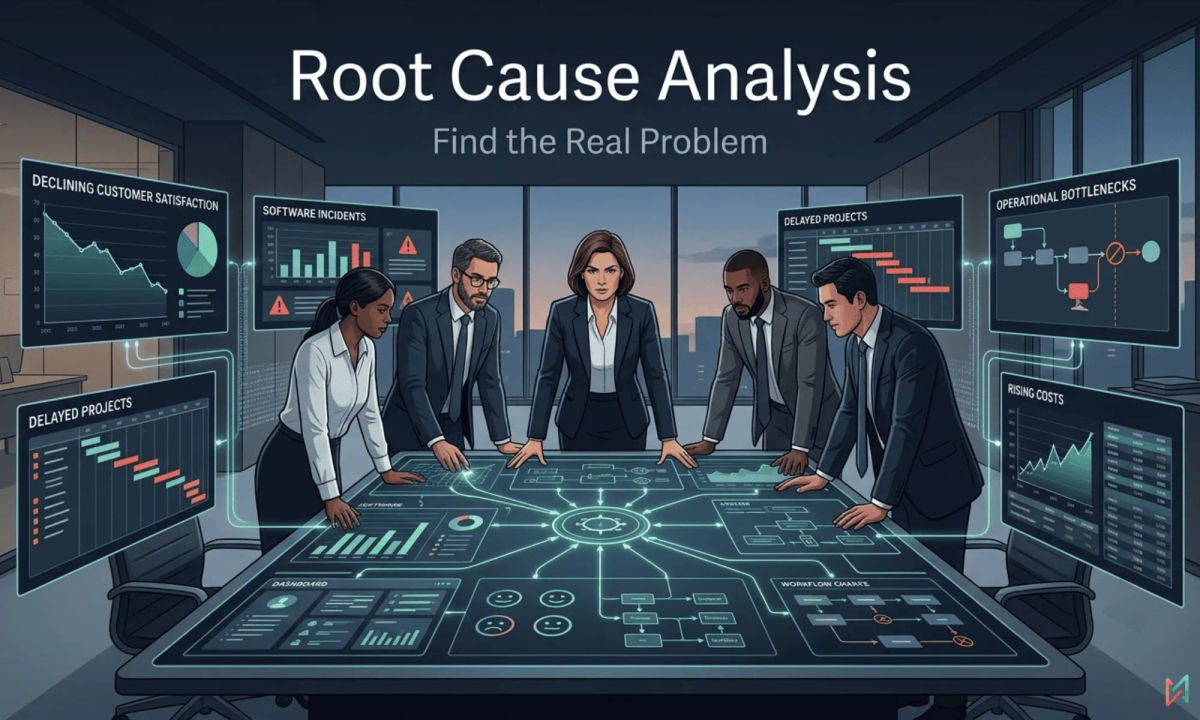
Why Smart Teams Don't Keep Solving the Same Problem
Imagine your production server crashes during business hours. The operations team restarts the service, dashboards return to green, and customers regain access. A few days later, the same outage happens again. Although the team responds quickly each time, the real issue remains because they're treating the symptom instead of eliminating the underlying cause.
This pattern exists across every organization. Sales targets are missed, so more reports are introduced. Customer complaints rise, so more support staff are hired. Employee engagement falls, so another team-building event is planned. These actions may provide temporary relief, but they rarely solve the real problem.
High-performing organizations think differently. Instead of asking, "How do we recover quickly?", they ask, "Why did this happen?" By investigating the underlying cause rather than repeatedly fixing symptoms, they prevent recurring issues instead of simply reacting to them.
This approach is known as Root Cause Analysis (RCA). In this guide, you'll learn the most effective RCA techniques and how leaders and engineering teams use them to solve problems permanently instead of temporarily.
What Is Root Cause Analysis?
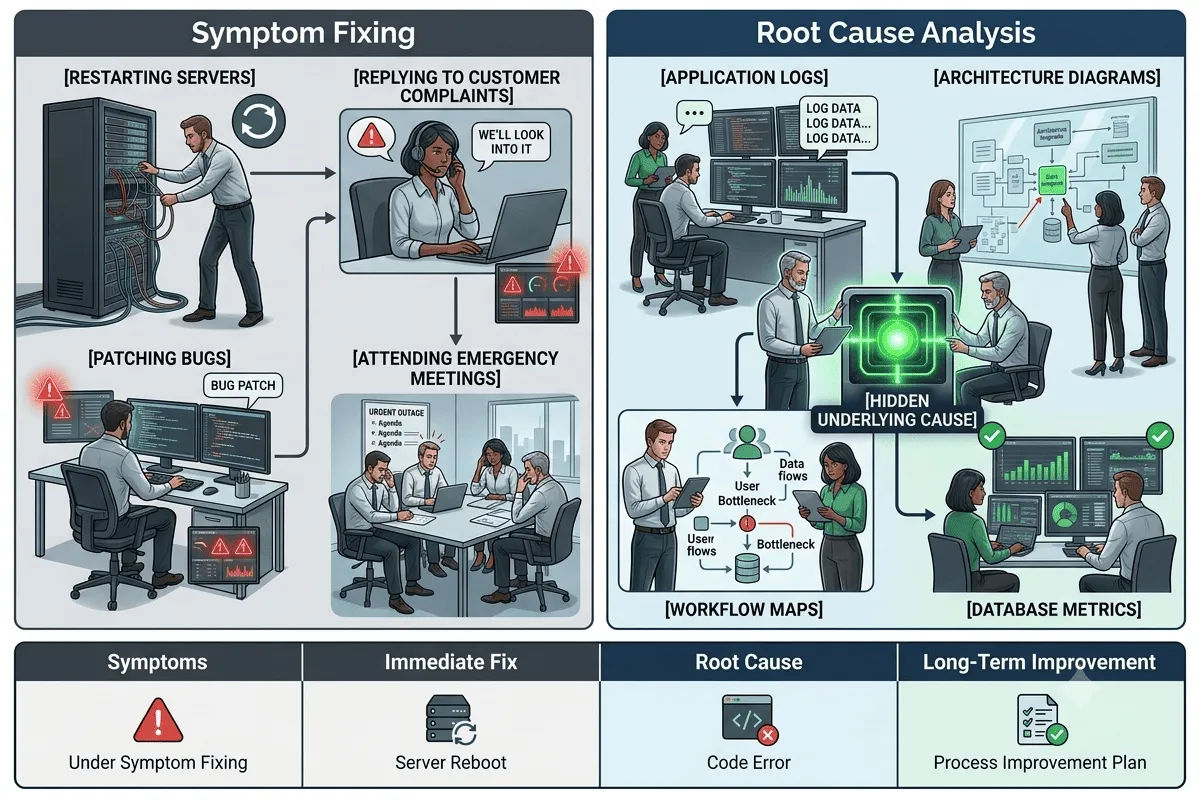
Every problem has two parts: the visible symptom and the hidden root cause. Most teams focus on the symptom because it's urgent, but fixing visible issues rarely prevents them from returning.
Root Cause Analysis (RCA) is a structured method for identifying why a problem occurred and eliminating its underlying cause. Rather than asking, "How do we recover?", RCA asks, "Why did this happen, and how do we stop it from happening again?"
Consider an office printer that stops working every Monday morning. Employees replace paper, change toner, and even consider buying a new printer, yet the issue persists. An RCA investigation eventually reveals a faulty electrical connection that cuts power every weekend. Fixing that single issue permanently resolves the problem.
The same principle applies in business. High employee turnover may result from poor onboarding rather than recruitment, while slow software performance may stem from inefficient database queries instead of inadequate hardware. Solving the root cause creates lasting improvements instead of temporary fixes.
Why Root Cause Analysis Works Better Than Quick Fixes
Many organizations confuse incident resolution with problem resolution. Restarting a service or replacing a component may restore operations today, but unless the underlying cause is removed, the same issue is likely to return.
Root Cause Analysis shifts the focus from reacting to investigating. Instead of asking, "How do we fix this?", effective teams ask, "Why did this happen?"
For example, a software application that crashes every Friday evening might appear to need more server capacity. A Root Cause Analysis could instead reveal an inefficient database query that exhausts memory during a scheduled reporting job. Optimizing the query permanently eliminates the recurring outage.
The same applies to business. A sales team repeatedly misses targets despite additional meetings and reports. A deeper investigation reveals that sales representatives spend too much time on administrative work instead of meeting customers. Simplifying internal processes—not increasing oversight—solves the real problem.
Quick fixes restore normal operations. Root Cause Analysis prevents the same problem from returning.
Five Root Cause Analysis Techniques Every Professional Should Know
Root Cause Analysis (RCA) isn't a single method but a collection of techniques that help teams investigate problems from different perspectives. The right approach depends on the complexity of the issue, available evidence, and the level of analysis required. Understanding these techniques allows you to choose the most effective method instead of relying on guesswork.
1. The 5 Whys
The 5 Whys, popularized by Toyota, is one of the simplest Root Cause Analysis techniques. By repeatedly asking "Why?", teams move beyond symptoms to uncover the underlying cause.
For example, if an e-commerce website goes offline, asking successive "Why?" questions may reveal that an inefficient database query exhausted server memory after a schema change. Instead of upgrading hardware, the team fixes the query and permanently resolves the issue.
The goal isn't to ask exactly five questions—it's to continue until you reach a controllable root cause.
2. Fishbone Diagram (Ishikawa Diagram)
When multiple factors may contribute to a problem, the Fishbone Diagram helps organize possible causes into categories such as People, Process, Technology, Materials, Environment, and Measurement.
For instance, declining customer satisfaction could result from inadequate training, outdated software, unclear processes, or product quality issues. Mapping these possibilities visually helps teams investigate systematically rather than jumping to conclusions, making this technique particularly useful during cross-functional workshops.
3. Pareto Analysis (80/20 Rule)
Pareto Analysis helps teams focus on the few causes responsible for the majority of problems. Based on the 80/20 Principle, it encourages prioritizing high-impact issues instead of trying to solve everything at once.
A support team, for example, may discover that most customer complaints stem from only a few recurring issues such as delayed deliveries or login failures. Likewise, software teams often find that optimizing a handful of inefficient database queries delivers greater performance improvements than rewriting an entire application.
The goal is simple: fix the issues that create the biggest impact first.
4. Fault Tree Analysis
Complex systems often fail because of multiple interconnected causes rather than a single mistake. Fault Tree Analysis (FTA) works backwards from a failure, mapping every possible contributing factor in a logical tree.
For example, a payment system outage may involve database failures, network interruptions, expired certificates, or cloud infrastructure issues. By tracing each branch, investigators can identify the exact combination of events that caused the incident. This technique is widely used in industries where reliability and safety are critical.
5. Timeline Analysis
Sometimes the fastest way to uncover the root cause is to reconstruct events in chronological order. Timeline Analysis helps investigators identify patterns, dependencies, and turning points that individual logs or isolated observations may miss.
Imagine a software deployment that causes widespread failures. By documenting each event—from deployment and database migration to traffic spikes and rising error rates—teams can determine precisely when the problem began and which event triggered it. Timeline Analysis is equally valuable for investigating project delays, operational incidents, and customer escalations where understanding the sequence of events is essential.
Choosing the Right Root Cause Analysis Technique
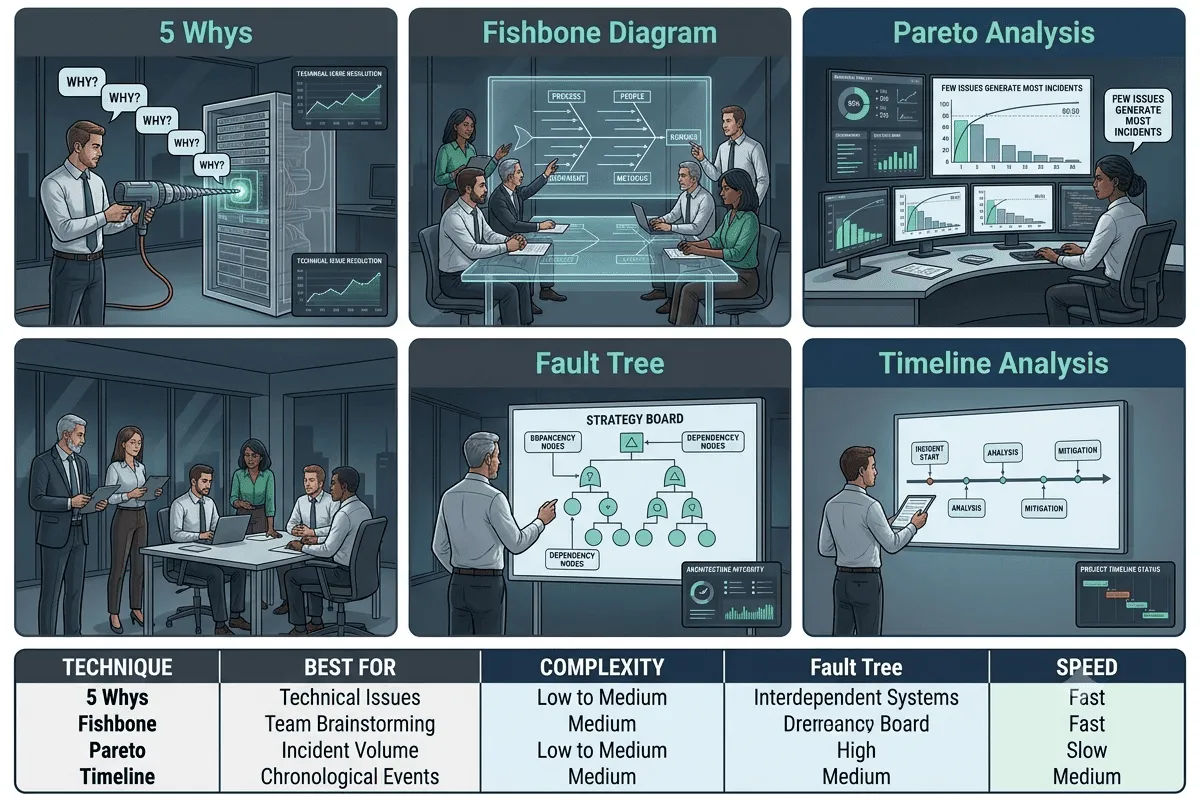
Each Root Cause Analysis technique serves a different purpose, and experienced investigators often combine multiple methods during the same investigation.
For straightforward problems, the 5 Whys is usually the fastest way to uncover the underlying cause. When multiple factors may be involved, a Fishbone Diagram helps organize potential causes into logical categories. If a small number of issues create most of the impact, Pareto Analysis helps prioritize improvement efforts. For complex systems with multiple interacting failures, Fault Tree Analysis maps the relationships between contributing events. When understanding the sequence of events is critical, Timeline Analysis reconstructs what happened and when.
The most effective investigators don't rely on a single technique. They choose the method that best fits the problem, follow the evidence, and continue investigating until the true root cause becomes clear.
Applying Root Cause Analysis in the Real World
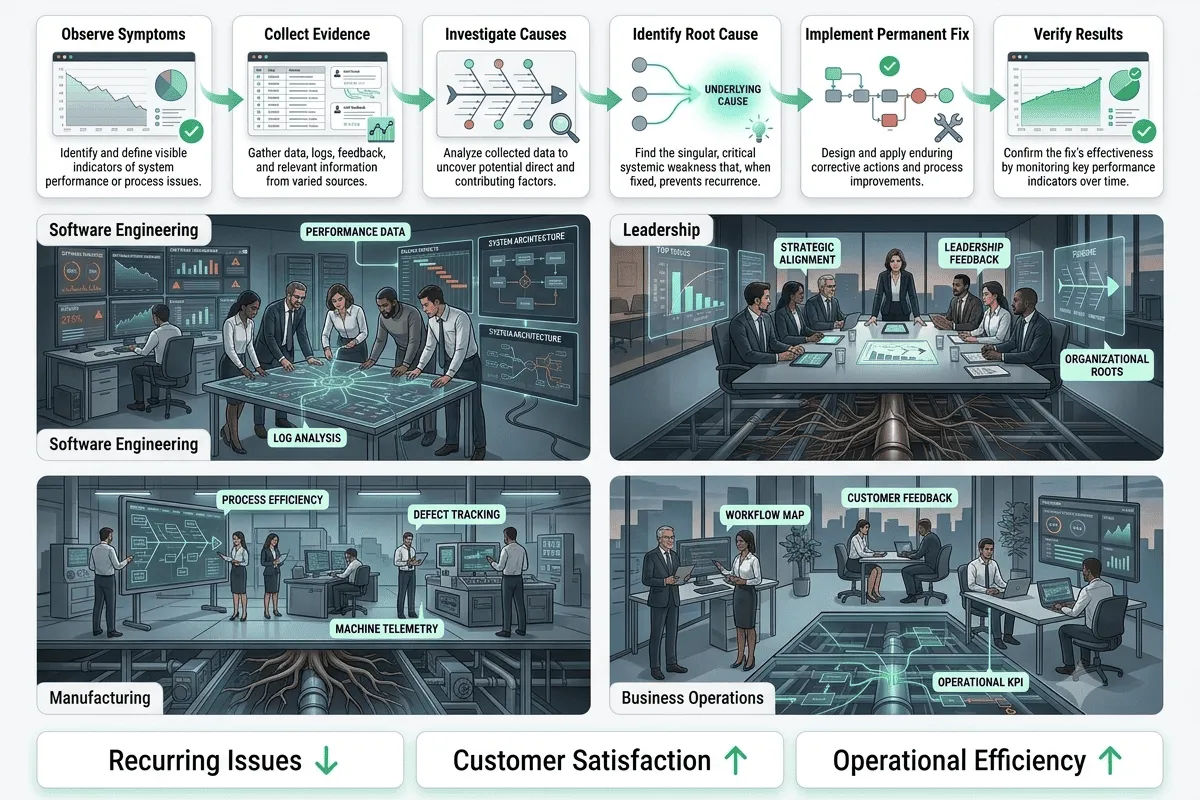
The real value of Root Cause Analysis lies in preventing problems from recurring. Instead of reacting to individual incidents, organizations that practice RCA investigate why those incidents occurred and improve the underlying system.
In Software Engineering
Rather than repeatedly restarting services or rolling back deployments, engineering teams analyze logs, infrastructure metrics, and code changes to identify the actual cause of production incidents. This approach reduces recurring outages, lowers technical debt, and improves long-term system reliability.
In Leadership and Management
Performance issues, missed deadlines, and low morale are often symptoms of deeper problems. Effective leaders investigate workload, communication, expectations, and team dynamics before introducing new rules or additional oversight, leading to more sustainable improvements.
In Business Operations
Recurring customer complaints, delayed deliveries, and rising costs often point to systemic process issues rather than isolated incidents. Root Cause Analysis helps organizations identify these patterns and eliminate the underlying causes, improving efficiency and customer satisfaction.
In Everyday Life
Root Cause Analysis is equally valuable in personal decision-making. Whether improving health, finances, productivity, or relationships, identifying the underlying cause instead of repeatedly treating the symptoms leads to more meaningful and lasting results.
Five Common Root Cause Analysis Mistakes
Even experienced teams can undermine an investigation if they rush to conclusions. Avoid these common mistakes when performing Root Cause Analysis:
- Stopping at the first obvious cause. The first explanation is rarely the complete explanation. Continue investigating until you reach a cause that can be addressed permanently.
- Looking for someone to blame. Effective Root Cause Analysis focuses on improving systems and processes, not assigning fault to individuals.
- Ignoring evidence. Assumptions should never replace facts. Use logs, metrics, timelines, interviews, and data to support every conclusion.
- Treating every problem the same way. Different situations require different investigation techniques. Choose the method that best fits the complexity of the issue.
- Failing to verify the solution. Eliminating a suspected root cause isn't enough. Monitor results to confirm the problem has genuinely been resolved and does not return.
A Practical Five-Step Root Cause Analysis Framework
Whenever you encounter a recurring problem, work through these five steps:
Step 1: Clearly define the problem. Describe what happened, when it occurred, and who or what was affected.
Step 2: Gather evidence. Collect logs, reports, timelines, customer feedback, metrics, or observations before making assumptions.
Step 3: Investigate the causes. Use techniques such as the 5 Whys, Fishbone Diagram, Pareto Analysis, or Timeline Analysis to identify possible contributing factors.
Step 4: Identify the root cause. Confirm the underlying issue using evidence rather than opinions. Ensure you're solving the cause—not merely another symptom.
Step 5: Implement and monitor the solution. Apply corrective actions, measure the results, and continue monitoring to verify that the issue does not recur.
Consistently following this framework transforms Root Cause Analysis from a reactive exercise into a culture of continuous improvement.
Key Takeaways
Before solving your next problem, remember these Root Cause Analysis principles:
- Don't confuse symptoms with the actual problem.
- Gather evidence before jumping to conclusions.
- Keep asking "Why?" until you uncover the underlying cause.
- Choose the RCA technique that best fits the situation.
- Focus on improving systems instead of blaming people.
- Verify that your solution prevents the problem from returning.
- Long-term improvement begins by solving the right problem.
Final Thoughts
Every recurring problem is trying to tell you something.
Whether it's a production outage, declining customer satisfaction, project delays, or poor team performance, visible symptoms are often only the surface of a much deeper issue. Responding quickly is important, but lasting improvement comes from understanding why the problem occurred in the first place.
That's why Root Cause Analysis remains one of the most valuable problem-solving frameworks used by engineers, project managers, business leaders, healthcare professionals, and operations teams around the world. It replaces assumptions with evidence, encourages structured investigation, and helps organizations solve problems permanently instead of repeatedly.
The next time you face a recurring challenge, resist the temptation to apply another quick fix. Instead, pause, investigate, and ask the questions that lead beneath the surface. The real solution is rarely the first one you see.