 WORKPLACE SIGNALS
 5 Dark Office Secrets Nobody Tells You (But You Should Know)
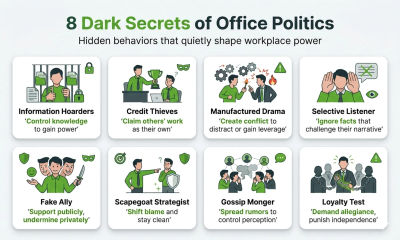
The conventional wisdom in career development often emphasizes hard work, skill enhancement, and result-oriented performance. While these elements are undoubtedly crucial for professional advancement, they fail to capture the full complexity of workplace dynamics. Read more on 8 Dark Secrets of Office Politics (And How to Handle Them).
Workplaces, beyond being mere environments where tasks are executed, are intricate social systems that operate on unwritten rules and subtle cues. These unspoken norms can significantly impact your career trajectory more than documented policies ever could.
For instance, observing how informal networks influence decision-making processes reveals the importance of building relationships outside formal structures. Understanding these nuances not only helps in circumventing bureaucratic hurdles but also in leveraging opportunities that might otherwise go unnoticed.
- The power of personal connections: Informal networks often wield more influence than official hierarchies.
- Perception matters more than performance metrics: How you are perceived by colleagues and superiors can shape your career trajectory just as much as, if not more than, your actual achievements.
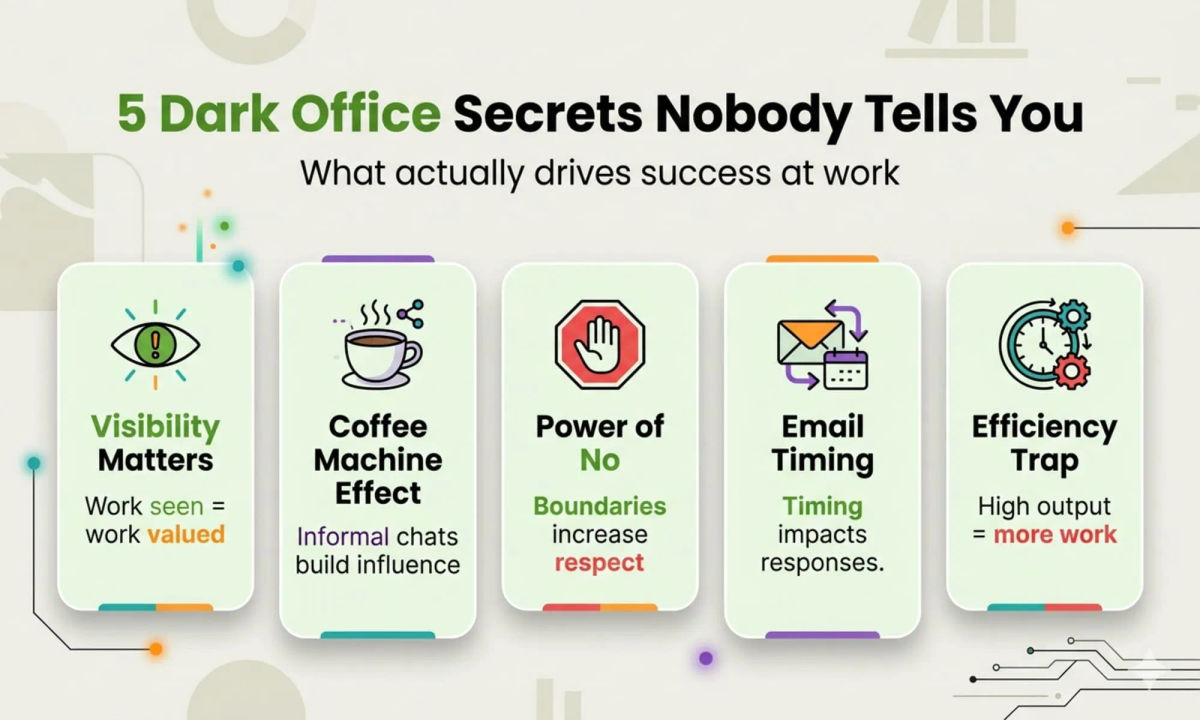
1. The 80/20 Visibility Rule
In many organizations, performance alone often fails to secure the recognition it deserves. This is because visibility plays a crucial role in how your work is perceived and valued by others. Often, a substantial portion of professional success hinges on what colleagues and superiors are aware of rather than an exhaustive list of accomplishments.
For instance, consistently updating team members about project milestones can be just as vital as achieving those milestones themselves. However, it’s important to strike the right balance—promoting your work too aggressively can backfire. Instead, focus on strategically placing your contributions where they are most likely to be seen and appreciated. Read more on 6 Hidden Reasons You’re Underpaid at Work (Even If You Work Hard) to find out if anyone matches for you.
This might mean sharing insights during meetings, actively participating in discussions, or keeping detailed records of progress. By doing so, you increase the likelihood that your efforts will receive the recognition they deserve.
Anecdotally, many professionals report that visibility within their organization — not just performance — plays an outsized role in who gets promoted.
A nuanced perspective here is that sometimes being too visible can overshadow your actual contributions. For example, a colleague who talks about progress incessantly but lacks substantive achievements might dilute perceptions of your own hard work. Therefore, the key is to be both present and productive, ensuring that visibility complements rather than competes with substance.
2. The Coffee Machine Effect
The coffee machine is often more than just a place to get your caffeine fix; it's where informal conversations and unexpected collaborations happen. In the bustling office environment, these casual interactions serve as crucial moments for building trust and understanding between colleagues who may not interact formally on a regular basis.
For instance, while grabbing a cup of coffee during a busy morning, Sarah overheard her colleague John discussing an innovative approach to a project they both work on but rarely talk about in meetings due to time constraints. Such encounters can be incredibly valuable, as they allow for open and relaxed communication that might not occur within the structured confines of formal discussions.
This casual chatter often leads to spontaneous brainstorming sessions or quick problem-solving exchanges that can have a significant impact on ongoing projects. Over time, these brief but meaningful conversations foster an environment where team members feel more comfortable sharing ideas and supporting each other’s work.
It's worth noting that the effectiveness of such informal interactions is not just anecdotal; research indicates that strong workplace relationships correlate with higher job satisfaction and productivity levels.
For example, a study from Gallup found that employees who have close friends at work are seven times as likely to be engaged in their jobs compared to those without such friendships. This underscores the importance of these seemingly trivial conversations in driving meaningful outcomes within organizations.
3. The Power of Saying “No”
Saying "yes" to every request might seem like a way to demonstrate dedication and commitment, but in practice, it often leads to diminishing returns. When professionals consistently accept extra work without considering their limits, they risk appearing less valuable because they are spread too thin across numerous tasks.
For instance, if you agree to take on project A while still managing projects B, C, and D, your ability to deliver high-quality results in any of these areas might suffer due to the sheer volume of responsibilities. By contrast, choosing to say "no" to certain opportunities demonstrates a clear understanding of what is truly important and aligns with personal capacity.
This selective approach allows you to maintain focus on critical tasks and enhances your perceived value by showing that you are capable of prioritizing effectively. According to a study published in Harvard Business Review, professionals who set boundaries and say "no" to non-essential requests tend to be more respected and appreciated for their contributions.
Setting these limits is not about being uncooperative; it’s about maintaining your productivity and well-being. High-performing individuals often recognize that protecting their time carefully is a sign of strength, not weakness. This clarity in decision-making reflects confidence and professionalism, and it ultimately benefits both the individual and their organization by ensuring that efforts are concentrated on high-priority initiatives. Also read more on why Prioritization Is Not About Saying Yes to Everything — It’s About Choosing What Matters Most.
4. Email Psychology
Effective communication goes beyond the message itself; it is deeply intertwined with when you choose to send your emails. Timing can drastically alter how recipients perceive and react to your content, making a significant difference in the response rate. For instance, during the early weeks of a fiscal quarter, managers are often buried under new projects and goals, leaving little room for detailed email exchanges.
By contrast, as the week progresses into midweek mornings, people tend to have more bandwidth and mental clarity to process complex information thoroughly. According to studies, emails sent on Tuesday and Wednesday receive 20% higher engagement rates compared to those sent at the beginning or end of the work week.
This insight can be leveraged to enhance your email strategy by targeting key messages during optimal times. Another nuanced consideration is the psychological shift toward closure as the workweek winds down. Late-week emails might prompt immediate action but often result in rushed responses, potentially diminishing the quality of communication.
Recognizing these patterns allows you to tailor your approach, ensuring that critical information reaches recipients when they are most likely to engage thoughtfully and effectively.
5. The Efficiency Trap
High performance is often rewarded with greater responsibility, a situation that can be both advantageous and potentially problematic. As you consistently meet deadlines and excel in your tasks, expectations naturally rise, leading to an ever-increasing workload. Explore Why Promotions Don’t Go to the Smartest Person (9 Traits That Actually Matter) to find the real cause.
Over time, this pattern can result in a disproportionate increase in responsibilities without the corresponding appreciation or compensation one might expect for such high-quality output. Managing these escalating expectations becomes crucial to maintaining your professional well-being.
While delivering quality work is undoubtedly important, it's equally vital to pay attention to pacing and communication with stakeholders. For instance, a project manager who frequently delivers ahead of deadlines may find their team’s scope expanding without clear boundaries or additional support, leading to unsustainable pressure.
Sustainable performance relies on finding a balance that supports growth rather than pushing towards burnout. In the long run, efficiency should be harnessed as a tool for career advancement and personal satisfaction—not just a means to handle more work.
A nuanced approach involves setting realistic goals and ensuring that your contributions are recognized through open dialogue with supervisors. For example, incorporating regular check-ins with mentors or HR can help align expectations and secure the necessary support for ongoing success.
Why These Insights Matter
The insights into workplace dynamics aren't about exploiting loopholes or manipulating situations; they're about fostering a deeper understanding of the environment you operate in. This awareness isn't just theoretical—it equips you to make smarter, more informed decisions every day.
For instance, when you know how team communication typically unfolds, you can preemptively address potential misunderstandings and streamline processes. With this knowledge, you can enhance your interactions by communicating more effectively, building stronger relationships with colleagues, and safeguarding your time and energy from draining tasks.
Consider a scenario where you recognize the signs of an upcoming project deadline that's likely to strain team resources; by anticipating these pressures early on, you can allocate roles and responsibilities in a way that minimizes stress and maximizes productivity.
Awareness also empowers you to navigate complex organizational structures with ease. It’s like having a map in a maze—instead of wandering aimlessly, you know which paths lead to success and which might be dead ends. This nuanced perspective can sometimes feel counterintuitive; for example, stepping back from immediate problem-solving to observe broader patterns may seem less productive at first but often yields long-term benefits.
How to Apply These Lessons
When implementing new strategies in your personal or professional life, it's crucial to approach changes gradually rather than attempting a complete overhaul. Small adjustments can be more effective and sustainable over the long term. For instance, you might start by sharing updates about your projects and achievements with colleagues on a regular basis, which can enhance transparency and foster better communication within your team.
Incremental Changes for Lasting Impact
In addition to improving communication, consider expanding your network outside of formal settings. Engaging in casual conversations at industry events or even through social media platforms like LinkedIn can lead to unexpected collaborations and opportunities.
For example, connecting with a fellow professional who shares similar interests might result in an innovative project proposal that neither of you would have considered independently. Moreover, setting clear boundaries is essential for maintaining work-life balance.
This means being transparent about your availability and commitments to avoid burnout. A practical approach could be to establish specific hours during which you are not available for meetings or emails, allowing you to focus on personal time without feeling guilty.
Over time, these small but deliberate changes will accumulate into a significant transformation in both how others perceive you and your overall satisfaction with professional relationships. By taking it one step at a time, you can achieve lasting improvements without the stress of radical change.
Conclusion
Workplaces are shaped by more than just performance metrics; they are influenced by perception, communication, and human behavior. Understanding these elements does not make you inauthentic—it enhances your effectiveness. Success isn't solely about what you do but also how your work is perceived and valued.
For instance, a manager might excel at hitting targets yet struggle with team morale because they fail to communicate effectively or consider their team's perceptions. This scenario underscores the importance of recognizing that how you present yourself and interact can significantly impact outcomes more than just task completion.
A nuanced perspective here is acknowledging that sometimes stepping back to listen and understand others' viewpoints can be more impactful for long-term success than pushing forward with your own agenda.