 WORKPLACE SIGNALS
 7 Types of Difficult Bosses (And Smart Ways to Handle Them Without Risking Your Job)
Not All Difficult Bosses Are Obvious
Not every challenging manager is openly aggressive or visibly toxic. In reality, some of the most difficult bosses are those who operate subtly and quietly, hindering your productivity without raising their voice or micromanaging overtly. Over time, this behavior can erode your confidence and clarity.
When faced with such a boss, you might find yourself questioning various aspects of your work environment: "Why is everything so frustrating?" "How come I never receive clear direction?" "Why does it feel like every task takes twice as long as it should?" These questions point to underlying issues that aren't always obvious on the surface.
The key to addressing these challenges lies in understanding your boss's unique management style. Once you identify whether they are a micromanager disguised as a mentor, an aloof leader who prefers hands-off management, or any other nuanced type of difficult boss, you can start to strategize how best to work within this framework.
The good news is that by adapting your approach and understanding the specific dynamics at play, you can protect your personal growth and maintain productivity. Let's delve into the seven types of subtly challenging bosses and explore practical strategies for each one. Here are some popular Work Conversations: Do’s and Don’ts That Instantly Improve Your Communication.
1. The Chronically Unavailable Boss
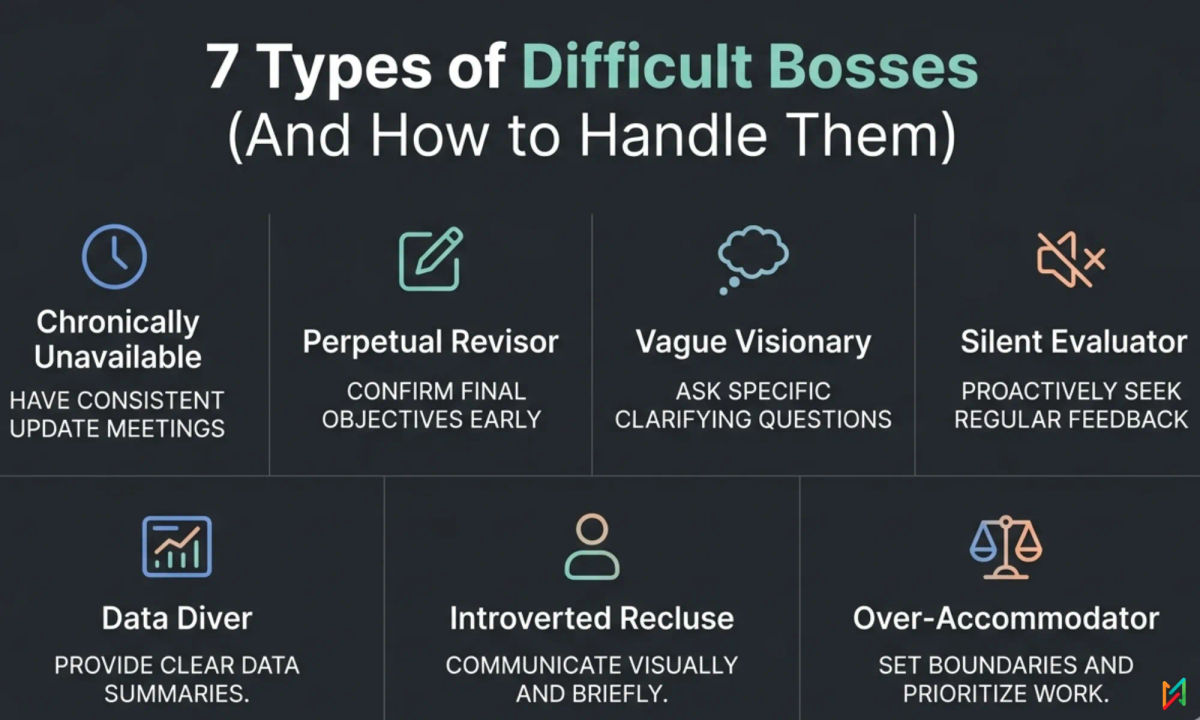
The chronically unavailable boss often causes bottlenecks and delays, characterized by perpetual engagement in meetings or travel, leading to uncertainty detrimental to productivity. This unpredictability hinders decision-making processes and affects team morale, leaving employees feeling undervalued.
Strategies to Handle It
To mitigate these challenges, use asynchronous updates like email summaries and schedule brief micro-meetings of 10-15 minutes for efficient communication. Ask clear, decision-focused questions to gain necessary guidance quickly without extensive back-and-forth.
A team member might send an email summary of weekly progress at the end of each day, schedule a quick call for pressing issues, and frame questions around specific decisions or clarifications. This approach respects your boss's time while enhancing productivity by ensuring smoother workflows.
2. The Perpetual Revisor
The perpetual revisor is a boss who demands constant tweaks and adjustments long after initial drafts are submitted. This behavior consumes time, diminishes focus on tangible results, and can lead to career stagnation as each tweak pushes back deadlines.
Strategies to manage
Pre-align early with your boss about their standards by asking directly what 'good enough' means for the project. Engaging in this dialogue helps set clear expectations and reduces last-minute changes.
- Share drafts earlier and seek feedback at each stage to address concerns while they are still manageable.
- Clarify expectations upfront regarding timelines and deliverables to reduce misunderstandings and save time.
The goal is to establish alignment early in the project cycle, reducing extensive revisions later. By taking proactive steps, you can maintain a clear path towards successful project completion while fostering a more productive working relationship. Read more on 10 Behaviors That Define Great Leaders (What Actually Builds Trust and Influence).
3. The Vague Visionary
This boss has grand ambitions but struggles with providing concrete direction. Teams feel directionless due to a lack of clear priorities.
Why this is problematic
Ambiguity in directives hinders progress and morale, as employees struggle to prioritize initiatives and connect the inspiring vision with daily tasks.
Strategies for navigating this challenge
To address vagueness, translate lofty ambitions into measurable goals. For example, if enhancing customer experience is a goal, reduce wait times by 20% within a quarter.
- Clarify priorities by asking which initiatives are most critical now.
- Test the waters with smaller-scale projects before full commitment, such as launching a pilot program to improve customer service in one department.
The aim is to bridge visionary thinking and practical action, turning abstract concepts into actionable steps for real progress. If you are already in a leadership role and struggling to coach your team, explore What Makes a Good Mentor? (4 Traits That Truly Matter) to improve your coaching skills.
4. The Silent Evaluator
This boss rarely offers direct feedback, leaving employees unsure about their performance unless mistakes occur. Such an approach creates a stressful work environment where team members constantly guess whether they are meeting expectations. Without regular, constructive feedback, employees struggle to identify areas for improvement and may feel undervalued, hindering personal growth and professional development. For instance, consistent lack of acknowledgment can lead to demotivation.
To combat this issue, proactive strategies are essential: ask specific feedback questions (e.g., "What’s one thing I can improve?"), share self-assessments, invite corrections proactively. These approaches encourage open communication and show willingness to grow. The goal is to take control of your professional development by pulling feedback instead of waiting for it. Implementing these strategies fosters a more transparent and supportive work environment, benefiting individuals and the organization.
5. The Data Diver
The Data Diver thrives on numbers but struggles to take decisive action, often leading to project delays and unmet goals. This boss spends hours analyzing data without initiating concrete steps forward, causing paralysis by analysis. For example, a team ready to launch a marketing campaign waited weeks due to endless rounds of data review, impacting the campaign's timing and staff morale.
To address this issue, start by transforming raw data into clear narratives highlighting key points. Instead of overwhelming with details, present 2-3 crucial insights alongside actionable recommendations. This simplifies decision-making and increases the likelihood of timely action.
- Turn data into clear narratives, focusing on impactful aspects and omitting unnecessary minutiae.
- Provide key insights + actionable recommendations.
- Set decision deadlines to create urgency, breaking through analysis paralysis and moving towards implementation.
The goal is to bridge the gap between analysis and action. By making data-driven decisions more efficient and targeted, ensure that insights translate into tangible results and maintain momentum in projects.
6. The Introverted Recluse
The introverted boss avoids unnecessary social interaction, preferring brief, essential communication. This can make them seem distant or aloof to those accustomed to extroverted leadership styles. Despite this perception, their communication style is not a reflection of disinterest but rather how they navigate the world. Read more on The Power of Quiet People and Why They Make Exceptional Leaders
Why This Is a Problem
The challenge lies in building rapport and securing guidance without frequent informal chats, leading to fewer opportunities for trust and understanding. Employees might feel disconnected from their leadership, potentially causing misunderstandings or missed cues regarding performance expectations.
How to Handle It
To manage an introverted boss effectively, respect their communication style by opting for written forms of contact over spontaneous verbal exchanges. For instance, send concise emails before scheduling meetings to save time and reduce stress. Prepare structured yet thoughtful questions in advance for any conversations or meetings planned with them. This ensures the interaction is efficient and relevant.
Your aim should be to adapt to their communication preferences rather than expecting them to change to suit your comfort level, fostering a more harmonious working relationship while demonstrating flexibility and professionalism.
7. The Over-Accommodator
This boss avoids conflict and tough decisions to please everyone, leading to sidestepped issues and unclear direction. This results in employee confusion, inefficiencies, and frustration. If you are in a leadership role or planning for one, Are You a Good Leader? Take This 2-Minute Test to Find Out.
Strategies for dealing
To move an over-accommodating boss towards effective decision-making, present clear options with trade-offs. Offer two viable solutions, explaining pros and cons to highlight implications and consequences. Gently point out tensions without confrontation to prompt decisive action. Focus on assisting them in making decisions rather than avoiding them by fostering a proactive management environment.
Explore How to Actually Resolve Conflict as a Manager (9-Step Framework That Works).
🧩 The Bigger Insight: It’s Not Personal—It’s Behavioral
The truth about challenging bosses isn’t always what it seems. Most often, these individuals aren't out to make your life miserable; instead, they're driven by their own pressures and constraints. A difficult boss might seem like an obstacle, but understanding the roots of their behavior can change how you perceive daily struggles.
First, every leader deals with unique demands and expectations from superiors or clients. Second, personality traits such as perfectionism or impatience exacerbate these pressures unintentionally. Lastly, leadership blind spots—areas where even experienced managers lack insight into how their actions affect others—contribute to this complexity.
Once I worked with a boss who was notorious for micromanaging every detail. Initially, it felt like he didn't trust me or anyone else on the team. But after discussing his perspective, I learned that his background in high-stakes financial deals had instilled a fear of making costly mistakes. His perfectionism wasn was about control but rather an overcompensation mechanism for past failures.
Understanding these factors can shift your mindset from frustration to a more productive outlook. Recognizing difficult behavior stems from external pressures or personal traits allows you to approach challenging situations with empathy and strategy. This mental pivot—from viewing challenges as insurmountable roadblocks to seeing them as manageable issues—can significantly impact job satisfaction and performance.
🎯 How to Protect Your Growth (No Matter Your Boss Type)
No matter the personality or management style of your boss, several strategies can ensure professional growth. Taking charge of communication is key; initiate conversations about expectations, deadlines, and project goals from day one to clarify your role and demonstrate reliability.
For instance, draft an email outlining specific questions if unsure about a new project's scope. Maintain detailed records of all decisions, meetings, and feedback exchanges as documentation serves as a safeguard against disputes and provides a reference point for ongoing projects. A simple example is maintaining a shared Google Doc where all team members can log updates and action items in real-time, ensuring everyone stays informed and accountable.
Setting clear goals and direction at the start prevents costly rework later. During initial meetings or onboarding processes, discuss long-term objectives to align personal and company-wide goals. This proactive alignment streamlines processes and reduces stress significantly.
Aim to be an employee who makes your boss's life easier by anticipating needs, offering solutions proactively, and handling tasks efficiently. For example, offer to take on additional responsibilities or simplify complex processes when your boss is juggling multiple priorities. This enhances reputation and fosters a collaborative work environment. Maintaining professionalism even in challenging situations builds trust and respect. Use this question kit of 3 Powerful Questions to Test Your Boss’s Leadership (And Improve Team Alignment).
Stepping back from heated discussions can provide clarity and space for finding common ground. Whether dealing with unreasonable deadlines or conflicting feedback, keeping composure often leads to more productive outcomes.
🚀 Final Thought
In business, working under a boss who doesn't align with personal or professional values is common. Adapting to their management style can significantly impact career trajectory. Observing communication patterns and decision-making processes helps navigate workplace dynamics effectively.
For example, if your manager prefers concise updates over detailed reports, learn to communicate succinctly to reduce misunderstandings and build a better relationship. This adaptation reduces stress and improves performance by working efficiently within the framework rather than resisting it. Building influence becomes more achievable as others notice your ability to thrive under various leadership styles.
"A leader's effectiveness is often a reflection of their team members' adaptability." - Anonymous
This perspective shows that while you may not control who leads you, being proactive and responsive can influence outcomes positively. This strategic approach ensures career growth even when faced with challenging leadership styles.