 WORKPLACE SIGNALS
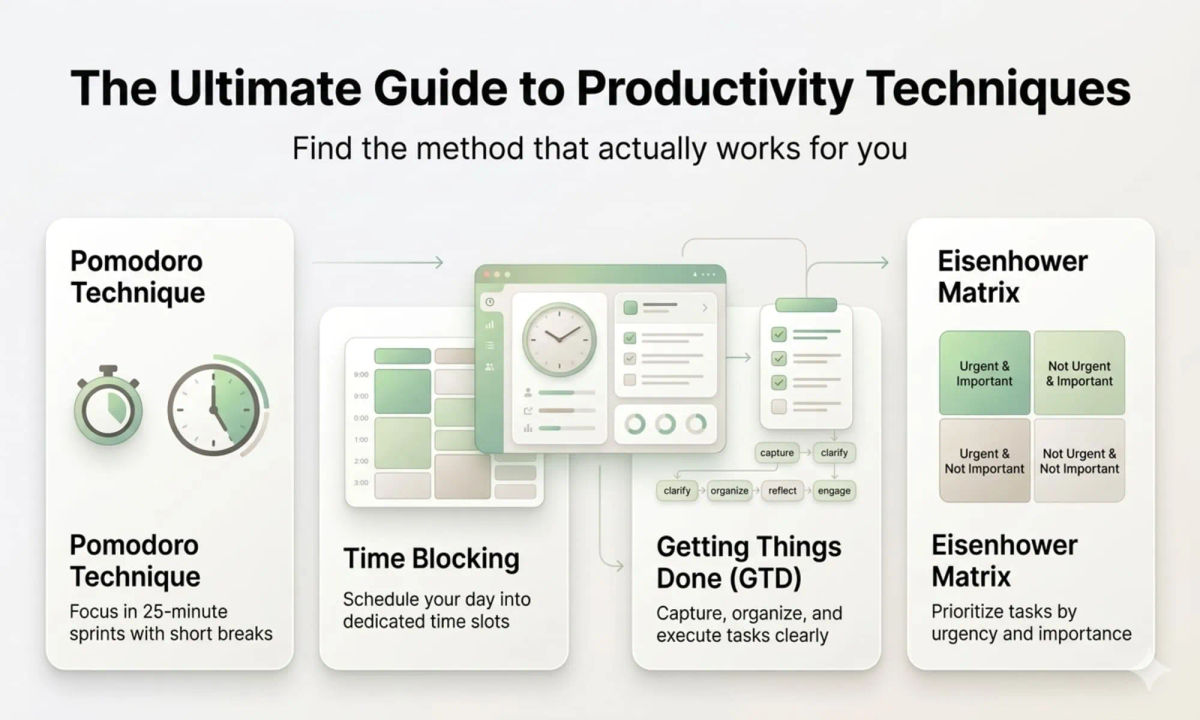
 The Ultimate Guide to Productivity Techniques: Find the Method That Actually Works for You
We live in an era of endless distraction. Between overflowing inboxes, back-to-back meetings, social media pings, and a never-ending to-do list, getting meaningful work done can feel almost impossible. The good news? Decades of research — and millions of productive people — have given us battle-tested systems to cut through the noise.
This guide breaks down the most popular and proven productivity techniques, how each one works, who it's best suited for, and how to start using it today.
What Is a Productivity Technique?
A productivity technique is a structured method or system designed to help you manage your time, attention, and energy more effectively. These aren't vague tips like "wake up earlier" or "stop procrastinating." They are repeatable frameworks with clear rules that, when followed consistently, produce measurable results.
The key insight: productivity is not about doing more things. It's about doing the right things, without burning out.
1. The Pomodoro Technique
Best for: People who struggle with focus or get overwhelmed by large tasks.
Developed by Francesco Cirillo in the late 1980s, the Pomodoro Technique is one of the most popular Time Management methods in the world — and for good reason. It's simple, low-friction, and immediately effective.
How it works:
- Choose a single task to work on.
- Set a timer for 25 minutes (one "Pomodoro").
- Work on that task with zero interruptions until the timer rings.
- Take a 5-minute break.
- After four Pomodoros, take a longer break of 15–30 minutes.
The genius of this method is in how it reframes your relationship with time. Instead of dreading a four-hour project, you only commit to 25 focused minutes. That psychological shift makes starting much easier — and once you start, momentum takes over.
It also builds in regular rest, which prevents mental fatigue and keeps your performance consistent throughout the day.
Pro tip: Use a physical timer rather than your phone to avoid the temptation to check notifications mid-session.
2. Time Blocking
Best for: Professionals with diverse responsibilities who struggle to protect focused time.
Time blocking is the practice of scheduling every hour of your workday in advance, assigning specific blocks of time to specific tasks or types of work. Rather than working from a to-do list and hopping between tasks reactively, time blocking forces you to be intentional about where your hours go.
How it works:
- At the start of each week (or the night before), open your calendar.
- Block time for your most important work — deep projects, writing, strategy.
- Schedule admin tasks, email, and meetings in their own blocks.
- Treat each block like an appointment you cannot cancel.
Cal Newport, author of Deep Work, is one of the most well-known advocates of time blocking. He argues that without deliberately protecting time for cognitively demanding work, the shallow tasks will always fill your day by default.
Who benefits most: Managers, freelancers, writers, developers, and anyone whose output depends on uninterrupted concentration.
3. Getting Things Done (GTD)
Best for: People who feel overwhelmed by the volume of tasks, projects, and commitments in their life.
Created by productivity consultant David Allen and detailed in his bestselling book Getting Things Done, GTD is less a time management tool and more a complete system for capturing, organizing, and executing on everything in your life and work.
The five steps of GTD:
- Capture — Write down every task, idea, and commitment so it's out of your head.
- Clarify — Process each item: Is it actionable? What's the next step?
- Organize — Sort items into lists (projects, someday/maybe, reference, calendar).
- Reflect — Review your lists regularly to stay current and in control.
- Engage — Simply do the work with clarity and confidence.
The core philosophy of GTD is that your brain is for having ideas, not holding them. When your mind is cluttered with half-remembered tasks and unresolved loops, focus becomes nearly impossible. GTD externalizes all of that into a trusted system.
Warning: GTD has a learning curve. Give yourself two to three weeks before judging whether it's working.
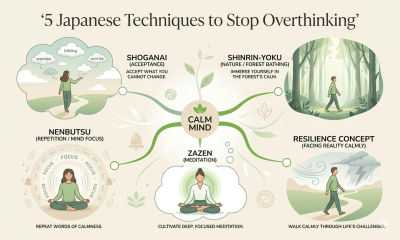
Read more on: 5 Japanese Techniques to Stop Overthinking and Find Mental Clarity
4. The Eisenhower Matrix
Best for: Decision-makers who need to prioritize ruthlessly and stop wasting time on low-value tasks.
Named after U.S. President Dwight D. Eisenhower, this prioritization framework asks a simple but powerful question about every task: Is it urgent? Is it important?
The four quadrants:
| Urgent | Not Urgent | |
|---|---|---|
| Important | Do immediately | Schedule it |
| Not Important | Delegate | Eliminate |
Most people spend their days in the "urgent but not important" quadrant — reacting to other people's priorities instead of working on what truly matters. The Eisenhower Matrix helps you see that pattern and break it.
How to use it: At the start of each day, categorize your tasks into the four boxes. Do the important-urgent items first. Block time for important-not-urgent work. Delegate or drop everything else.
Read more on: Prioritization Is Not About Saying Yes to Everything — It’s About Choosing What Matters Most
5. Deep Work
Best for: Knowledge workers, creators, and anyone whose best output requires sustained, undistracted concentration.
Cal Newport coined the term "Deep Work" to describe professional activity performed in a state of distraction-free concentration that pushes your cognitive capabilities to their limit. The opposite — shallow work — is logistical, non-cognitively demanding tasks that can be done while distracted.
The argument is stark: the ability to do deep work is becoming increasingly rare and increasingly valuable. Those who cultivate this skill will thrive.
How to practice deep work:
- Choose a deep work philosophy (monastic, bimodal, rhythmic, or journalistic).
- Schedule deep work sessions and guard them fiercely.
- Create rituals that signal to your brain that it's time to focus.
- Embrace boredom — stop reaching for your phone the moment you feel friction.
- Quit social media, or at least give it a fixed, small window each day.
Deep Work is not a technique so much as a professional habit and a life philosophy. It pairs well with time blocking.
6. Eat the Frog
Best for: Chronic procrastinators who defer their most important work until it's too late.
The concept, popularized by Brian Tracy, comes from a Mark Twain quote: "If it's your job to eat a frog, it's best to do it first thing in the morning." Your "frog" is your biggest, most daunting, most important task of the day. The one you're most likely to procrastinate on.
The method is dead simple:
- Identify your most important (and often most avoided) task.
- Do it first thing in the morning, before email, before meetings, before anything else.
The power here is psychological. Once the hardest thing is done, everything else feels manageable. You also protect the task from the entropy of the day — because something always comes up.
Read more on The Superpower of Taking Action (Why Momentum Beats Motivation).
7. The Two-Minute Rule
Best for: People drowning in small tasks and admin that pile up into mental clutter.
Borrowed from David Allen's GTD system, the two-minute rule is simple: if a task will take less than two minutes to complete, do it now rather than adding it to your list.
This prevents the accumulation of tiny tasks that each carry cognitive overhead. Replying to a quick email, filing a document, confirming a meeting — these take more mental energy to track and defer than to simply handle.
Combine this with GTD or time blocking for maximum effect.
How to Choose the Right Technique for You
There is no universally "best" productivity system. The right method depends on your role, personality, work environment, and the type of output you're trying to produce. Here's a quick guide:
- You're easily distracted → Start with the Pomodoro Technique.
- You feel overwhelmed and scattered → Try GTD.
- Your calendar controls your life → Use time blocking.
- You spend time on the wrong things → Apply the Eisenhower Matrix.
- You do creative or knowledge work → Invest in deep work habits.
- You procrastinate on important tasks → Eat the frog every morning.
- Small tasks pile up → Enforce the two-minute rule.
The best move is to pick one, commit to it for thirty days, and evaluate honestly. Most people who "try" a productivity technique and abandon it do so in the first week — before the habit has had time to form and the results become visible.
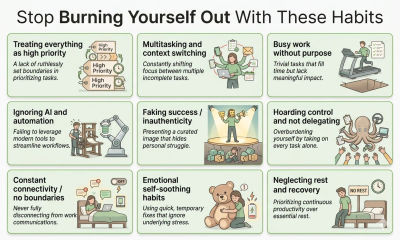
When small tasks pile up, here are 15 Simple Steps to Get More Done (Without Burning Out).
Final Thoughts
Productivity techniques are tools, not magic. They work when you use them consistently, adapt them to your context, and pair them with the basics — adequate sleep, regular breaks, clear goals, and the discipline to protect your time.
Start small. Pick one technique from this list. Use it for thirty days. Then layer in another. Over time, you'll build a personal productivity system that fits your life — and your best work will follow.