 WORKPLACE SIGNALS
 5 Japanese Techniques to Stop Overthinking and Find Mental Clarity
Overthinking has become an inescapable facet of contemporary existence, often spiraling into a relentless cycle of rumination and anxiety. Whether it’s dissecting past interactions or projecting worry onto future scenarios, this habit can consume our mental bandwidth to the point where it feels overwhelming.
The critical issue isn’t the act of thinking; rather, it's the lack of control over one's thoughts—a phenomenon that turns contemplation into a source of stress. This unbridled mind activity doesn't just occupy your attention but also depletes your mental resources.
Traditional Japanese philosophies present intriguing solutions to this challenge by emphasizing practices like mindfulness and acceptance, which aim to create calm amidst the chaos. These approaches advocate for a gentle redirection of focus rather than an aggressive suppression of thoughts, fostering a more serene state of mind.
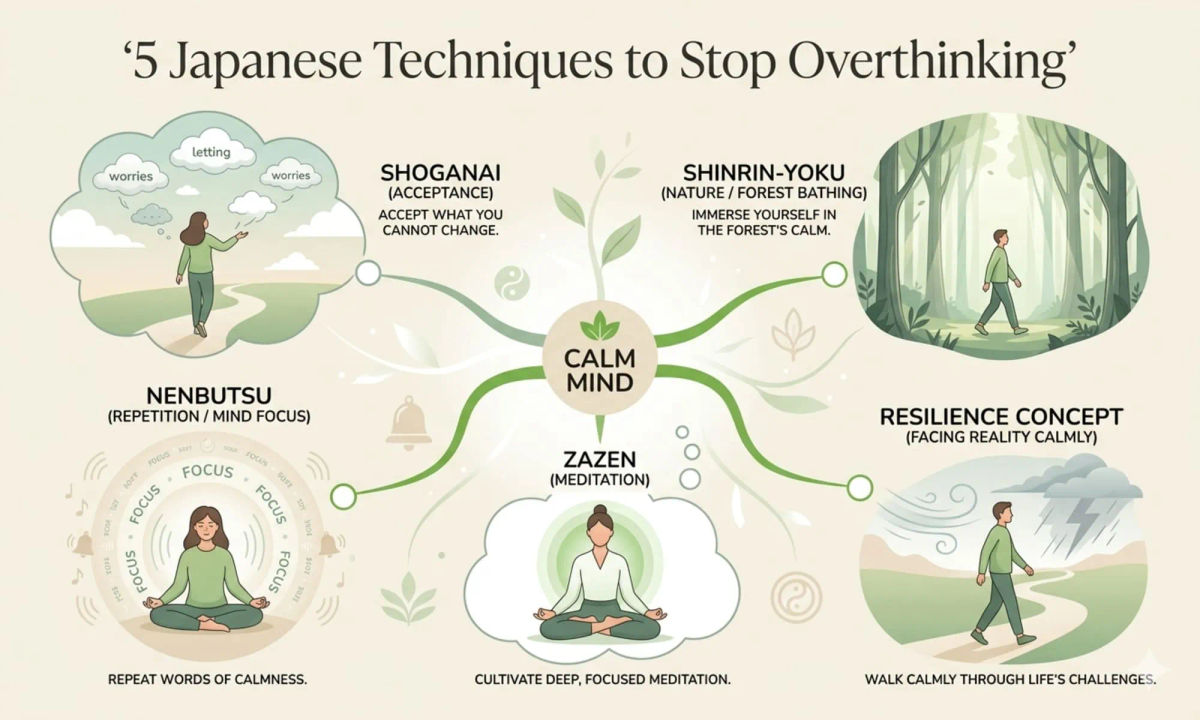
To navigate through this mental clutter effectively, consider adopting five Japanese-inspired techniques designed to help regain balance and clarity. These methods offer practical guidance on managing excessive thinking without resorting to harsh self-discipline or rigid thought control.
🌿 1. Shoganai — Accept What You Cannot Control
The Japanese concept of "shoganai," which roughly translates to “it cannot be helped,” offers a profound perspective on handling life’s uncontrollable aspects. While it might initially seem like an expression of resignation, shoganai is actually a powerful tool for mental clarity and personal growth. When faced with challenges beyond our control—like the opinions of others, unforeseen events, or past decisions—we often waste energy in futile attempts to influence them.
Shoganai teaches us to accept what we cannot change rather than striving to alter it. By embracing this mindset, we redirect our focus and effort towards areas where our actions can truly make a difference. For example, instead of agonizing over someone else’s critical remarks about your work performance, you might choose to improve your skills through training or mentorship, thereby making tangible progress in your professional life.
This mental shift not only alleviates unnecessary stress and anxiety but also enhances our ability to act with purpose and clarity. When we recognize the limits of our control, we are better equipped to manage our reactions and responses effectively. For instance, if a sudden rainstorm disrupts your planned outdoor event, shoganai encourages you to find alternative ways to enjoy or adapt the experience indoors rather than dwelling on what cannot be changed.
Shoganai is not about giving up; it’s about letting go of futile struggles and channeling energy into productive actions.
Ultimately, by adopting this philosophy, we can navigate life's uncertainties with greater ease and resilience. We learn to appreciate the moments when external factors are beyond our control while still asserting agency over what truly matters in our lives.
🌲 2. Shinrin-yoku — Reconnect with Nature
In our fast-paced digital age, where every moment seems to be hijacked by the incessant demands of technology and social media, finding moments of genuine tranquility can feel like a luxury. This is precisely why practices such as shinrin-yoku, or forest bathing, have gained significant traction among individuals seeking respite from modern life's relentless pace.
Shinrin-yoku encourages you to immerse yourself fully in the natural world, engaging all your senses in an unhurried and mindful way. As you wander through a tranquil forest, taking time to observe the intricate patterns of light filtering through leaves or listening attentively to the rustling of branches in the breeze, you begin to notice how these simple experiences can recalibrate your mental state.
For instance, imagine stepping into a dense woodland on a crisp morning. The air is cool and filled with the earthy scent of damp soil and pine needles. You might pause at the base of an ancient tree, its branches reaching skyward in silent majesty, allowing yourself to breathe deeply and let go of the day's stresses. This act of presence, rather than focusing on physical exertion or any goal-driven activity, allows your mind to quieten and refocus.
The benefits of such a practice extend beyond mere relaxation; they encompass deeper psychological impacts that enhance overall well-being. Regular sessions of shinrin-yoku have been shown not only to lower cortisol levels but also to boost immune function and improve mood. By fostering a closer connection with the natural environment, individuals often report increased resilience against stress and a renewed appreciation for life's simpler pleasures.
🔁 3. Nenbutsu — Calm the Mind Through Repetition
Nenbutsu is a practice rooted in simplicity yet profoundly effective for mental clarity. It involves repeating a phrase, sound, or even focusing on your breath to anchor your mind amidst chaos. Overthinking often stems from scattered attention, causing our thoughts to flit between various concerns without settling on any one thing.
Repetition serves as an antidote to this mental restlessness by establishing a rhythmic pattern that silences the internal chatter and brings focus back to the present moment. For instance, when faced with overwhelming decisions or anxiety-provoking situations, reciting "Nam Myoho Renge Kyo" can be a powerful way to center oneself.
By choosing to repeat something meaningful, you not only reduce mental clutter but also create space for introspection and calm reflection. This shift in mindset allows for better clarity and control over your thoughts, enabling more effective problem-solving and decision-making processes without being bogged down by constant distractions or anxieties.
🧘 4. Zazen — Observe Thoughts Without Attachment
Zazen, a cornerstone practice in Zen Buddhism, involves sitting meditation aimed at observing thoughts without reacting to them. This technique differs from attempts to suppress thought, instead inviting practitioners to adopt an observational stance towards their mental activity. Imagine your mind as the vast sky and each thought as a passing cloud; you notice these clouds but do not feel compelled to interact with every one of them.
With consistent practice, Zazen helps individuals develop a non-attachment mindset regarding thoughts. Over time, this leads to an increased awareness that thoughts are transient phenomena—ephemeral and fleeting like the clouds mentioned earlier. As you grow more adept at observing thoughts without engaging, it becomes easier to let go of those mental patterns that previously held your attention captive.
"When I first started Zazen, every thought seemed urgent and important," recalls Sarah, a longtime practitioner. "But as weeks turned into months, I noticed how often my worries faded away on their own without any action from me."
This shift in perspective can dramatically reduce the habit of overthinking by breaking down the automatic response to engage with each new idea that arises. The outcome is a calmer mind and improved mental clarity, enabling more effective decision-making and emotional regulation.
🌊 5. Embrace Resilience — Move Forward Despite Uncertainty
The unpredictability of life means that challenges and setbacks are a part of our daily existence, making it crucial to develop resilience as a coping mechanism. Overthinking often stems from the fear of uncertainty, but true strength lies in accepting that not everything can be controlled or planned for, yet still choosing to move forward with determination and purpose.
Resilience is about handling difficult situations without succumbing to panic or despair; it's about maintaining a calm demeanor and finding inner strength when faced with adversity. Rather than dwelling on hypothetical worst-case scenarios, resilient individuals focus on the present moment, making small but meaningful steps towards their goals. For example, imagine encountering a major setback in a project at work—instead of questioning every decision made up to that point or worrying about potential consequences, one can shift attention to actionable next steps.
Progress, however incremental, is key to reducing overthinking and fostering resilience. Each small step taken builds confidence and demonstrates that forward movement is possible even under challenging conditions. By prioritizing action over speculation, individuals not only overcome obstacles but also strengthen their mental fortitude for future uncertainties.
🧠 The Bigger Insight
The techniques discussed share a common thread: they don't aim to eradicate thought, but rather to alter our interaction with it. Instead of pushing thoughts away or trying to control them entirely, these methods encourage acceptance and mindfulness towards the uncertainties life presents.
For instance, consider someone dealing with chronic overthinking about career choices. Rather than suppressing this anxiety or dwelling on endless possibilities, they might learn to observe their thoughts without judgment, creating mental space for calmness and clarity. This shift in perspective can significantly reduce the overwhelming nature of constant pondering.
By embracing uncertainty and focusing our attention wisely, we effectively lower the volume on incessant mental chatter, making room for more constructive thought processes.
The practice of mindfulness and acceptance isn't just about feeling good; it's a strategic approach to mental health. When we accept that not everything can be known or controlled—like predicting every twist in our professional journey—we free ourselves from the grip of anxiety and overthinking. This newfound freedom allows us to engage more fully with life, making better decisions with clarity rather than clouded judgment.
💡 Final Thought
Overthinking is frequently seen as a weakness, yet it often stems from a heightened awareness of one’s surroundings and circumstances. When left unchecked, however, this constant rumination can become overwhelming and draining.
The challenge lies in transforming overthinking into productive thinking rather than trying to eliminate thoughts altogether. By adopting just one effective technique and dedicating yourself to its consistent practice, you can start to see a noticeable change in your thought patterns.
Imagine someone who constantly worries about their performance at work. Instead of suppressing these concerns, they choose to focus on setting specific goals for each day and reflecting on what was accomplished by the end of it. Over time, this individual notices not only an improvement in their mental clarity but also a more positive outlook on their daily tasks.
This shift is not merely about altering your cognitive processes; it transforms how you perceive and engage with the world around you. The key lies in patience and persistence—small changes can lead to significant improvements over time.