 WORKPLACE SIGNALS
 How to Present to Senior Leadership Like a Leader (Not Just a Presenter)
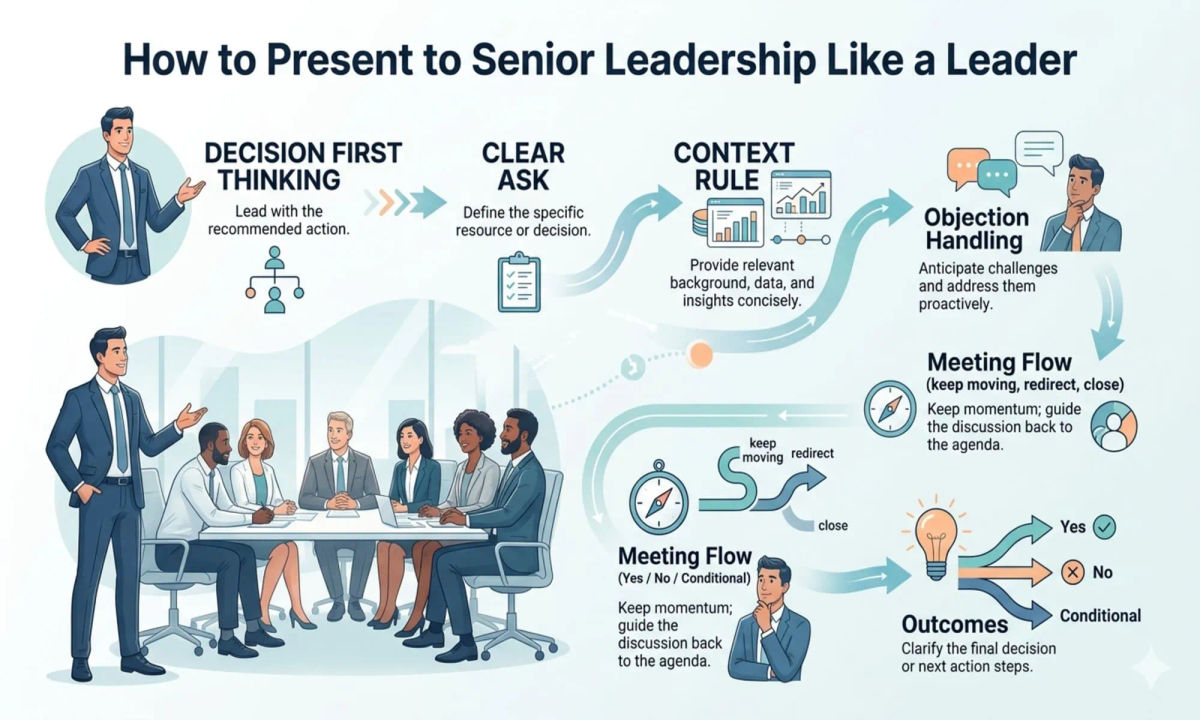
Presenting to senior leadership is about driving decisions and shaping the future, not just sharing updates. Professionals often leave meetings without achieving clarity or actionable steps. Impactful leaders craft compelling narratives that resonate and inspire action by understanding key priorities and tailoring presentations accordingly.
For instance, if growth strategies are a focus, highlight alignment with these goals and specific outcomes. To stand out, prepare strategic plans demonstrating thought leadership and commitment to the organization’s success. This earns trust from executives and opens career opportunities.
🚪 1. Before You Walk Into the Room: Define the Decision
Before entering a pivotal meeting, take a moment to ponder your purpose and what decision you need to make by the time you leave. This introspective question serves as the foundation for crafting an impactful presentation. If articulating your desired outcome in one succinct sentence proves challenging, it might be wise to reconsider whether you're fully prepared.
Leaders often falter when they seek more information rather than clear direction and actionable decisions. When your requests lack clarity, so too will their responses. A practical example is presenting a new project proposal in a team meeting; if you merely list goals without specifying the decision you need from attendees—such as whether to proceed or allocate resources—the outcome may disappoint.
Clearly understanding what needs resolution and communicating it effectively ensures that everyone is aligned. Defining decisions beforehand not only sharpens your own objectives but also guides participants towards focused, efficient discussions. This clarity steers away from unnecessary information overload, allowing the meeting to address key issues head-on and propel projects forward with purposeful momentum.
🎯 2. Use a Decision-First Structure
Executives are outcome-driven and prefer to see the bottom line upfront, rather than being led through a detailed narrative. A decision-first approach in your presentation simplifies their task by immediately conveying the key takeaway or request.
For instance, instead of starting with an elaborate backstory, you should jump straight into what you’re asking for. The structure of such a conversation hinges on four essential components: The Ask, Context, Objections, and a Clear Restatement of The Ask. Begin your discussion by clearly stating the desired outcome or decision point right away.
Think of it as a direct call to action that aligns with your objectives. Following this initial ask, provide only the necessary context required for understanding why this request is being made. This keeps the conversation focused and prevents unnecessary details from diluting the message.
Before addressing potential objections, which is crucial for overcoming any resistance upfront, it’s important to ensure that all critical information has been shared succinctly. By doing so, you demonstrate respect for your audience's time and highlight the relevance of your request early on. Finally, end with a clear repetition of The Ask, reinforcing its importance and ensuring there’s no ambiguity about what needs to be done next.
🗣️ 3. How to State Your Ask Clearly
A strong leader communicates with clarity and confidence, ensuring that their requests are understood without room for ambiguity. One effective way to communicate is by using a straightforward structure that clearly outlines the decision needed from others. This approach not only streamlines communication but also sets clear expectations.
- Start by stating your request directly: “Here’s the decision I need from you today…”
- Follow up with the purpose or benefit of this action: “This allows us to achieve…”
- Highlight potential risks if no action is taken: “If we don’t act, the risk is…”
After laying out your ask in these terms, it’s crucial to give others space to process and respond. In professional settings, over-explaining can dilute your message and undermine your authority. By being concise yet thorough, you demonstrate respect for others’ time while building trust through clear communication.
Imagine a scenario where a project manager needs input on a critical decision: stating the ask clearly and then allowing team members to reflect before responding fosters an environment of mutual respect and effectiveness.
Clear communication is not just about saying what you mean, but also knowing when to stop talking. Over-explaining can lead to confusion or misinterpretation, whereas concise, well-structured requests promote clarity and accountability. This approach ensures that everyone involved understands their role and the expected outcomes without unnecessary complications.
🧩 4. The Context Rule: Less is More
The cardinal sin in executive communication is overwhelming the decision-makers with too much information. Executives are inundated with data and reports, making it crucial to provide them with only what they need to make informed decisions. Instead of presenting a comprehensive overview of every detail at your disposal, focus on distilling the essence of the issue down to its core components.
To achieve this clarity, start by asking yourself probing questions: What information is truly essential for their decision-making process? What elements can be safely omitted without compromising understanding or outcomes? Which factors actually influence the final verdict and which are mere distractions?
Clarity beats completeness every time. When you strip away non-essential details and present only what’s necessary, your message resonates more effectively.
This approach not only saves executives' time but also ensures that they receive focused insights tailored to their needs. For instance, imagine preparing a report on project timelines; rather than detailing every single task and its progress, highlight key milestones, potential roadblocks, and proposed solutions. This streamlined approach provides immediate value by equipping decision-makers with the precise information required for strategic planning.
⚡ 5. Master the 3 Meeting Moves
Great leaders control meeting flow without dominating, keeping discussions productive and focused. They steer conversations back on track when they veer off course. For instance,
“To stay on track, let’s focus on the decision at hand.”
This keeps everyone aligned and maintains momentum. Leaders who keep meetings moving ensure discussions don’t linger indefinitely on any single topic. If a conversation seems to lose direction, interject with
“Let’s revisit this idea later; right now, we need to address our current priorities.”
This keeps everyone engaged and ensures valuable time isn’t wasted. Acknowledging side topics during a meeting is important for showing that you value all contributions but it’s equally crucial to keep these ideas from derailing the main discussion. When participants veer off into unrelated territory, acknowledge their point briefly and suggest setting it aside:
“That’s an important aspect we need to discuss further—can we capture this idea now so we can revisit it after addressing our current priorities?”
This keeps the meeting on schedule while not dismissing any valuable input. The final move is to ensure that meetings conclude with a clear understanding of what comes next. Always close by asking, “Are we all aligned and ready to move forward?” This ensures everyone leaves knowing their responsibilities and what the immediate next actions are.
🛡️ 6. Address Objections Before They Derail You
Strong presenters react to objections on the spot, but effective leaders anticipate challenges and plan accordingly. Common concerns include cost, timing, risk, and capacity issues. Cost concerns often top the list. Instead of letting budgetary issues dominate, make a compelling case for ROI or highlight costs associated with inaction.
For example, showing how failing to invest now could lead to higher expenses later can provide a powerful argument. Timing concerns are another issue. Many stakeholders worry about fitting new initiatives into an already crowded schedule. Address this by clearly explaining urgency or what might be lost by delaying action.
Emphasizing the critical nature of timing can help secure buy-in for your proposal. Risk aversion is also a major barrier. Address these fears head-on with a detailed risk mitigation plan that outlines how you will handle potential issues before they occur. Demonstrating that you have identified key risks and developed strategies to manage them can alleviate anxiety about unforeseen problems.
Capacity concerns are frequent—people worry about the ability to take on new projects or responsibilities without compromising existing workloads. By detailing how your plan will be executed, including any support structures like additional staffing or streamlined processes, you can reassure stakeholders that capacity is sufficient for success.
🏁 7. Define What Success Looks Like
To ensure every executive conversation is productive and decisive, it's essential to aim for one of three clear outcomes: a definitive yes, an outright no, or a conditional approval with specific conditions attached. Anything short of these leaves the door open for ambiguity and delays.
- ✅ Clear YES: This green light means the proposal is approved, and action can proceed without further ado.
- ❌ Clear NO: A red flag indicating that the proposal has been declined and does not move forward as it stands.
- ⚖️ Conditional YES: An amber signal suggesting approval with caveats. This implies that certain changes or conditions must be met before proceeding.
If you find yourself hearing vague responses like “Let’s revisit later,” “Send more details,” or “We’ll think about it,” then it's a clear sign that the conversation lacked the clarity needed to make an informed decision. These phrases often serve as smoke screens for indecision, delaying progress and potentially creating unnecessary backlogs.
Driving clarity in executive conversations is crucial because it not only moves projects forward but also sets realistic expectations for all stakeholders involved. For instance, if a team leader pitches a new initiative and receives a conditional approval with specific conditions to meet before proceeding, the team can focus on addressing those requirements rather than waiting indefinitely for a final decision.
🔍 8. Quick Self-Assessment Before Your Next Presentation
As you prepare for your upcoming presentation, reflect on key elements to ensure success. Clarity and readiness are crucial.
- Can I state my ask in one sentence? If not, your audience might miss the main point.
- Am I leading with the decision? Starting strong sets the tone; presenting a clear direction upfront guides the conversation towards achieving objectives.
These steps lay down foundational blocks for effective communication. Anticipating objections and knowing how to redirect conversations ensures you address challenges proactively and keep discussions on track. The final step is ensuring closure: Are you ready to close clearly? A strong finish consolidates your message, emphasizing key takeaways and next steps. If you hesitate or can't affirmatively answer these questions, refine your strategy. Adjustments mean the difference between a mediocre presentation and one that resonates with your audience.
💡 Final Thought
The key takeaway here is that your role isn't to dazzle the audience but to drive decisions forward. Effective professionals understand that conveying information is secondary to facilitating action and change.
- Individual contributors focus on tasks, while leaders make strategic choices impacting teams and organizations.
- Beyond communication, trusted advisors influence decision-making processes through deep insight and experience.
- Presenters captivate with delivery, but true influencers shape outcomes by persuading and engaging stakeholders beyond presentations.
Mastery of driving decisions positions you as a trusted authority whose opinions lead to tangible results, transforming how others perceive your contributions and elevating your influence within any organization or community.