 WORKPLACE SIGNALS
 How to Handle a Micromanager Without Damaging Your Career
Working with a micromanager can be one of the most frustrating experiences in a professional environment. It often feels like your autonomy is constantly questioned, your decisions are second-guessed, and your workflow is interrupted at every step. But here's the reality—micromanagement is rarely about you. It is usually driven by a manager's need for control, lack of trust, or pressure from higher levels.
Understanding this shift in perspective is important because it changes how you respond. Instead of reacting emotionally, the most effective professionals learn how to manage up. They create clarity, build trust, and reduce the need for constant oversight. The key is not confrontation. The key is communication.
- Prioritize clear and concise communication
- Set clear expectations and goals
- Offer solutions rather than just presenting problems
- Focus on the outcome, not the process
By understanding the underlying drivers of micromanagement and adopting effective communication strategies, you can turn what might seem like a frustrating experience into an opportunity for growth and improvement. Data-driven insights suggest that when employees feel empowered to make decisions and take ownership of their work, they are more engaged, motivated, and productive. By learning how to manage up effectively, you can create a more positive and productive work environment.
🧭 Start by Understanding Their Expectations
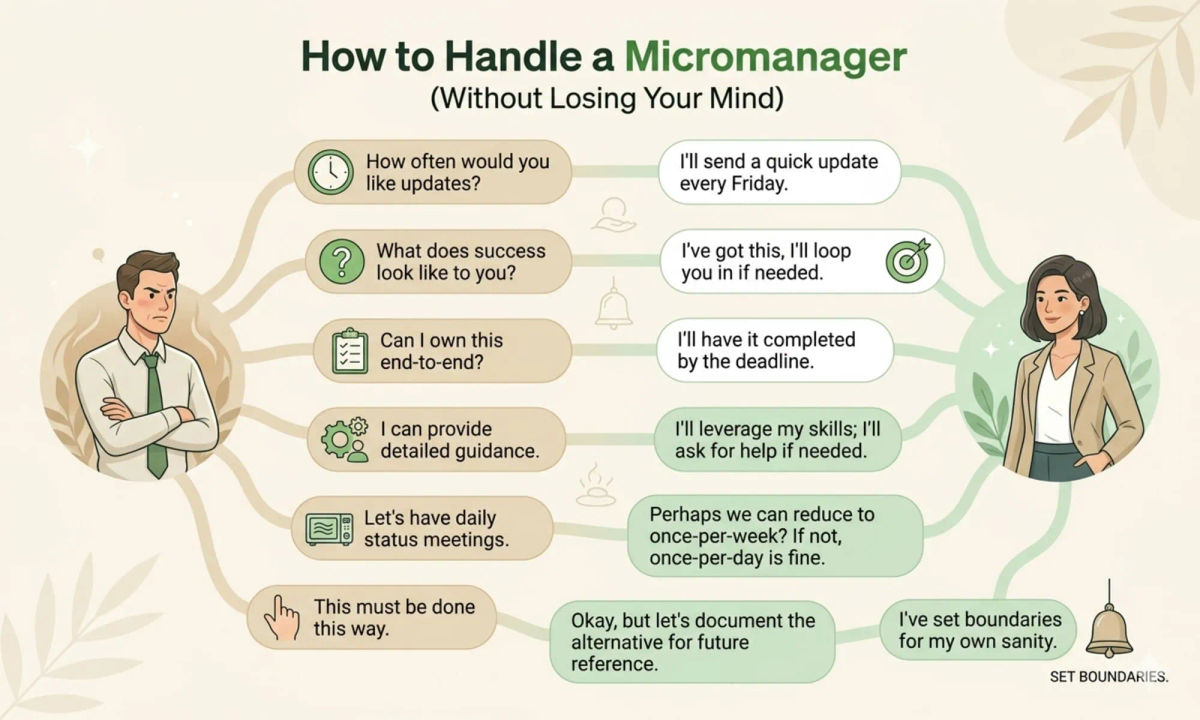
One of the biggest triggers for micromanagement is uncertainty. When expectations are unclear, managers tend to step in more frequently. You can reduce this by asking questions that create alignment from the beginning. This might include asking "What does a successful outcome look like to you?" or "How often would you like updates?" These questions help set clear expectations and give your manager a sense of control over the project.
- "What does a successful outcome look like to you?"
- "How often would you like updates?"
When your manager knows what to expect, they feel less need to constantly check in. By setting clear expectations and boundaries, you can help prevent micromanagement and create a more collaborative work environment.
For instance, if you're working on a project that requires frequent progress reports, ask your manager how often they'd like those updates. This way, you both are on the same page, and you won't feel the need to constantly check in or provide unnecessary updates.
| Question | Example Answer |
|---|---|
| "What does a successful outcome look like to you?" | A successful outcome would be having all project tasks completed within the given timeline and meeting the agreed-upon quality standards. |
| "How often would you like updates?" | I'd like weekly progress reports, with any significant changes or issues highlighted. |
🔄 Build Trust Through Proactive Communication
Micromanagers often check in because they fear things might go off track. You can reduce this by staying ahead of their concerns. Instead of waiting to be asked, try:
- “Quick update: everything’s on track.”
- “Just a heads-up, I wrapped this early.”
- “I’ll send a quick progress update every Friday.”
This kind of proactive communication builds confidence over time. When managers feel informed, they naturally step back.
🛑 Set Boundaries Without Being Defensive
Setting boundaries is important, but how you communicate them matters. Avoid sounding resistant. Instead, frame your approach in a positive, professional way: using "I" statements helps you express your needs without creating conflict. This subtle shift can make all the difference. For instance, instead of saying "don't touch my project," you could say "I'm responsible for this project, and I'll take care of it."
Similarly, instead of saying "stop interrupting me," you could say "I need a moment to focus on this task." By rephrasing your requests in terms of your own needs and feelings, you can avoid giving the impression that you're being defensive or resistant. This approach also helps you take ownership of your work and your time, which can lead to greater job satisfaction and reduced stress.
- “I do my best work with space to run.”
- “I’ve got this, and I’ll loop you in if needed.”
Remember that setting boundaries is not a one-time task. It's an ongoing process that requires consistent communication and negotiation. By being mindful of how you communicate your needs, you can build stronger relationships with your colleagues and create a more positive and productive work environment.
🎯 Ask for Ownership
Micromanagement often exists where ownership is unclear. When you take initiative and explicitly ask for responsibility, you shift the dynamic:
- "Can I own this piece start to finish?"
This signals confidence and readiness. It shows that you are not just executing tasks—you are capable of leading them.
| Key Takeaways |
|---|
| Own the process, own the outcome |
| Prioritize initiative over delegation |
| Build confidence through ownership |
Leadership isn't about managing tasks, it's about empowering people.
⏳ Protect Your Focus and Workflow
Constant interruptions can break your momentum. A simple way to manage this is by structuring when feedback happens:
- "Can I get your feedback once the first version's done?"
This approach ensures that you stay focused during execution while still keeping your manager involved at the right stage. By implementing a structured feedback process, you can maintain your workflow and avoid the disruption caused by constant interruptions.
Additionally, this approach shows respect for both parties' time. You're giving your manager a clear understanding of when to expect feedback, while also ensuring that you have uninterrupted time to work on your tasks.
- Set clear expectations with your manager about the timing of feedback.
- Use email or project management tools to track and manage feedback requests.
By implementing these strategies, you can protect your focus and workflow, ensuring that you're able to complete tasks efficiently and effectively. This is especially important in today's fast-paced work environment where distractions are plentiful. By prioritizing your time and staying focused, you'll be better equipped to handle the demands of modern work life.
🧠 Address Concerns Before They Become Control
Micromanagers often act based on underlying concerns. Instead of reacting to their behavior, address the root cause:
- “What are your biggest concerns about this?”
By inviting their worries upfront, you create a space for clarity. Once concerns are addressed, the need for constant oversight reduces. When you understand what drives their behavior, you can develop targeted strategies to address these concerns. This approach fosters a more collaborative and less controlling environment.
Sometimes, the simplest questions can reveal profound insights. By asking “What are your biggest concerns about this?” you create an opportunity for employees to share their thoughts and feelings.
🤝 Involve Them Strategically (Without Losing Control)
You do not need to exclude your manager. You need to involve them in a way that maintains your ownership. Try framing the conversation by saying, "Here's how I'm thinking through this—open to your input." This gives them visibility and a voice, but keeps you in control of execution.
- “Here’s how I’m thinking through this—open to your input.”
This approach allows you to collaborate with your manager while preserving your vision and autonomy. By being transparent about your thought process, you can build trust and credibility, which are essential for a successful partnership.
📩 Document for Clarity
Miscommunication often fuels micromanagement, which can lead to a lack of autonomy and motivation in team members. A simple habit like summarizing discussions can go a long way in clarifying expectations and preventing misunderstandings.
Clear documentation reduces confusion and builds trust among team members. By keeping all stakeholders informed and aligned, you can create an environment where everyone feels empowered to make decisions and take ownership of their work.
“Just summarizing here by email so we’re aligned.”
This approach also helps to prevent the need for constant updates and clarifications, freeing up more time for actual work. By prioritizing clear communication and documentation, you can create a culture of transparency and trust that benefits everyone involved.
⚖️ Balance Urgency with Realistic Expectations
Micromanagers often create pressure by labeling everything as urgent. Instead of pushing back directly, reframe the conversation:
- “I know this is urgent—can we agree on a realistic timeline?”
This acknowledges their concern while setting a practical boundary. When faced with an urgent task, it's essential to strike a balance between meeting deadlines and respecting the team's workload. One effective approach is to ask clarifying questions:
- “What are the top priorities for this project?”
- “Are there any dependencies or constraints we should be aware of?”
This helps to establish a clear understanding of what needs to be done and when, allowing for more realistic expectations. For example: Task: "Implement new feature" Clarifying questions: "What are the key requirements?" "Are there any dependencies with existing code?" In this way, you can ensure that your team is working efficiently towards a common goal without sacrificing quality or morale.
🧠 The Bigger Insight
Handling a micromanager is not about changing their personality. It is about changing the way you interact with them. When you communicate proactively, clarify expectations, and build trust over time, you reduce the need for micromanagement naturally.
- Communicate proactively
- Clarify expectations
- Build trust over time
You reduce the need for micromanagement naturally.
💡 Final Thought
You may not always be able to choose your manager, but you can choose how you respond. The right communication can turn a stressful dynamic into a manageable one—and in some cases, even a productive partnership. Because the goal is not just to survive a micromanager. It is to grow despite them.