 WORKPLACE SIGNALS
 4 Storytelling Frameworks Every Business Leader Should Know
In the realm of business, logic serves as a guide but stories hold the power to persuade and inspire action. While data, metrics, and strategy are indispensable tools for decision-making, they often lack the emotional resonance needed to drive real-world change. Effective communication hinges on the ability to convey ideas in a way that resonates with people's emotions and experiences, fostering alignment and commitment.
Storytelling emerges as a pivotal skill for leaders looking to enhance their influence and effectiveness. It is not about crafting elaborate narratives or entertaining audiences; rather, it involves simplifying complex concepts through structured storytelling that builds trust and emotional connection. According to a study by MIT Sloan Management Review, teams who use stories in their communication processes show a 37% increase in engagement levels.
Leaders can adopt various frameworks to harness the power of storytelling more effectively. By understanding these frameworks, leaders not only improve their ability to communicate but also strengthen their influence and execution capabilities within their organizations.
1. The Hero’s Journey
The Hero’s Journey is a storytelling framework that has transcended its literary roots to become an indispensable tool for navigating and communicating transformation in business settings. By using this narrative structure, leaders can present change as a journey rather than a mandate, making the process more relatable and engaging.
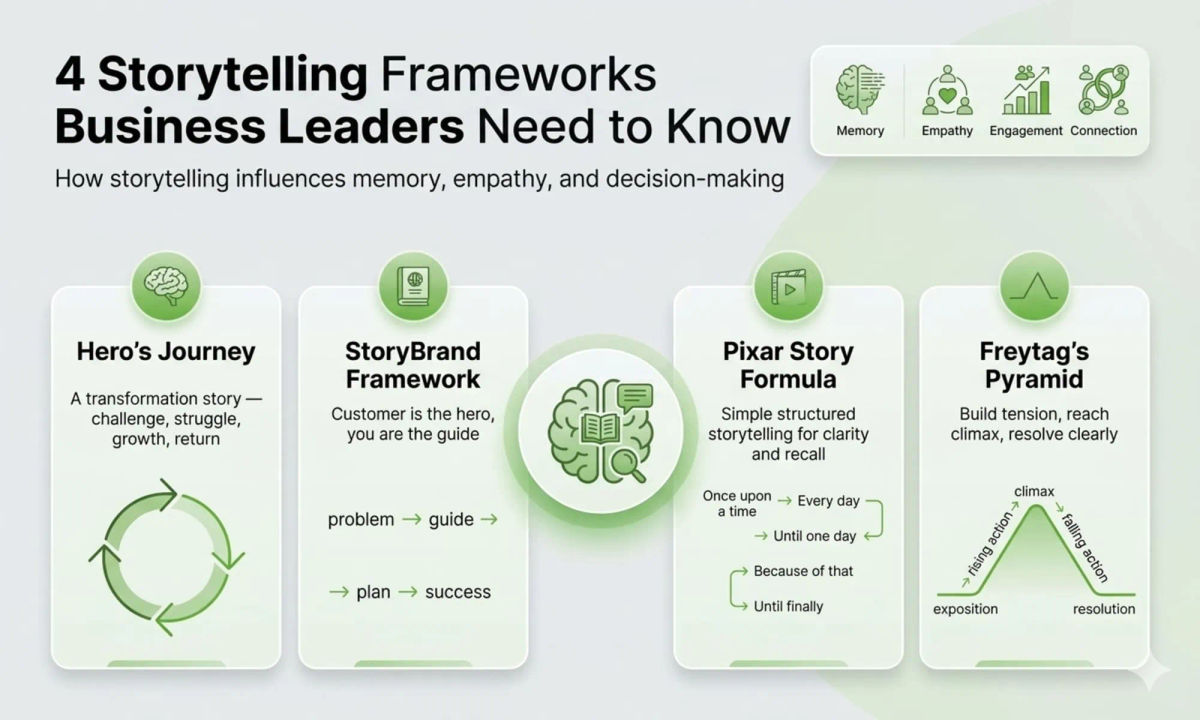
At its heart, the Hero’s Journey involves three key stages: departure, initiation, and return. Departure begins when a character leaves their comfort zone to face challenges; initiation is where they confront obstacles and gain wisdom or insight; finally, return sees them transformed by the experience. This sequence provides a clear roadmap for anyone undergoing significant change.
In practice, consider a company facing digital transformation. The leadership can frame this challenge as an epic journey of discovery, innovation, and reinvention. By doing so, employees are more likely to embrace their roles in overcoming technological hurdles, thus fostering a sense of shared purpose and achievement.
2. The StoryBrand Framework
The StoryBrand framework represents a transformative shift in how businesses communicate their message, positioning the customer as the hero rather than the company itself. This perspective change is crucial because it moves the narrative focus from what the business offers to the specific challenges faced by its audience. By doing so, companies can better articulate themselves as guides who provide clear solutions and pathways forward.
At its core, StoryBrand follows a straightforward yet compelling structure: a character (the customer) encounters a problem, meets a guide (the company), receives a plan to address the issue, and is encouraged to take action that leads to success. This framework is particularly effective in presentations, stakeholder communications, and product messaging because it ensures that all discussions are relevant and focused on addressing the audience's needs rather than merely promoting company features.
Consider an example where a software development firm uses StoryBrand in its product launch presentation. Instead of highlighting technical specifications or internal achievements, they focus on the challenges faced by their target users—such as inefficiencies in project management—and position themselves as problem solvers who offer a user-friendly solution to enhance productivity and satisfaction. This approach not only engages stakeholders more deeply but also builds stronger connections with potential customers.
3. The Pixar Storytelling Formula
The Pixar storytelling formula is renowned for its clarity and simplicity, making it an invaluable tool for crafting compelling narratives that resonate deeply with audiences. This method deconstructs the storytelling process into a series of straightforward steps: once upon a time, every day, until one day, because of that, and finally. Each stage serves to build context around the protagonist's journey, setting up the world they inhabit before introducing the catalyst for change.
By adhering to this structure, storytellers can easily convey complex themes and plot points in a digestible manner. For instance, when explaining a business project or presenting a case study, the Pixar formula helps maintain focus on key moments that drive progress or highlight pivotal decisions. In doing so, it ensures that listeners not only follow the narrative but also grasp its significance by connecting individual events to broader goals and outcomes.
The true power of this approach lies in its ability to distill information down to its core essentials. This process often reveals insights that might otherwise be overlooked or underappreciated. For example, a company presenting the launch of a new product could use this format to highlight how market research led to critical features and innovations, emphasizing the importance of these findings for future success. By focusing on what truly matters, the formula encourages a deeper engagement with content, ensuring that audiences are not just informed but inspired by the story.
4. Freytag’s Pyramid
Freytag’s Pyramid is a well-known storytelling structure that emphasizes tension and resolution, breaking down narratives into distinct stages: exposition, rising action, climax, falling action, and resolution. This framework isn’t just for novels; it’s incredibly useful in crafting presentations that captivate an audience from start to finish.
Instead of delivering information in a straightforward manner, Freytag’s Pyramid encourages you to create a narrative arc. Begin by setting the scene and laying out the context. Then, build tension by introducing challenges or conflicts. This rising action keeps your listeners on edge as they wait for the outcome. The climax is where everything comes to a head, creating a pivotal moment that demands attention.
After the climactic peak, the falling action guides the audience through the aftermath and resolution of the conflict. This structure makes your presentation more engaging because it mirrors how we naturally consume stories, enhancing retention and making your final message much more impactful. For instance, when a CEO uses Freytag’s Pyramid to present a new strategic initiative, they can introduce the current state, highlight obstacles, reach a critical point like a pilot project launch, and finally conclude with clear next steps.
This method is particularly effective for leaders who need to convey complex ideas or address significant organizational challenges. By structuring your presentation in this way, you not only maintain audience engagement but also ensure that the resolution feels satisfying and conclusive.
Why Storytelling Matters for Leaders
Storytelling is not just a communication tool—it is a leadership capability that empowers leaders to align teams, influence decisions, and drive action. Effective leaders know that the success of these efforts hinges on both what they communicate and how they do it.
Stories have a unique ability to activate emotional and cognitive responses, making information more memorable and meaningful for listeners. They help people see beyond immediate details to grasp the bigger picture, understand the context behind decisions, and connect with the underlying purpose of their work. For example, when Steve Jobs introduced the iPhone in 2007, he didn’t just list features; he told a story about how it would change the way we live and communicate.
In today’s fast-paced business environment, leaders face the challenge of capturing attention amidst high levels of complexity. The ability to craft compelling narratives can be a significant competitive advantage. According to research by Forbes, executives who effectively use storytelling are 56% more likely to inspire their teams to action than those who do not.
How to Apply These Frameworks
Understanding these frameworks is just the beginning. The true value lies in their deliberate application, which can transform how you communicate and solve problems. Start by identifying your context—whether it's explaining a complex strategy or facilitating change management—and select the framework that best aligns with your needs.
Focusing on clarity is crucial once you've chosen your framework. Simplify your message and avoid convoluted explanations; use the framework’s structure to guide your communication, ensuring each element supports the overall narrative without adding unnecessary complexity. For instance, when presenting a business strategy, using the “Message Box” framework can help streamline your pitch, making it more compelling and memorable.
Consistent practice is essential for mastering these frameworks. Like any skill, storytelling improves with repeated application. Over time, you’ll find that integrating these frameworks into your communication becomes second nature, enhancing both the effectiveness and efficiency of your messages. A nuanced perspective here: while initial adherence to framework structures might feel restrictive, embracing their flexibility can lead to more creative and impactful outcomes.
Conclusion
In a world saturated with information, clarity is indeed a powerful asset. Storytelling equips business leaders with the tools to craft compelling narratives that bridge logical arguments and emotional connections. This approach ensures messages are not only heard but also remembered.
For instance, Steve Jobs was renowned for his ability to weave storytelling into product launches, making Apple's innovations feel personal and revolutionary to consumers. By doing so, he transformed mundane technical details into inspiring journeys that resonated deeply with audiences. Despite the rapid pace of technological change, these stories endure because they capture the essence of why a product matters.
Ultimately, while facts may fade from memory over time, the narrative framework remains. This is true whether you are launching a new business idea or trying to inspire your team; storytelling can elevate communication beyond mere information transfer.