10 Hidden Reasons You're Not Getting Promoted (And How to Fix Each One)
You work hard. You hit your targets. You show up early and stay late. So why does someone else keep getting the promotion? The uncomfortable truth is that most of the things blocking your career advancement have nothing to do with your competence.
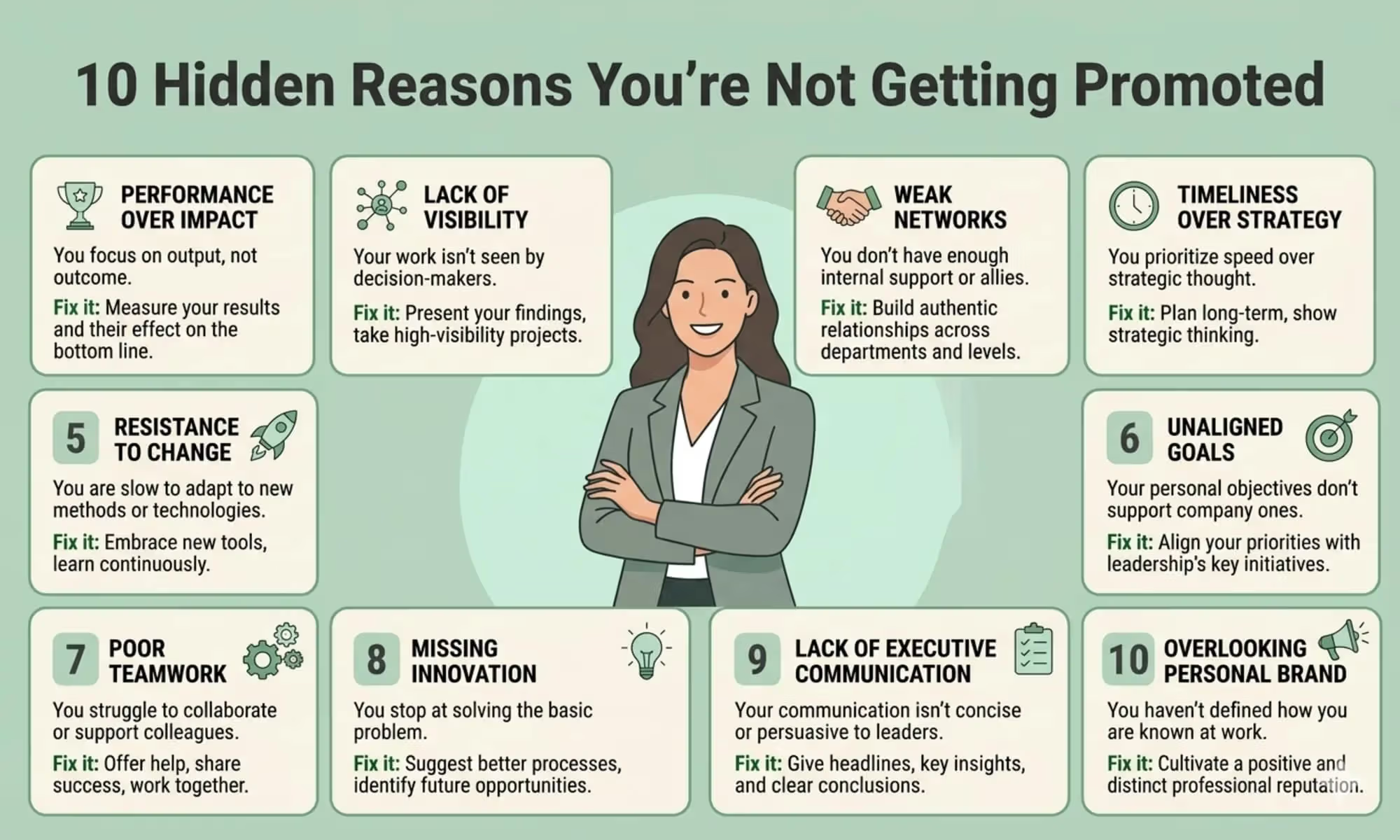
They are invisible — patterns of behavior, perception gaps, and unspoken rules that no one put in your job description. Understanding them is the first step to changing them. Here are the ten most common hidden reasons talented people get passed over — and exactly what to do about each one.
1. You're a Quiet Achiever
Excellence without visibility is a career killer.
You do outstanding work, but you let it speak for itself. The problem is, in most organizations, work doesn't speak — people do. Decision-makers promote the people they know are delivering, not just the people who are. If your wins go unannounced, they go unnoticed.
Fix it: Start sharing your wins — not as bragging, but as updates. Send a brief summary when a project lands well. Mention it in your next one-on-one. Own your narrative. If you don't tell your story, someone else will tell a version of it — or worse, no one will tell it at all.
2. You "Don't Do Politics"
"I just focus on my work" is another way of saying career stagnation.
The people who say they don't play politics are often the ones most frustrated by how politics affects their career. Here's the reframe: organizational influence isn't dirty — it's how things get done. Relationships, trust, and strategic communication are not games. They are the infrastructure of professional impact.
Fix it: Stop thinking of relationship-building as politics and start thinking of it as influence that multiplies your impact. Find allies across teams. Understand what matters to key stakeholders. Help people before you need something from them.
3. Your Work Lacks Visible Impact
Getting things done is not the same as making an impact.
Many professionals are busy — completing tasks, attending meetings, closing tickets — but their work isn't clearly connected to anything that moves the needle for the organization. Promotions go to people who can demonstrate that their contributions shifted outcomes, not just activity levels.
Fix it: Identify the two or three KPIs your organization actually cares about and orient your work around them. When you contribute to those metrics, make the connection explicit. "This initiative reduced churn by 8%" is a promotion conversation. "I managed the retention project" is not.
4. You're Too Good at Your Current Job
Being irreplaceable in your current role makes you stuck in it.
This is one of the cruelest traps in corporate life. You become so valuable where you are that your manager — consciously or not — resists losing you. You're the expert. The go-to person. The one who holds all the tribal knowledge. And that's exactly why no one moves you up.
Fix it: Work smarter, not just harder. Document your processes. Train others to do what only you currently do. Build systems that scale beyond your individual contribution. Make yourself promotable by making yourself replaceable in your current role.
5. You Have No Network
People promote people they know, like, and trust.
Competence gets you considered. Relationships get you chosen. If the decision-makers in your organization don't know you personally — your ambitions, your values, your track record — you're invisible at the moment it counts most.
Fix it: Build relationships before you need them. Have coffee with peers in other departments. Introduce yourself to senior leaders in low-stakes moments. Volunteer for cross-functional projects. Trust is built slowly and spent quickly — start accumulating it now.
6. You're Too Technical
Technical skills open doors; people skills build careers.
Early in your career, being the smartest person in the room technically is a superpower. At some point — usually sooner than people expect — the ceiling on purely technical careers becomes visible. Leadership, communication, empathy, and the ability to influence without authority become the actual differentiators.
Fix it: Deliberately invest in soft skills. Actively work on how you communicate complex ideas to non-technical audiences. Practice giving feedback. Lead a meeting. Mentor a junior colleague. Soft skills compound over time just like technical ones — but most people neglect them until it's late.
7. You're a Yes-Aholic
Saying yes to everything produces low delivery standards on everything.
When you take on every request, attend every meeting, and volunteer for every initiative, you spread yourself across too many things to do any of them well. Worse, you train people to see you as someone who reacts to others' priorities rather than drives their own agenda.
Fix it: Protect your time fiercely. Say no — or "not now" — to requests that don't align with your highest-impact work. Do fewer things with more focus and depth. Quality of output is what gets promoted. Volume of activity is what gets burned out.
8. You're a Lone Wolf
You avoid asking for help, and it costs you more than you realize.
Independence is a strength up to a point. Beyond that point, it signals that you can't collaborate, can't delegate, and can't scale beyond yourself. Leaders don't do everything — they work through others. If you're still trying to prove yourself by going it alone, you're playing the wrong game.
Fix it: Find mentors who have already achieved what you want. Use their experience as a shortcut, not a crutch. Ask for help early on problems, not after you've exhausted every other option. Build a reputation as someone who brings people together, not just someone who works alone.
9. You Resist Action
You endlessly research and plan instead of doing.
Analysis paralysis is a form of fear wearing the mask of diligence. Some people spend so long trying to feel "ready" that they never move. In a world where learning by doing is often faster than learning by preparing, the bias toward action is a measurable advantage.
Fix it: Start before you feel completely ready. Ship the imperfect version. Launch the project with 80% of the information. The final 20% will reveal itself in the doing, not the planning. Promotions go to people who move — and who make smart decisions in motion, not people who wait for certainty.
10. You're a Perfectionist
Impossible standards lead to missed opportunities and invisible output.
Perfectionism is not a virtue in a fast-moving organization — it's a liability. The person who ships good work consistently outperforms the person who occasionally ships perfect work, every time. Perfectionism also kills momentum: yours and your team's.
Fix it: Redefine "done." Align your effort with the actual impact of the deliverable. A quick internal report does not need the same polish as a client presentation. Learn to ask "is this good enough to achieve its purpose?" and trust that answer. Progress over perfection, consistently, wins.
The Common Thread
Read through all ten and you'll notice a pattern. Most of these traps come down to one core misunderstanding: promotions are not rewards for past performance. They are bets on future potential.
Your organization is not asking "who worked the hardest this year?" It's asking "who can operate at the next level? Who do people follow? Who creates impact beyond themselves?"
That shift in framing changes everything. It means visibility, relationships, communication, and strategic thinking aren't extras — they are the job, at the level you're trying to reach.
Where to Start
Don't try to fix all ten at once. Pick the two or three that resonate most — the ones where you felt that slight uncomfortable recognition. Work on those with intention for the next ninety days. Then reassess.
Career growth isn't linear, and it doesn't happen on anyone else's timeline. But it also doesn't happen by accident. The people who get promoted are the ones who understand the game, play it with integrity, and invest in themselves with the same discipline they bring to their work.
Start today. Not when you're ready. Now.