 WORKPLACE SIGNALS
 Why Companies Keep Toxic Managers While Good Employees Quit
The Misconception: Companies Don’t Choose Toxic Managers
Most companies don’t intentionally choose toxic managers. That’s what makes this issue so difficult to recognize and fix. Organizations rarely make a conscious decision to place someone in a leadership role knowing they will damage team morale or push employees out. Instead, what happens is far more subtle. They tolerate behaviors that should have been addressed early. Over time, that tolerance turns into acceptance, and acceptance eventually becomes part of the culture.
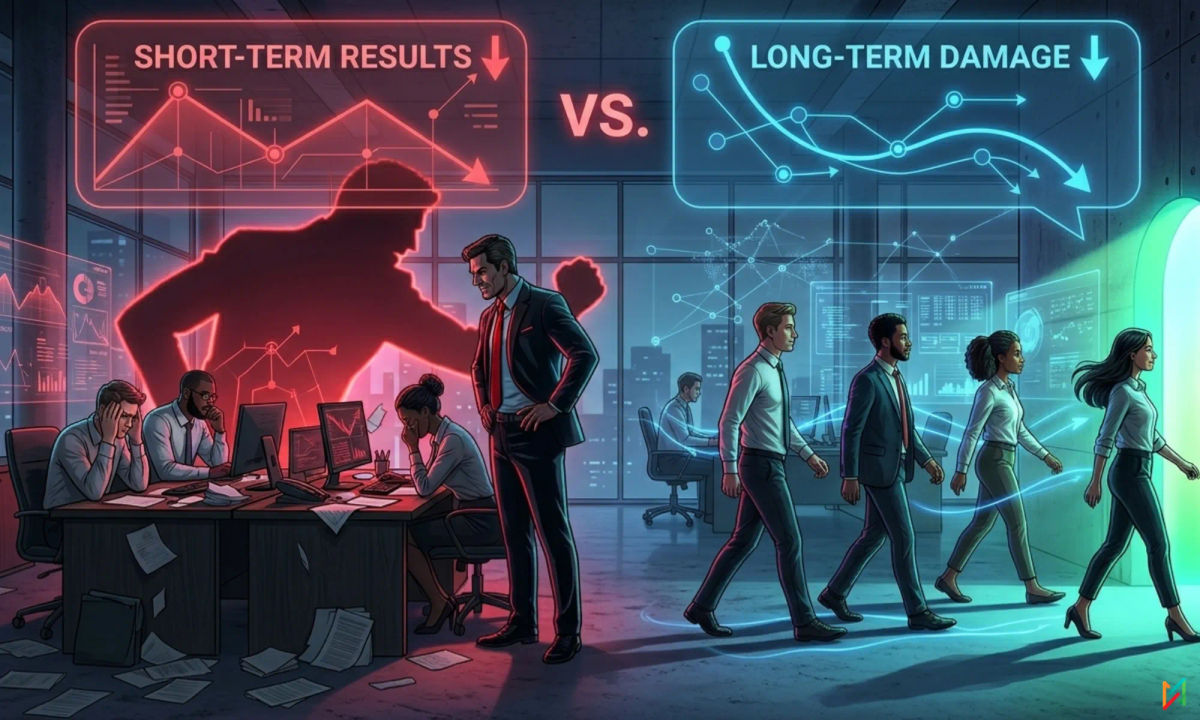
Toxic managers don’t survive because they are great leaders. They survive because they deliver something organizations are conditioned to value—short-term results. They hit targets, push teams to meet deadlines, and create the appearance of productivity. On the surface, it looks like strong performance. But what’s happening underneath often tells a very different story.
- The pressure to perform is immense, leading to burnout and turnover among team members.
- The fear of speaking up or reporting toxic behavior is palpable, creating an environment of silence and apathy.
- Ultimately, the long-term costs of tolerating toxic managers far outweigh any short-term gains in terms of productivity or profits.
This reality is what makes addressing toxic management so crucial. It requires a shift from solely focusing on results to prioritizing the well-being and growth of team members. By acknowledging the subtle nature of this issue, organizations can begin to take proactive steps towards creating a healthier, more sustainable culture.
The Illusion of Performance
Toxic managers know how to operate within the system of measuring performance through visible outcomes. Metrics, dashboards, and reports highlight delivery, revenue, and efficiency. They present confidently in meetings, communicate effectively with senior leadership, and position themselves as strong performers.
They understand how to manage upward, framing progress in a way that builds credibility. But while they are building trust with stakeholders above them, they often break trust with the people who report to them. This damage is less visible, showing up in team dynamics, reduced collaboration, and the gradual loss of motivation.
This damage doesn't show up immediately in reports or numbers. It's harder to quantify, which is why it's often overlooked. A focus on short-term gains can lead to long-term consequences that are difficult to recover from.
- When teams are motivated and engaged, they are more productive and creative. When motivation and engagement decline, so do productivity and creativity.
- Sustainable performance requires a focus on team well-being, not just individual outcomes.
The Silent Behavior of Good Employees
High-performing employees typically don't escalate issues immediately. They don't complain loudly or create disruptions. Instead, they try to adapt. They take on more responsibility. They adjust their expectations. They attempt to work around challenges rather than confront them directly. They believe that with enough effort, they can make things work.
For a period of time, this approach holds. But there is a limit. Over time, the lack of support, recognition, and respect begins to take a toll. It affects not only their performance but also their energy and engagement. What once felt manageable starts to feel draining. And when that threshold is crossed, they don't always fight back. They leave.
Quietly, without confrontation, without escalation—just a decision to move on.
- They take on more responsibility. They adjust their expectations. They attempt to work around challenges rather than confront them directly.
- The lack of support, recognition, and respect begins to take a toll. It affects not only their performance but also their energy and engagement.
| What happens | Why it's problematic |
|---|---|
| They take on more responsibility. They adjust their expectations. | This can lead to burnout and decreased job satisfaction. |
What once felt manageable starts to feel draining.
Why Organizations Tolerate Toxic Managers
There are several reasons why organizations continue to tolerate toxic managers, even when the impact becomes evident. The first is measurement. Results are easier to track than damage. It is simple to quantify revenue, delivery timelines, and output. It is far more difficult to measure trust, morale, or psychological safety.
Another reason is perception. From the outside, fear can look like control. A strict or high-pressure manager may appear disciplined and results-driven. Deadlines are met, and teams seem focused. But what’s often mistaken for discipline is actually compliance driven by pressure.
When concerns are raised, they are sometimes dismissed. Complaints may be labeled as attitude problems or resistance to pressure. Instead of being explored, they are minimized. This discourages further feedback and reinforces silence within teams.
There is also the perceived risk of change. Replacing a manager feels disruptive. It introduces uncertainty, requires transition, and may temporarily impact performance. Losing individual contributors, on the other hand, feels more manageable. So organizations choose what appears to be the safer option in the short term.
The Hidden Cost of Losing Good Employees
What many organizations fail to recognize is that losing good employees carries a much higher long-term cost. Each departure removes more than just a role – it removes experience, context, and consistency. It weakens the team in ways that are not immediately visible.
The people who leave are often those who contribute the most. They take ownership, support others, and raise the overall standard of the team. When they exit, the impact is not limited to output – it affects culture. The remaining team begins to shift. Some lower their expectations. Others disengage.
A few may stay but operate with reduced motivation. Over time, the overall environment changes, not through a single event but through a series of small, cumulative losses. By the time leadership recognizes the pattern, the damage is already significant.
The Real Problem: Decision-Making, Not Turnover
Turnover is often treated as the problem. In reality, it's a symptom. The deeper issue lies in the decisions that allow these patterns to continue. It's the choice to prioritize short-term comfort over long-term health. It's the tendency to focus on visible results while ignoring invisible impact.
Avoiding difficult conversations may feel easier in the moment. Addressing a toxic manager requires effort, clarity, and sometimes uncomfortable action. But choosing not to act creates a much larger problem over time. Strong organizations approach this differently.
They don't limit themselves to what is easy to measure. They pay attention to patterns. They ask why certain teams experience higher attrition. They examine feedback and look for recurring themes. They treat these signals as indicators, not exceptions.
What Strong Leadership Looks Like
Organizations that handle feedback well create systems where concerns flow in all directions. Rather than dismissing them, leadership explores these issues. Evaluation focuses not only on outcomes but also on how those outcomes are achieved. This approach yields a more holistic understanding of what drives success. Strong leadership recognizes that performance and culture aren't separate entities – they're deeply connected.
A healthy culture enables consistent performance, while a toxic one undermines it. When organizations prioritize both aspects, they foster an environment where people feel valued, supported, and empowered to excel. In reality, strong leadership means considering the method matters. It's not just about achieving results; it's about how those outcomes are achieved. This shift in perspective acknowledges that performance and culture are intertwined and that neglecting one can have far-reaching consequences. By embracing this mindset, organizations can build a strong foundation for long-term success.
Final Thought
Companies don't lose good employees by accident. They lose them through patterns—through what they tolerate and what they choose not to address.
- The real failure is not turnover itself. It is the decision to prioritize short-term stability over long-term integrity.
- Leadership is not about avoiding discomfort. It is about having the courage to address it early.
Because in the end, sustainable success is not built on results alone. It is built on the environment that produces them.