 WORKPLACE SIGNALS
 10 Harsh Signs of a Toxic Workplace Culture (Most Companies Ignore)
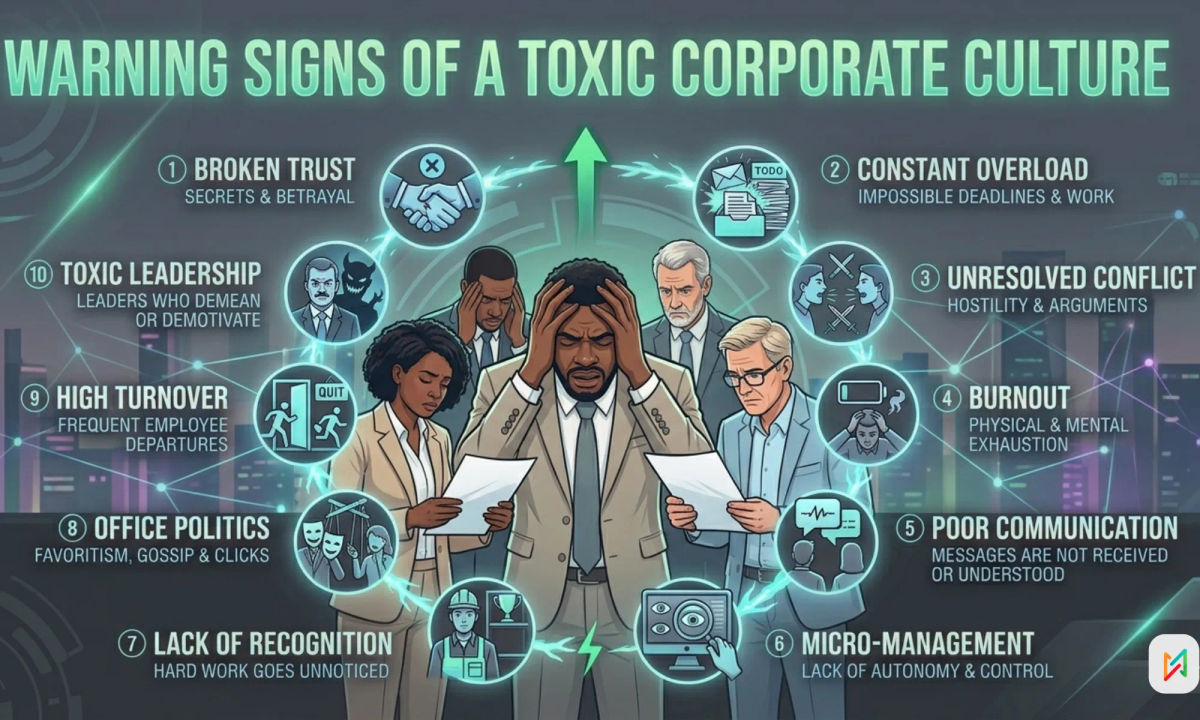
Culture Is Not What You Say—It’s What You Tolerate
Every organization talks about culture. Values are written, posters are designed, and leadership messages emphasize collaboration, respect, and growth. On the surface, everything looks aligned.
But real culture is not defined by what's written. It's defined by what's tolerated. A workplace doesn't become toxic overnight; it happens gradually, through repeated behaviors that go unaddressed. Small compromises become accepted norms, and over time, those norms shape the daily experience of employees.
The challenge is that many of these signs are subtle. They don't always appear as major issues at first. But when combined, they create an environment that drains energy, reduces trust, and pushes people away.
- A workplace does not become toxic overnight. It happens gradually, through repeated behaviors that go unaddressed.
- Small compromises become accepted norms.
- Those norms shape the daily experience of employees.
Recognizing these signs early is critical.
Employees Are Expected to Work While Sick
One of the clearest indicators of a toxic culture is when health is treated as secondary to output. This can be seen in the way employees are expected to power through illness, rather than being given the autonomy to take care of themselves.
When employees feel pressured to work while sick, it signals that performance is valued more than well-being. Even if this expectation is not explicitly stated, it can be reinforced through behavior—such as praising those who “push through” illness. This creates an environment where people are reluctant to prioritize their health, fearing it will impact their job or career.
Over time, this creates an unhealthy standard. People stop prioritizing their health, which leads to burnout and reduced long-term productivity. It's essential for organizations to recognize the importance of employee well-being and create a culture that values health alongside performance.
Taking a Break Requires Permission
Breaks are not a privilege, but rather a necessary component for sustained performance. In toxic environments, however, even short breaks may feel restricted, as employees may feel the need to justify stepping away or worry about how it will be perceived. This constant pressure reduces mental recovery time, creating an environment where people are always "on" – which ultimately reduces both focus and efficiency. It's essential to recognize that taking a break is not only allowed but also necessary for maintaining productivity and overall well-being.
For instance, consider the example of an employee working in a high-stress industry where the constant pressure to meet deadlines can lead to burnout. In this scenario, taking regular breaks to recharge and refocus can help mitigate the negative effects of stress and promote better job performance.
Work Never Truly Stops—Even on Vacation
A healthy workplace respects boundaries. When it becomes normal to message employees during their time off, it sends a clear message: availability is expected at all times. Vacations lose their purpose. Time meant for rest becomes another extension of work. This not only affects individual well-being but also reduces long-term performance. People return from breaks just as exhausted as when they left. The blurred lines between personal and professional life erode the very fabric of our relationships, making it difficult to disconnect and recharge.
| Key Takeaway | Impact on Well-being |
|---|---|
| Avoid messaging employees during their time off | Reduces stress and promotes relaxation |
As a result, employees become increasingly disconnected from their work, leading to stagnation in productivity and job satisfaction. It's time for leaders to reevaluate their priorities and recognize that true fulfillment comes from respecting the boundaries between work and personal life. By doing so, they'll create a more sustainable work environment where employees can thrive.
The blurred lines between personal and professional life erode the very fabric of our relationships.
Leaders must prioritize respecting employees' boundaries to foster a healthy work environment.
Bullying Is Ignored or Minimized
Toxic behavior does not always appear as open conflict. Instead, it can manifest in subtle ways, such as exclusion, dismissive communication, or consistent negativity. When these behaviors are ignored, they become normalized and a culture of disrespect emerges.
Employees quickly notice when issues are not addressed. It signals that respect is optional, which erodes trust within the team and creates an environment where people feel unsafe speaking up. This can lead to a toxic work culture where people feel uncomfortable, unmotivated, or even bullied.
It's essential to recognize the signs of bullying and take them seriously. By addressing these issues promptly, you can prevent the normalization of toxic behavior and foster a culture of respect, empathy, and inclusivity.
Feedback Becomes Personal Instead of Constructive
When feedback is not constructive, it can have far-reaching consequences. In an unhealthy culture, feedback often becomes emotional or personal, replacing the original intent with tone and criticism.
This shift in focus changes the purpose of feedback from improvement to control. As a result, employees become defensive or disengaged, leading to slowed learning and strained communication.
- The key issue is that constructive feedback is no longer the primary goal. Instead, it's used as a means to assert power or control over others.
When this happens, individuals are less likely to engage with the feedback, leading to a lack of growth and development. It's essential to recognize when feedback has become personal instead of constructive and take steps to address the issue.
Deadlines Are Always Unrealistic
Toxic cultures often operate in a constant state of pressure, where deadlines are set without considering effort, complexity, or resources. This creates a cycle where teams are always catching up and trying to play catch-up.
This relentless pace leads to fatigue and reduced quality of work over time. The constant struggle to meet unrealistic expectations drains the motivation and morale of team members, ultimately affecting their well-being and job satisfaction.
- Urgency is sometimes necessary, but when everything is urgent, nothing is sustainable.
- This is why it's essential to prioritize realistic deadlines that account for the complexity and resources required to complete tasks effectively.
When teams are given the space to work efficiently and sustainably, they can produce high-quality results with reduced stress and burnout. It's time to re-evaluate our approach to deadlines and prioritize the well-being of our team members.
Effort-based deadlines would allow for more realistic expectations and reduce the pressure on teams. This approach prioritizes quality over quantity, ensuring that work is done efficiently and effectively. It's not about meeting arbitrary deadlines; it's about delivering exceptional results while maintaining a healthy work-life balance.
High Performers Are Overloaded
While it may seem logical to reward strong performers with more work, this approach often creates imbalance. The most reliable employees end up carrying the heaviest load, while others operate with less accountability.
This not only leads to burnout for high performers but also creates frustration. Effort is not distributed fairly, and recognition may not match contribution. Furthermore, it can stifle innovation as those who are overworked become increasingly risk-averse.
- Fair distribution of effort and recognition are crucial for maintaining a healthy team dynamic.
- High performers should be recognized and rewarded in ways that don't exacerbate the problem, such as through additional training or leadership opportunities.
| Characteristic | Impact |
|---|---|
| Burnout | Lowers morale and increases turnover. |
| Frustration | Leads to decreased job satisfaction and motivation. |
Favoritism Divides the Team
Favoritism can be a significant obstacle to overcome in any team or organization. When some individuals receive preferential treatment, it creates an environment where people feel uncertain about their role and the fairness of the system.
When favoritism is present, it's not just a matter of personal relationships; it's a structural issue that can have far-reaching consequences.
This type of unfairness can lead to decreased morale, increased turnover rates, and a general sense of dissatisfaction among team members. It's essential to recognize the impact favoritism has on an organization's culture and to take steps to address it.
- Introduce transparent decision-making processes
- Encourage open communication and feedback
- Foster a sense of shared responsibility and ownership
- Solicit input from all team members, not just the favored few
The benefits of addressing favoritism far outweigh the costs. By creating a fair and inclusive environment, you can increase trust, boost morale, and ultimately drive better results.
Competition Becomes Unhealthy
When competition turns personal, it can damage relationships and lead to unhealthy dynamics.
This is particularly true when individuals prioritize their own wins over collective success. As a result, information may be withheld, support decreases, and teams become fragmented.
The consequences of this shift are far-reaching, reducing overall effectiveness and creating unnecessary tension. Instead of fostering growth and improvement, competition can become a source of stress and burnout.
- When individuals prioritize their own success over the team's, it can lead to a lack of trust and cooperation.
- This type of competition can also lead to a culture of fear, where people are reluctant to share ideas or take risks.
It's essential for teams to recognize the signs of unhealthy competition and make a conscious effort to shift their focus back to collective success. By doing so, they can create a more positive and supportive team environment that fosters growth and improvement.
Personal Time Is Not Respected
Work should not consume every part of life. When personal time is ignored, it can lead to burnout and decreased job satisfaction.
In toxic environments, however, personal time is often treated as flexible. Late messages, weekend work, and constant availability become expected. This lack of boundaries leads to exhaustion that seeps into both professional and personal relationships.
Over time, the effects trickle down, affecting not only performance but also overall well-being. People begin to disconnect—not just from work, but from the organization itself—leading to decreased motivation and increased stress levels.
| Affected Performance | Affected Well-being |
|---|---|
| Decreased productivity and motivation | Increased stress, anxiety, and burnout |
Final Thought
Toxic culture is rarely the result of a single issue. It's the culmination of patterns: small behaviors that are ignored, standards that are not enforced, and decisions that prioritize short-term results over long-term health.
The impact may not always be immediate, but over time it becomes clear – through disengagement, burnout, and attrition. The strongest organizations don't just focus on performance; they focus on the environment that enables it.
Culture is not what you claim – it's what people experience every day. It's the subtle cues, the tone deaf leadership, the lack of empathy, or the constant pressure to perform. When we prioritize the former over the latter, we set ourselves up for failure.