 WORKPLACE SIGNALS
 Elon Musk’s Company-Building Principles: How Great Companies Are Actually Built
Why Elon Musk’s Thinking Stands Out
When you think about pioneering companies like Tesla or SpaceX, it's natural to focus on the revolutionary ideas, bold visions, and futuristic concepts that set them apart. However, what truly sets Elon Musk apart is not just his vision – it's the way he thinks about building companies from scratch.
Musk's approach is a refreshing departure from the status quo, where most organizations operate based on inherited processes, assumptions, and industry norms. He challenges all of that by questioning everything, simplifying aggressively, and focusing only on what truly matters. This mindset allows him to identify and eliminate inefficiencies, creating a streamlined process that drives innovation and growth.
What's remarkable is that these principles aren't just reserved for billion-dollar companies like Tesla or SpaceX. The same thinking can be applied by founders, managers, and even individual contributors looking to improve how work gets done. By adopting a similar mindset, anyone can challenge assumptions, simplify processes, and focus on what truly drives results – making them more effective in their roles.
The Algorithm: A Relentless Approach to Improvement
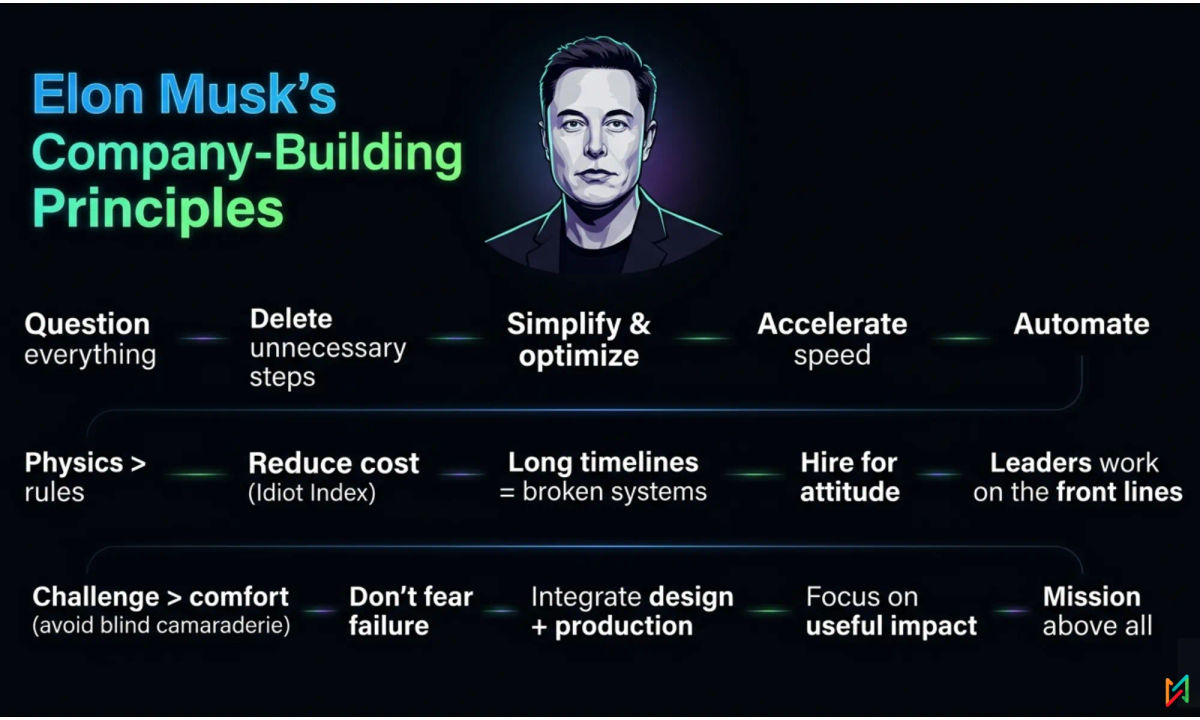
In a world where innovation drives success, Elon Musk's approach through "The Algorithm" stands out. This thought process challenges traditional norms and encourages bold experimentation by questioning every requirement. Musk believes most processes exist simply because that’s how it has always been done, arguing they should be challenged unless grounded in physics or necessity. This mindset identifies inefficiencies and frees up resources for meaningful pursuits.
The next step is deletion – a crucial yet often daunting task. Removing steps feels risky but, according to Musk, if you're not adding things back later, you didn't delete enough. This willingness to cut the status quo allows his teams to focus on innovation and progress by stripping away unnecessary complexity, streamlining processes, reducing waste, and accelerating growth.
First Principles Thinking: Physics Over Opinions
In a world where conventional wisdom often holds us back, Elon Musk's philosophy of first principles thinking is a refreshing antidote. At its core lies the notion that the only real constraints are the laws of physics – everything else is open to challenge.
This revolutionary approach involves breaking down problems to their fundamental truths and building solutions from there. Rather than asking how something is typically done, we ask what is actually required. By doing so, we bypass conventional limitations and uncover more efficient, innovative solutions. Take the development of electric cars, for instance. Instead of simply copying existing gasoline-powered designs, Tesla's designers started from scratch, applying fundamental principles of physics to create a vehicle that was truly game-changing.
The shift in thinking required by first principles thinking is what drives innovation forward. It involves questioning assumptions that others take for granted and having the courage to challenge norms, even if it means inviting resistance. But it's this willingness to push boundaries that ultimately leads to breakthroughs – and a world where seemingly insurmountable obstacles are overcome.
The Idiot Index: Rethinking Cost Structures
Musk's "Idiot Index" redefines cost structures by comparing finished product costs to raw materials. This calculation reveals inefficiencies in manufacturing, design, or supply chains, indicating areas for cost savings without quality loss. The principle shifts focus from surface pricing to underlying processes, encouraging teams to question and optimize costs continuously. This mindset drives efficiency improvements, boosting profit margins and enabling reinvestment in growth or innovation.
Speed as a Competitive Advantage
Musk's philosophy is straightforward: if a timeline stretches far into the future, it's likely flawed. This mindset highlights the importance of speed in today's fast-paced business environment.
The issue with long timelines lies not only in their complexity but also in the inefficiencies they often mask. Unnecessary approvals, convoluted processes, and sluggish decision-making can all contribute to a false sense of security while slow-tracking progress. In reality, prolonged timelines create an environment where it's easy for teams to get stuck in cycles of delay and indecision.
The key takeaway from Musk's approach is that speed isn't just about working faster; it's about streamlining processes, eliminating unnecessary barriers, and empowering teams to move quickly without getting bogged down. When organizations prioritize speed, they can learn faster, adapt quicker, and outperform their slower-moving competitors. In many cases, the ability to act swiftly becomes the ultimate competitive advantage.
Hiring for Attitude, Not Just Skill
The phrase "hiring for attitude" is often met with skepticism - after all, skills can be developed through training and experience. However, a person's attitude, which includes traits like curiosity, drive, and resilience, is harder to change.
Elon Musk prioritizes hiring people who are curious, driven, and aligned with his companies' missions. While technical ability is crucial, mindset determines long-term success. Would you rather have someone with exceptional coding skills but apathetic about their work or a less technically proficient individual passionate about the project?
Prioritizing attitude in your hiring process leads to more adaptable individuals who are willing to learn from mistakes and challenge assumptions - essential qualities for innovation and growth. This approach also fosters stronger cultures within organizations, where teams share a common mindset and collaboration becomes easier and more effective.
Leadership from the Front Lines
Musk's leadership style is a testament to the importance of hands-on management. Rather than micromanaging from afar, he immerses himself in the system, making key decisions and working closely with teams to drive results. This approach allows him to stay informed about real-world challenges and make data-driven choices that benefit the organization.
When leaders are directly involved in the trenches, they gain a deeper understanding of the problems their teams face. By being on the front lines, they can identify bottlenecks, address misconceptions, and develop targeted solutions. This proximity also enables them to spot opportunities for growth and improvement, fostering a culture of continuous learning.
The benefits of hands-on leadership extend beyond the immediate impact – it also builds trust and credibility among team members. When leaders are willing to roll up their sleeves and tackle challenges alongside their teams, they demonstrate a commitment to shared goals and a willingness to learn from failures. This participatory approach not only boosts morale but also encourages collaboration, creativity, and innovation.
The Hidden Risk of Camaraderie
When it comes to teamwork and collaboration, there's a fine line between fostering camaraderie and sacrificing accountability. Elon Musk highlights this: too much social bonding can lead to poor decision-making due to lack of constructive criticism. The issue arises when teams become overly comfortable; without external pressure or differing opinions, they may avoid challenging ideas. Groupthink results, leading to poor decisions and stagnation. For instance, a software development team might stick to tried-and-true methods rather than taking risks if too familiar with each other.
Healthy teams balance support and constructive tension. This means questioning assumptions and pushing for improvement without creating unnecessary conflict. Embracing discomfort through constructive criticism drives better decision-making. By balancing camaraderie and accountability, teams achieve remarkable results.
Learning to Handle Failure
When embarking on new endeavors or pursuing ambitious goals, the fear of failure can be overwhelming. However, recognizing that failure is inevitable helps shift our mindset to view it as an opportunity for growth and learning rather than a setback. Early failures are challenging, leaving us frustrated and disappointed; yet they shape resilience, adaptability, and perspective. Confronting failure repeatedly fosters self-awareness, enabling us to pivot and adjust our approach. As comfort with failure grows, so does the willingness to take calculated risks, sparking innovation. Treating failure as valuable feedback rather than a catastrophic outcome fuels creative solutions and meaningful progress.
Integration of Design and Production
Data-driven organizations struggle to reconcile creative design processes with operational production efficiency. Isolated functions lead to delays, misalignment, and inefficiencies. A company that designs innovative products without streamlining manufacturing faces costly rework, inventory issues, and missed deadlines.
Fostering open communication and immediate feedback loops is crucial for integrating design and production. Tesla’s Elon Musk advocates for close collaboration between teams. As soon as a design is finalized, the production team receives immediate feedback to make swift adjustments. This integration accelerates development cycles, reduces errors, and boosts efficiency.
Integrating design and production benefits companies by enabling them to create practical and executable innovative products while streamlining development processes. Organizations can respond quickly to market changes and customer needs. Eliminating silos between design and production teams unlocks new levels of productivity, creativity, and competitiveness.
Focus on Meaningful Impact
Musk's philosophy is built around a fundamental question: Is this useful for civilization? This inquiry lies at the heart of his approach, guiding decision-making and prioritization. By focusing on meaningful impact, teams can stay aligned and avoid wasting effort on distractions.
When teams are clear about their purpose, they're better equipped to navigate ambiguity and uncertainty. For instance, consider a project aimed at developing sustainable energy solutions. With a shared understanding of the mission's significance, team members can collaborate more effectively, leveraging each other's strengths to drive progress toward meaningful outcomes.
The clarity that comes from focusing on meaningful impact has a profound effect on motivation. When individuals understand the purpose behind their work, they're more likely to feel invested and driven by a sense of purpose. This, in turn, enables teams to stay focused and resilient in the face of challenges, even when obstacles arise. By prioritizing meaningful impact, teams can achieve remarkable results that truly make a difference.
Mission Above Everything
The foundation of any successful organization is a clear and compelling mission statement. When every team member understands the why behind their work, it becomes easier to stay focused on what truly matters.
A great example of this can be seen in companies like Google or Amazon. Their founders didn't just set out to build products – they had a clear vision for how technology could improve people's lives. This mission-driven approach guides every decision, from product development to hiring and company culture. As a result, these companies attract top talent who are motivated by more than just a paycheck.
The benefits of prioritizing your mission are twofold. Not only does it simplify decision-making and reduce distractions, but it also fosters resilience within your team. When everyone is working towards a shared goal, they're more willing to push through challenges and adapt to changes. By keeping the bigger picture in mind, you'll be better equipped to navigate setbacks and emerge stronger on the other side.
Final Thought
Understanding what drives individuals like Elon Musk reveals a discipline in thinking rather than just ambition. This discipline stems from simple yet powerful principles. Musk focuses on removing unnecessary elements and accelerating processes, creating space for creativity and bold moves. Great companies are built by design, not chance, through discipline, focus, and questioning everything. Applying these principles can transform how you operate and help achieve goals. Remember, it's not just ambition but disciplined thinking that sets successful individuals apart.