 WORKPLACE SIGNALS
 5 Rules Lisa Su Used to Rebuild AMD: A Masterclass in Transformational Leadership
When Lisa Su took over as CEO of AMD in October 2014, the company was in a genuine crisis. Its stock had fallen below $2. Morale was fractured. The chip industry had written AMD off as a permanent also-ran to Intel and NVIDIA. Less than a decade later, AMD's market capitalization had grown by over 8,000 percent, its Ryzen and EPYC processor lines were setting performance benchmarks, and Lisa Su had become one of the most respected technology executives on the planet. The turnaround is now a case study taught in business schools — but the principles behind it are surprisingly human, accessible, and replicable for leaders at every level.
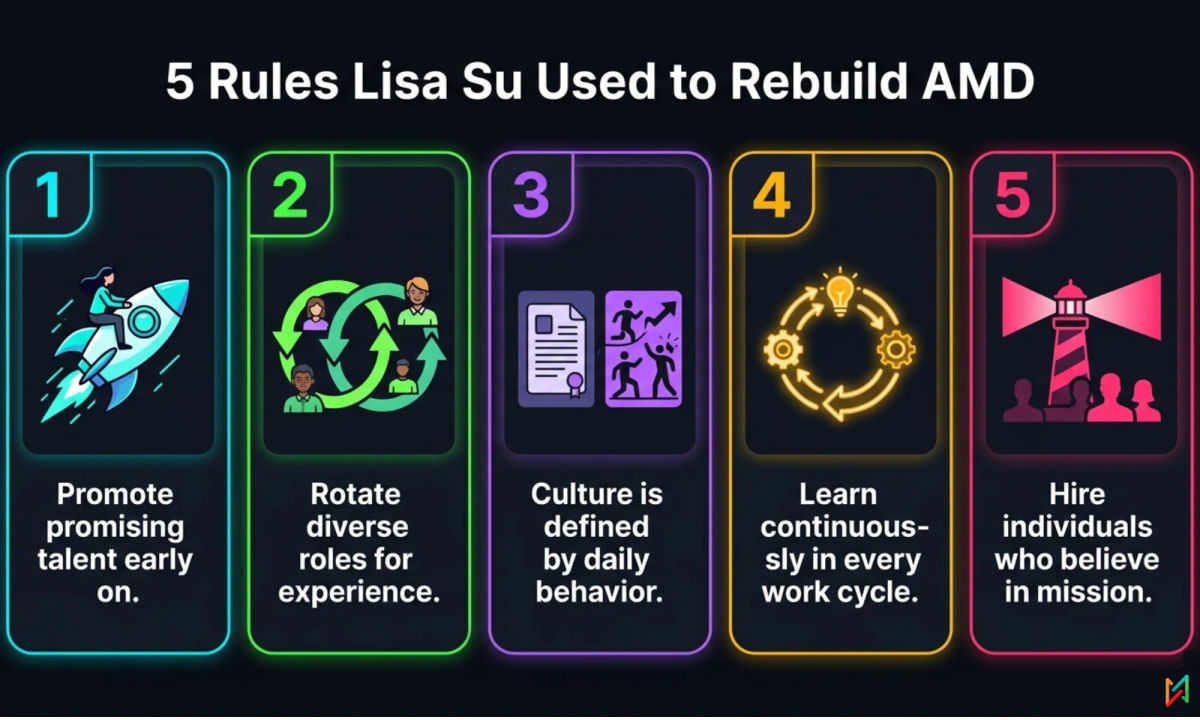
This is not a story about financial engineering or lucky market timing. It is a story about leadership philosophy: how you develop people, define culture, build learning into your operating rhythm, and hire for something deeper than credentials. Below are the five rules Lisa Su applied to rebuild AMD — and what they mean for leaders who want to build something that lasts.
Rule 1 — Promote Before People Are Ready
One of the counterintuitive things Lisa Su did early in her tenure was give bigger roles to high-potential individuals before they had fully proven themselves in those roles. This is not recklessness — it is a deliberate growth strategy rooted in a clear-eyed understanding of how people develop. Most high achievers grow fastest when they are slightly over their heads, surrounded by enough support to prevent failure but exposed to enough pressure to accelerate learning.
The conventional leadership instinct is to wait: promote when someone has demonstrated mastery. But mastery is often only built in the role itself. Waiting for certainty before promoting means your best people spend years in positions that underchallenge them — and they leave, or worse, they stay but stop growing. Su's approach inverts this: identify the potential, place the bet early, and then surround that person with the resources, mentorship, and organizational support they need to succeed. The promotion is not a reward for past performance; it is a catalyst for future development.
For leaders applying this today, it means looking at your talent pipeline differently. Who on your team is operating at the ceiling of their current role? Who would surprise you if given the chance? The answer is rarely the most obvious candidate. It is often the person who asks the most uncomfortable questions, who volunteers for the messy problems no one else wants, who has demonstrated judgment even without authority. Bet on those people early, back them hard, and watch what happens.
Rule 2 — Move People Across Roles to Build Range
Technical depth matters enormously in the semiconductor industry. But Lisa Su understood that the leaders who would carry AMD's future needed more than depth — they needed range. She deliberately rotated high performers across functions, moving people from engineering to product management, from sales into strategy, from operations into leadership roles they had never held before. The explicit philosophy: people grow by doing new things, not by repeating the same ones.
This stands in sharp contrast to how most organizations manage talent. Career ladders are typically vertical — you get better and better at one thing, climbing higher within a narrow function. The result is organizations full of deep specialists who lack the cross-functional empathy and systems thinking that complex challenges demand. When an engineering leader has never worked in sales, they struggle to understand why a technically superior product loses in the market. When a finance executive has never been in operations, they make decisions that look clean on a spreadsheet but are impossible to execute.
Cross-functional rotation builds the mental models that make great leaders. It creates the ability to translate between disciplines, to anticipate second-order effects, and to lead teams whose work you do not fully understand — which is, increasingly, the defining challenge of modern leadership. If you want to develop leaders who can think across the whole organization, you have to move them across the whole organization.
Rule 3 — Culture Is What People Experience Daily
Ask most executives to describe their company culture and they will point you to a values deck, a mission statement, or a set of principles on the wall. Lisa Su's insight is more demanding and more honest: culture is not what you write down. It is how leaders behave when things get hard. It is the decisions that get made under pressure. It is what gets tolerated, what gets celebrated, and what gets ignored — every single day.
This is a definition of culture that places the burden squarely on leadership behavior, not on communications or HR programs. At AMD, Su modeled the culture she wanted: direct in communication, rigorous in analysis, decisive under uncertainty, and deeply collaborative. She did not ask people to embody values she was not living herself. And because the behavior was consistent — in good quarters and bad — the culture became real rather than aspirational.
The gap between stated values and actual behavior is one of the most corrosive forces in organizational life. Employees are expert detectors of that gap. When a company says it values work-life balance but rewards people who never disconnect, everyone knows which value is real. When a company says it values psychological safety but shoots the messenger who brings bad news, the message is received clearly. Culture is defined by the delta between what leadership says and what leadership does — and the only way to close that gap is through consistent, observable, repeated behavior over time.
Rule 4 — Make Learning Part of Every Cycle
AMD's engineering culture under Lisa Su became famous for its rigor — not just in building things, but in learning from them. Su embedded structured reviews into every product cycle: what worked, what did not, what could be done differently, and most importantly, what could be learned from the failures that would make the next cycle better. The explicit principle was to learn more from mistakes than from successes — because success often obscures the things that almost went wrong, while failure makes them visible.
This is harder to implement than it sounds. Most organizations are structurally optimized to celebrate wins and move on from losses as quickly as possible. Post-mortems are rushed. Retrospectives are skipped when the calendar gets tight. The lessons from a product that failed are filed away and rarely retrieved. The result is that the same mistakes get made repeatedly, at increasing cost, by different teams who never had access to the institutional knowledge that could have prevented them.
Building a genuine learning culture requires treating the review process as non-negotiable, not as an optional extra that gets cut when teams are busy. It also requires psychological safety: people need to know that surfacing a failure honestly will be met with curiosity rather than blame. When leaders model this — when they openly discuss their own mistakes and what they learned from them — it creates permission for the rest of the organization to do the same. Over time, this compounds. Each cycle becomes slightly smarter than the last, and the organization builds a form of collective intelligence that is extraordinarily difficult for competitors to replicate.
Rule 5 — Hire for Belief, Not Just Skill
The fifth rule may be the most differentiated and the hardest to implement consistently: hire people who genuinely believe in the mission and want to work on hard problems — not just people with impressive resumes who are optimizing for compensation. At AMD's most difficult moments, when the company could not compete on salary with Intel or the growing tech giants of Silicon Valley, Su leaned into a different kind of competitive advantage: the mission itself.
AMD's mission — to push the boundaries of what processors can do, to compete with the best in the world on pure engineering — is genuinely compelling to a certain kind of person. That person would rather be part of a comeback story, working on problems that seem nearly impossible, than collect a larger paycheck at a company where the outcome feels predetermined. Su understood this and recruited accordingly. She competed on mission and cutting-edge technical challenge, not on compensation packages.
The practical implication for hiring is to screen explicitly for belief. Not belief as a soft cultural fit test, but belief as revealed through behavior: Has this person worked on hard problems before, by choice? Have they stayed with a difficult challenge even when easier options were available? Do they talk about the work itself with genuine energy, or does the conversation keep returning to career advancement and compensation? The believers — the people who are intrinsically motivated by the mission — are the ones who will perform when the work is hard and the outcome is uncertain. Those are exactly the conditions under which transformational things get built.
The Common Thread
What connects these five rules is a philosophy of leadership that treats people as the primary variable in organizational performance. Not strategy, not capital allocation, not market timing — people. The quality of the talent you develop, the culture you model daily, the learning systems you build, and the beliefs you hire for determine everything else. Lisa Su did not rebuild AMD by finding a clever competitive strategy and executing it flawlessly. She rebuilt it by creating the conditions under which extraordinary people could do extraordinary work — and then getting out of their way.
That is a leadership lesson that travels well beyond the semiconductor industry. Whatever organization you lead, whatever industry you operate in, the question Su's playbook puts to every leader is the same: Are you investing in your people the way a turnaround demands? Because in a world of accelerating change and intensifying competition, the organizations that survive and win are not the ones with the best plans. They are the ones with the best people — and the best leaders for those people.