 WORKPLACE SIGNALS
 Your Manager Isn’t Watching Your Work—They’re Watching These 7 Behaviors
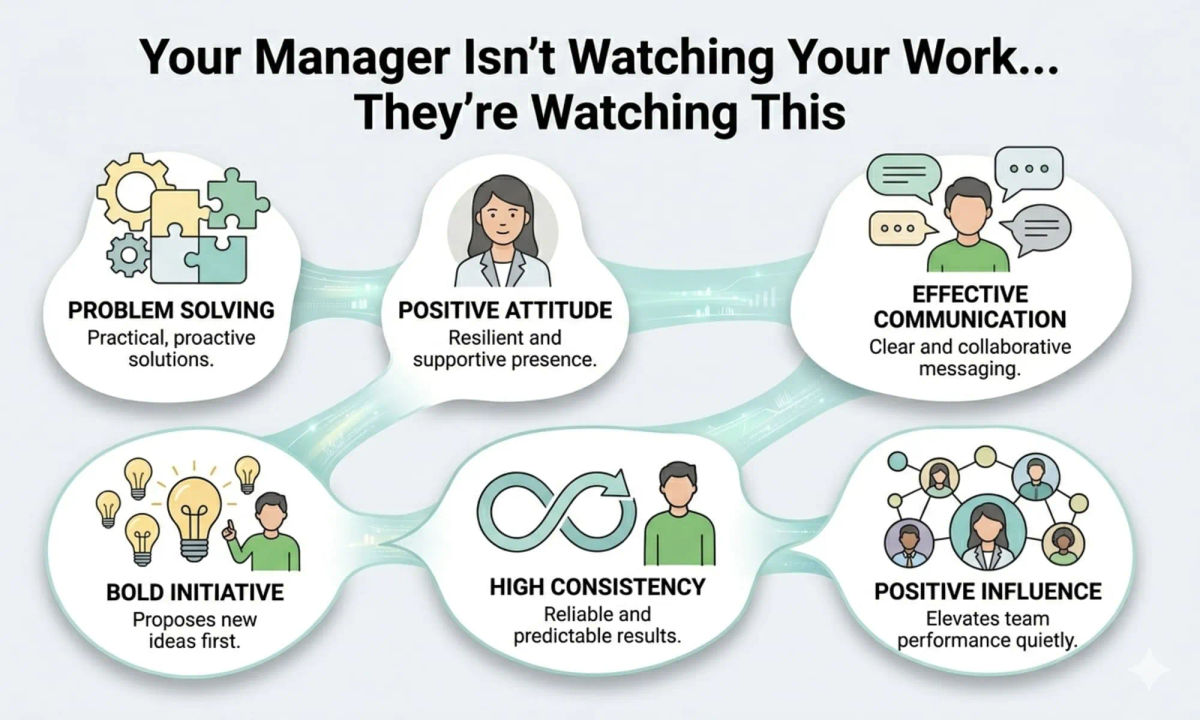
The notion that career growth hinges solely on the quality of one's work has become an ingrained assumption in many professional circles. While producing high-quality results is undoubtedly crucial, it often overshadows other vital factors that contribute to a manager's perception. In reality, managers are driven by more than just what you achieve; they're intrigued by how you accomplish your goals.
Take, for instance, a team member who consistently delivers exceptional work but struggles with communication and collaboration. Their manager might appreciate the quality of their output but be concerned about the negative impact their behavior has on the team's dynamics. This dichotomy highlights the significance of considering not just what you do but also how you do it.
Moreover, promotions, trust, and leadership opportunities are rarely bestowed solely based on individual performance metrics. Instead, they're often granted to individuals who consistently demonstrate a specific mindset, approach, and behavior pattern. By recognizing these patterns, professionals can better navigate their careers and cultivate the skills that truly matter. By understanding what your manager is really looking for, you'll be empowered to make deliberate choices that align with your goals.
🧠 1. How You Solve Problems
When it comes to problem-solving, managers aren't just looking for individuals who can complete tasks efficiently. They're seeking people who can effectively navigate uncertainty, pressure, and complexity. This means that how you approach problems is just as important as the solutions you propose.
Let's face a realistic scenario: when faced with a challenging issue, your response matters more than the problem itself. It's not about being perfect; it's about showing resilience and the ability to adapt in the face of uncertainty. For instance, imagine receiving an urgent request from a team member who needs help resolving a critical project issue. Your prompt response could mean the difference between meeting a deadline or facing costly delays.
The key to strong problem-solving is not panicking, but instead breaking down complex situations into manageable parts, thinking critically about potential solutions, and moving forward with clarity. By doing so, you build confidence in your ability to handle bigger responsibilities over time. This, in turn, opens up new opportunities for growth and development in your career.
😌 2. Your Attitude in Challenges
In the face of adversity, our true character is often revealed. Difficult situations have a way of exposing the layers beneath the surface, showcasing how we react under pressure. It's easy to impress with a polished performance when everything goes according to plan, but it's when chaos ensues that our attitude takes center stage.
Think about it: when deadlines are looming, priorities shift, or unexpected setbacks occur, your attitude becomes an indicator of how you'll navigate the situation. Will you panic and scramble for a solution? Or will you remain calm, focused, and composed? The way you respond in these moments says a lot about your character – and that's exactly what managers pay attention to.
A steady and composed attitude demonstrates maturity and reliability, essential qualities every leader values. When faced with challenges, ask yourself: Can I stay calm under pressure? Do I focus on finding solutions rather than dwelling on problems? Or do I tend to blame others or make excuses? Your attitude is a reflection of your growth mindset, and it's crucial for building trust and credibility with those around you.
💬 3. How You Communicate
The art of effective communication is often overlooked in today's fast-paced work environments. However, it remains one of the most powerful tools for career acceleration and success. By mastering the ability to convey ideas clearly and concisely, you can establish yourself as a reliable and trustworthy professional. When done correctly, communication can be a game-changer, allowing you to build strong relationships with colleagues and clients alike.
So, how do you communicate effectively? It's not about saying more; it's about saying things clearly. Managers notice whether your updates are concise, your messages are structured, and whether you bring clarity or confusion. Take the time to craft thoughtful emails, avoid jargon, and prioritize simplicity over complexity. By doing so, you'll save time, reduce misunderstandings, and foster a culture of trust and collaboration.
The consequences of poor communication can be severe. Long explanations, unclear emails, and excessive back-and-forth create friction, leading to wasted time and energy. On the other hand, clear and thoughtful communication can be a powerful catalyst for growth. By prioritizing effective communication, you'll not only improve your relationships but also increase your productivity and overall job satisfaction.
🧾 4. Ownership, Not Excuses
When we think about the hallmarks of strong leadership, one trait stands out above the rest: ownership. This isn't just a matter of taking credit for successes or deflecting blame when things go wrong. Real ownership means being accountable for outcomes, even when circumstances are outside our control. It's a mindset that separates leaders from mere managers.
Let me give you an example. Imagine your team is struggling to meet a critical deadline. As the leader, you've set clear goals and provided resources, but despite everyone's best efforts, the project is lagging behind. Instead of pointing fingers or making excuses, take ownership of the outcome. Acknowledge that you didn't get it right, and commit to finding a solution – whether that means re-prioritizing tasks, adjusting expectations, or seeking outside expertise.
The reason managers remember people who take ownership is because it's a powerful signal of reliability, integrity, and professionalism. When you own the outcome, you're demonstrating that you can be trusted with bigger responsibilities. It's not about being perfect; it's about being accountable. By embracing this mindset, you'll earn the respect of your team members and set yourself up for long-term success.
💡 5. Your Initiative
The concept of going beyond what's expected is a crucial aspect of professional growth. It's not just about completing tasks, but rather taking ownership and showing enthusiasm for your work. When you take initiative, it sets you apart from others and demonstrates your commitment to the organization.
A great example of taking initiative is volunteering for new challenges. This could mean stepping up to lead a project, offering to help a colleague with their workload, or even proposing a innovative idea that improves processes. Suggesting improvements shows that you're not only capable of doing your job well but also willing to think creatively and drive positive change. Additionally, asking thoughtful questions displays your curiosity and willingness to learn, which are valuable assets in any professional setting.
Taking initiative is essential for career advancement because it signals to managers that you're engaged, proactive, and invested in the bigger picture. When you take ownership of your work and show a desire to make a meaningful impact, it demonstrates a level of maturity and professionalism that's hard to ignore. By taking initiative, you're not only enhancing your reputation but also building a stronger foundation for future success.
🔁 6. Consistency Over Flashiness
The notion that exceptional moments are the key to career advancement is a widespread misconception. In reality, it's the consistent application of skills and effort that ultimately drives success. This might seem counterintuitive at first, as flashier achievements often grab headlines. However, think about it: a single impressive achievement may generate attention, but without consistent performance, it's unlikely to lead to long-term growth.
To illustrate this point, consider the scenario where an employee consistently delivers high-quality work for several months. While their individual contributions might not be earth-shattering, they're building trust and credibility with their manager and colleagues. On the other hand, a single exceptional achievement might generate excitement initially, but it's unlikely to have lasting impact without consistent follow-through.
Managers value employees who can consistently deliver reliable results, meet expectations, and maintain quality over time. When you demonstrate this type of consistency, you're building trust and credibility with your organization. Consistency reduces risk, as it allows teams to rely on each other's strengths. In professional environments, predictability is key to effective collaboration and long-term success.
🌐 7. How You Influence Others
Your impact is not limited to your individual performance; it extends far beyond that. It's about the way you interact with others, fostering a positive and supportive environment that benefits everyone involved. When you genuinely care about those around you, it shows in everything you do – from the way you communicate to the way you collaborate.
A manager's observation is not just about what you achieve individually, but also how you support your teammates, contribute to team dynamics, and influence outcomes beyond your role. It's about being a positive force that makes a meaningful difference in the lives of those around you. When you prioritize teamwork and collective success over individual goals, your value becomes exponentially greater.
Positive influence is not about authority or title – it's about collaboration and a willingness to lift others up. When you share knowledge, skills, and expertise with those who need it, you're not only helping them grow but also demonstrating your commitment to the team's success. By doing so, you become an invaluable asset to any organization, making your impact felt long after your individual achievements are recognized.
🧠 The Bigger Picture
In the world of professional development, it's easy to get caught up in the idea that work performance is the ultimate indicator of success. After all, consistently delivering high-quality results is crucial for career advancement. However, there's a crucial distinction between being good at your job and being considered for promotion – behavior.
Let me illustrate this point with a scenario. Imagine two employees, Jane and John, who have similar work performance records. Both are reliable, efficient, and produce quality results. The key difference lies in their behaviors outside of their core responsibilities. Jane takes initiative to help her colleagues, volunteers for special projects, and is always available to lend a hand when needed. In contrast, John mostly focuses on his own tasks, rarely lifts a finger to assist others, and expects everyone else to cover for him. When it comes time for promotion, who do you think managers are more likely to choose?
Managers are constantly evaluating who they can trust, who can take ownership of projects, and who has the potential to grow into bigger roles. It's not just about being good at your job; it's about demonstrating behaviors that showcase your character, work ethic, and commitment to the organization. By adopting a growth mindset and consistently exhibiting high-potential behaviors, you'll not only increase your chances of getting noticed but also set yourself up for long-term success.
💡 Final Thought
As you strive to accelerate your career, it's essential to shift your focus from simply completing tasks to considering the impact of your actions. Think about how you're showing up while getting the job done – are you bringing energy and enthusiasm or mere going-through-the-motions effort? By making this subtle yet significant adjustment, you'll not only boost your productivity but also start to stand out in the eyes of your manager.
Let me illustrate this with a scenario: Imagine you're tasked with completing a project on time. Your instinct might be to simply check off each item on your to-do list without giving much thought to how you're approaching each task. But what if, instead, you asked yourself how you can bring more creativity, curiosity, or passion to your work? You might start brainstorming innovative solutions, exploring new perspectives, and – as a result – deliver high-quality results that exceed expectations.
So, here's the takeaway: when you're looking to accelerate your career, don't just ask yourself what tasks to complete. Instead, take a step back and reflect on how you're showing up while doing them. Are you bringing your A-game or just going through the motions? By making this simple yet profound shift in focus, you'll start to reap tangible benefits – from increased job satisfaction to more recognition and rewards. And that's exactly what your manager will be watching.