 WORKPLACE SIGNALS
 8 Powerful Leadership Quotes That Will Change How You Lead
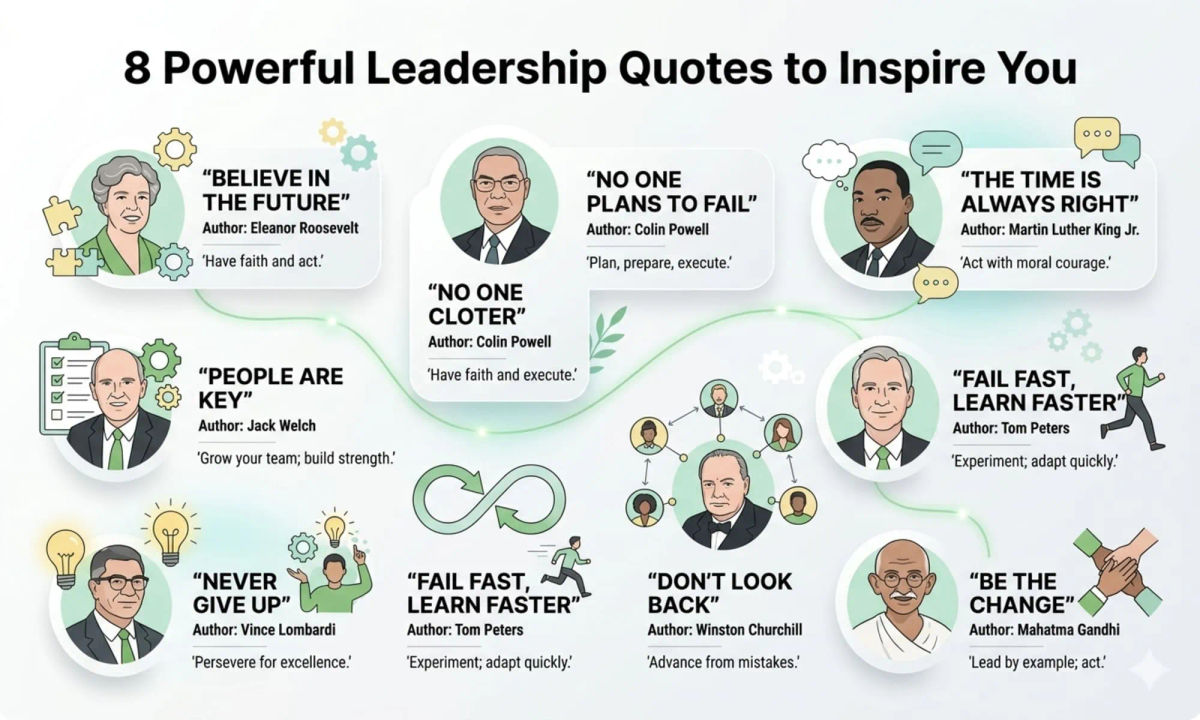
Leadership's true essence lies in embracing values, making personal decisions, tackling challenges head-on, taking responsibility, and nurturing team growth. The most impactful lessons come from real-world experiences where leaders learn to navigate uncertainty, confront adversity directly, and instigate transformative change.
Remarkable leaders articulate wisdom through actions and poignant words that reflect years of trial and error, shaping their leadership philosophy. These quotes encapsulate hard-earned knowledge, offering practical insights for tackling complex challenges in leadership journeys. In this article, we explore eight powerful leadership quotes providing unique perspectives on effective leadership.
🧭 1. Eleanor Roosevelt
Eleanor Roosevelt's insight on leadership highlights that true philosophy is a reality shaped by daily choices. Her quote underscores the importance of accountability in leadership, stressing that leaders are judged more by their actions than their beliefs. Every decision, no matter how trivial, demonstrates values and builds trust among team members.
For instance, prioritizing employee well-being over short-term profits showcases genuine commitment to ethical practices. This consistency reinforces principles through behavior rather than just directives. Roosevelt’s philosophy also suggests leaders must embody principles during tough times. An executive who listens to employees' concerns during a downturn maintains morale and loyalty, even when financial pressures demand immediate cost-cutting measures.
“One’s philosophy is not best expressed in words; it is expressed in the choices one makes, and the choices we make are ultimately our responsibility.”
In this context, true leadership often requires making difficult decisions that yield positive outcomes over time. Investing heavily in employee training programs, despite financial pressures, exemplifies such long-term commitment.
🪖 2. Colin Powell
Colin Powell once famously said, “Leadership is solving problems.” This quote encapsulates a leader's duty to address challenges rather than avoid them. A true leader views problems as opportunities for growth and improvement within their team or organization.When team members stop bringing issues, it often signals a lack of trust in your problem-solving capacity.
This disengagement can stem from fear of judgment, negative experiences with previous attempts, or feeling overwhelmed by challenges. Creating an environment where people feel safe to voice concerns is crucial for effective leadership. Trust-building involves active listening and demonstrating genuine care for team members' well-being and success.
For example, a leader might implement regular check-ins to foster open communication or establish clear channels for feedback. Leaders who encourage problem-sharing gain valuable insights into potential issues while promoting transparency and accountability. Imagine a project manager initiating weekly brainstorming sessions where obstacles are discussed openly without fear of retribution or criticism.
"True leadership creates an environment where people feel safe to speak up, share concerns, and seek guidance."
✊ 3. Martin Luther King Jr.
Martin Luther King Jr.’s quote encapsulates true leadership: standing firm in adversity and controversy. In his lifetime, Dr. King faced violent opposition and personal threats yet remained committed to nonviolent resistance and racial equality. Leadership is tested during crises. Guiding a team through smooth times is one thing; maintaining integrity amid chaos is another. A true leader inspires confidence and cohesion even in darkness, as Dr. King did through his speeches and actions.
“The ultimate measure of a man is not where he stands in moments of comfort, but where he stands at times of challenge and controversy.”
This quote highlights resilience and integrity—traits essential during crises. During the Montgomery Bus Boycott in 1955, Dr. King maintained morale and unity within the African American community despite daily obstacles. His ability to articulate a vision for justice while enduring personal hardships showcased his moral courage.
Leaders who navigate turbulent times with grace are remembered not just as figures of history but as transformative agents whose impact resonates decades later. Dr. King’s leadership style, combining strategic planning with compassionate communication, set a precedent for crisis management.
📈 4. Jack Welch
In the early stages of a career, success is often measured by personal achievements and milestones reached individually. However, as one ascends to leadership roles, the definition of success evolves dramatically, shifting focus from self-growth to nurturing the growth of others within the team.
The pivotal moment when an individual transitions into a leader requires embracing a new perspective—one that prioritizes the development and empowerment of their colleagues over personal accolades. This shift is not merely about changing titles; it involves adopting a mindset where one's worth as a leader is determined by the collective success and growth of those they lead.
Jack Welch, a renowned business leader known for his transformative leadership at General Electric, emphasized the importance of investing in others' development. For instance, during his tenure at GE, he implemented initiatives that encouraged continuous learning and professional advancement among employees, resulting in significant improvements across various departments. This approach not only fostered a culture of growth but also propelled the company towards unprecedented success.
🏈 5. Vince Lombardi
Vince Lombardi said, “Leaders aren’t born, they are made… through hard work.” True leadership develops over time through effort and dedication. It requires continuous learning, self-improvement, and practical experience. A young manager can earn respect from her team members by relentlessly working on leadership skills. This journey is marked by obstacles, mistakes, and new challenges. Every setback or failure offers an opportunity for growth if approached with determination.
🧩 6. Tom Peters
In Tom Peters' words, “Management is about arranging and telling. Leadership is about nurturing and enhancing.” Managers focus on organizing structures and ensuring daily operations run smoothly, while leaders foster growth and potential in their teams.
When a manager implements a new process for efficiency, they often concentrate on technical aspects. In contrast, leaders invest time understanding how each team member can adapt and thrive within the system. For example, a leader may discuss career aspirations with team members during one-on-one meetings to align personal goals with organizational objectives, thereby enhancing performance and morale.
True leadership inspires individuals to reach their full potential and develops skills over time. A study by the Center for Creative Leadership found companies that foster employee development see a 10% increase in productivity. Leaders prioritizing personal growth transform teams into high-performing units capable of innovation and resilience.
"True leadership goes beyond tasks—it involves inspiring and developing individuals."
🗣️ 7. Winston Churchill
Winston Churchill's quote, “Courage is what it takes to stand up and speak. Courage is also what it takes to sit down and listen,” encapsulates the essence of true leadership. Leadership isn't just about being vocal; it involves a profound ability to listen actively and understand others’ perspectives.
Speaking out requires bravery, but so does the act of listening. In many critical situations, such as during World War II, Churchill demonstrated that effective leadership often hinges on understanding the nuances of different viewpoints before making decisions. For instance, in the run-up to D-Day, his willingness to listen to various military strategists was crucial in planning a successful invasion.
Great leaders know when to take charge and direct the conversation, but they also recognize moments where stepping back to listen can provide invaluable insights. This balance is not just about personal courage; it’s about leveraging the collective wisdom of a team or community. For example, during negotiations with other Allied leaders, Churchill's ability to listen intently and respond thoughtfully often swayed crucial discussions in favor of more inclusive outcomes.
🌍 8. Mahatma Gandhi
Mahatma Gandhi’s iconic quote, “You must be the change you wish to see in the world,” encapsulates a profound truth about leadership. Leadership is fundamentally about setting an example—when leaders practice what they preach, their actions speak louder than words. Inconsistencies can lead to a breakdown in trust among team members, undermining credibility and effectiveness. Gandhi’s non-violent resistance movement inspired millions due to his commitment.
The essence of being the change also touches on fostering accountability. Leaders who take personal responsibility for promoting positive changes encourage others to do the same. In today's digital age, ethical data usage and privacy practices set a powerful precedent that can ripple through an entire industry.
You cannot expect others to follow values that you do not practice yourself.
Walking the talk is crucial. Leaders must be consistent in their behavior, especially when faced with challenging situations or temptations that might compromise integrity. Authenticity transforms organizations and societies for the better.
🧠 The Bigger Picture
The concept of leadership has been explored by countless individuals throughout history. A true leader guides others through personal integrity and commitment to growth, fostering an environment where team members feel inspired to reach their full potential. Leadership is fundamentally about influence, which emerges from how a leader interacts with others and responds to challenges. For example, a manager who acknowledges contributions and offers constructive feedback boosts morale and encourages continuous improvement.
Effective leadership often means stepping back to allow others the space they need to develop skills and confidence. It’s about being there as a mentor when needed, and knowing when to let go and trust in the abilities of those you lead. This balance is crucial for sustainable growth within any organization. Ultimately, leadership demonstrates consistent values and behaviors that inspire and empower others. A leader who shows up daily with dedication, empathy, and a commitment to learning sets the stage for a team’s success far beyond what mere authority can achieve.
💡 Final Thought
The power of well-chosen quotes lies in sparking inspiration and reflection, but the real value emerges when we put these words into practice. Personally, integrating one or two impactful quotes into daily routines profoundly influences leadership approaches. Consider selecting a single idea from suggestions and applying it consistently in professional life. For instance, adopting active listening can transform how you engage with team members during meetings, enhancing communication and fostering mutual respect and understanding within the organization.
Building effective leadership requires sustained effort and continuous improvement; every small action contributes cumulatively to developing a robust leadership style over time. According to a study by Harvard Business Review, leaders who consistently work on their skills see improvements in team performance within six months.