 WORKPLACE SIGNALS
 7 Reasons You’re Losing Your Top Performers (And Don’t Even Know It)
Top performers rarely quit overnight; their departure often builds quietly over time, stemming from gradual dissatisfaction. Leaders assume high performers leave for better pay or titles, but these factors are seldom primary motivators. Retention hinges on intangible elements like culture, recognition, and personal growth.
For example, a seasoned developer might leave due to feeling undervalued despite financial security. To retain talent, focus on understanding deeper reasons such as lack of career advancement or meaningful challenges. Addressing these subtle yet crucial factors can significantly improve retention rates and foster engagement.
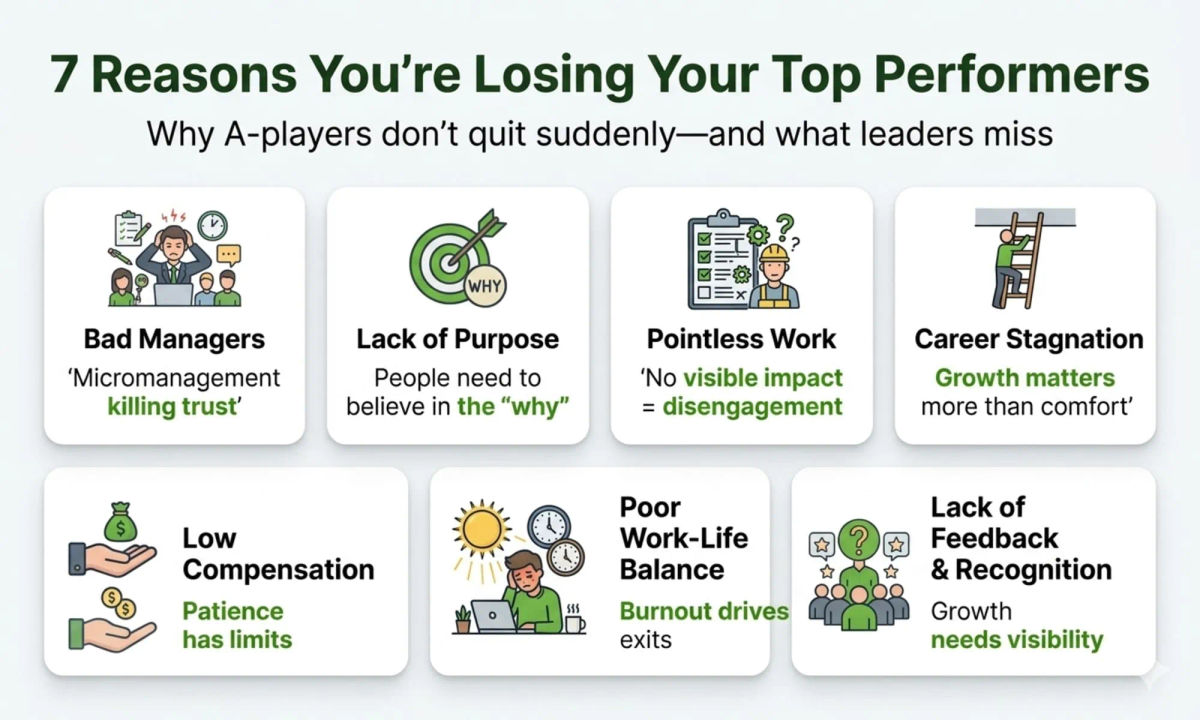
1. Bad Managers
A high-performing employee's most significant challenge is often their manager. Nothing drives top talent away faster than poor leadership practices such as micromanagement, a lack of trust, and inconsistent decision-making. These issues can quickly erode the motivation that keeps exceptional individuals engaged and productive.
Top performers thrive on autonomy. They seek environments where they have the freedom to think critically, act decisively, and deliver results without constant oversight. When managers fail to provide this space or instead impose restrictive controls, it leads to frustration. For instance, a manager who constantly checks in with an employee about every task can stifle creativity and innovation. This micromanagement not only disrupts the workflow but also diminishes trust between management and staff.
Over time, such managerial behaviors create an environment of disengagement. According to a study by Gallup, employees who feel undervalued are nearly three times more likely to look for new jobs. Managers must recognize that providing clear direction and allowing room for initiative is crucial in retaining high-potential talent.
2. Lack of Purpose
High performers are motivated by more than financial incentives—they seek meaningful work connections. Understanding how one’s efforts contribute to a larger purpose is crucial for sustained motivation; without clarity, work becomes transactional, lacking personal investment. The absence of a clear sense of "why" diminishes engagement and affects retention rates among top talent.
According to Deloitte, 75% of millennials believe that a sense of purpose is vital for job satisfaction and career growth. This underscores the importance of fostering an environment where employees feel their contributions matter beyond completing tasks. Consider Sarah, a software engineer who joined a tech startup with dreams of making a significant impact on user experience. Initially, her work was exhilarating as she saw how her code improved customer satisfaction.
However, over time, the company’s priorities shifted towards profit margins without emphasizing product improvement, leaving Sarah feeling like just another cog in a machine. This shift led to a decline in her productivity and creativity, highlighting the critical need for companies to articulate their mission clearly and consistently.
3. Pointless Work
The most accomplished professionals are acutely aware of their work's impact on project or organizational success. For instance, a top sales executive at a tech startup feels immense accomplishment when tracking her latest campaign’s direct contribution to closing high-value deals.
Conversely, if tasked with organizing endless meetings without strategic discussion or purposeful action, her motivation can plummet. When employees perceive daily tasks as repetitive or disconnected from meaningful outcomes, they often disengage. An IT specialist spending hours fixing minor issues in a fundamentally flawed system feels futile and unproductive, eroding confidence and diminishing job satisfaction over time.
Gallup found that engaged employees are more likely to stay longer with their organizations. However, if high-performing individuals cannot see the value in what they do day-to-day, turnover rates rise sharply. For example, a software developer might leave a well-established company for a fledgling startup offering more impactful work opportunities.
4. Career Stagnation
Growth is essential for high performers, driving them to seek new challenges. They look for opportunities to learn skills and take on greater responsibilities. When this stops, they sense a glass ceiling and limited future opportunities. For example, Sarah, a seasoned marketing executive at a mid-sized tech firm, noticed her projects becoming repetitive after two years in the same role and realized staying put meant missing out on leadership roles.
High performers then explore external opportunities where growth is encouraged. According to LinkedIn, over 60% of professionals are actively seeking new positions due to perceived career stagnation. This shift involves stepping away from comfort zones into uncertain territory but offers potential for significant personal and professional growth.
5. Low Compensation
Money isn't everything, but it matters when keeping top talent happy and engaged. High-performing employees might stay for potential growth or long-term benefits but won't tolerate stagnant pay forever. A clear path to better compensation is crucial; otherwise, even committed professionals become frustrated.
Industry reports show companies losing top talent due to low pay face recovery challenges. Jane, a mid-level manager at TechCorp, initially stayed for stock options and career advancement opportunities. When her salary remained unchanged despite significant company growth over two years, she began exploring other job openings outside the firm. This scenario isn't unique; many professionals find themselves in situations where the gap between their current earnings and market standards becomes too wide to ignore.
While financial incentives are crucial, they're just one piece of a larger puzzle. Employees also value recognition, flexibility, and work-life balance. At startups, employees might accept lower salaries for equity and excitement but only if there's genuine potential for those stocks to be worth millions someday. Otherwise, the setup risks leaving everyone feeling shortchanged.
6. Poor Work-Life Balance
Burnout rarely announces itself loudly; instead, it creeps up quietly over time through long hours and constant pressure without enough downtime to recharge. High performers are particularly vulnerable because they often push themselves harder than their peers, leading to a quicker descent into burnout.
When work starts affecting health, relationships, or overall well-being, the impact is clear and immediate. For instance, someone might find themselves calling in sick more frequently due to stress-related illnesses, experiencing strained personal relationships, or even feeling physically exhausted just thinking about going to work. At this point, leaving the job becomes a necessity rather than an option.
One surprising fact is that many high-achievers delay recognizing the signs of burnout because they equate success with relentless effort. However, studies show that employees who take regular breaks and maintain a healthy work-life balance are more productive and creative in the long run. For example, Google implemented policies to encourage its workers to spend 20% of their time on projects outside their usual responsibilities, leading to innovations like Gmail.
7. Lack of Feedback and Recognition
High performers are driven by a constant desire to improve, seeking regular feedback that goes beyond annual reviews. They aren't looking for validation but rather clarity on what they're doing right so they can build upon their successes. When this essential dialogue falls silent or is replaced with sporadic recognition, it can feel like they've become invisible within the organization.
The absence of meaningful interaction and acknowledgment over time leads to decreased engagement among top talent. A study by the Harvard Business Review found that 65% of employees are more likely to stay when their work is regularly recognized. Without clear signals about what they should continue doing, high performers may lose direction and motivation.
For instance, consider Sarah, a project manager who excels at meeting deadlines. When her efforts go unnoticed for months, she starts questioning the value of her contributions. Regular check-ins and specific praise from supervisors could have kept her motivated and focused on maintaining her performance levels. Growth hinges on feedback that guides development, while motivation thrives on recognition that highlights accomplishments.
Why Leaders Miss These Signals
Leaders often overlook critical issues because subtle cues are easy to dismiss or miss entirely. Team members may start attending meetings less eagerly, contribute fewer ideas, avoid team activities, and appear disconnected from their work. Staff who once led projects hesitate to propose new initiatives and wait for explicit instructions instead of taking proactive steps.
The cumulative effect can be significant; leaders often notice disengagement and a lack of motivation too late. A Gallup study found that 51% of employees plan to leave within a year, indicating the prevalence of this issue. Recognizing early signs before they escalate into high turnover rates or poor performance reviews is crucial.
For example, if an employee who used to be highly proactive suddenly stops suggesting improvements or attending training sessions, it’s clear something is amiss beneath the surface. Leaders must learn to read between the lines and address underlying concerns proactively.
How to Retain Your Top Performers
Retention strategies should focus on building a positive workplace environment that encourages long-term commitment through trust and autonomy. Employees are more likely to stay when their work aligns with broader goals, making them feel valued and motivated. Companies like Patagonia integrate environmental activism into their business model, showing how connecting work to a larger purpose boosts morale and loyalty.
Building trust and autonomy empowers individuals to innovate without fear of failure; connecting work to the bigger picture makes efforts more rewarding. Ensuring meaningful impact motivates by showing the difference employees make beyond tasks. Clear growth paths provide direction and personal development opportunities that keep top performers engaged over time.
Fair compensation is crucial but not the primary driver for long-term retention; competitive salaries meet basic needs without distracting from other factors. Maintaining work-life balance through flexible schedules or remote working options alleviates stress and prevents burnout. Consistent feedback keeps communication open, fostering a continuous improvement culture. Small steps can lead to substantial retention rates; regular check-ins or surveys gauge employee satisfaction effectively. According to LinkedIn, companies prioritizing engagement see 20% less turnover.
Conclusion
The departure of top performers is rarely random. Instead, these individuals leave when their key needs remain consistently unmet over time. Building a strong, high-performing team requires intentional efforts to retain talent; otherwise, the costs associated with losing great people can be substantial—not just financially but also in terms of momentum and cultural impact.
For instance, at XYZ Corporation, they lost one of their top developers due to a lack of professional growth opportunities, which not only affected morale but also slowed down several critical projects. Retention strategies must address specific needs such as career advancement, recognition, and work-life balance to prevent such losses. Interestingly, many companies overlook the importance of employee engagement surveys, which could provide early warnings about potential departures.