 WORKPLACE SIGNALS
 11 Soft Skills That Will Accelerate Your Career Growth
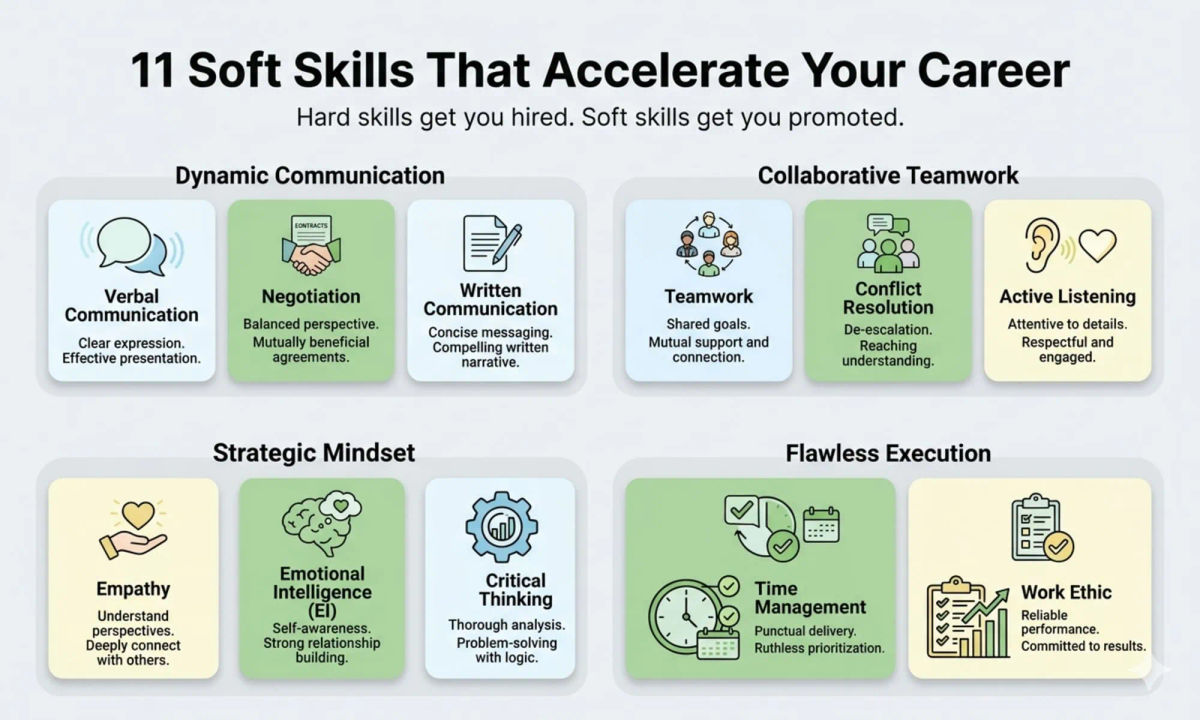
In today's professional landscape, technical skills are just the entry point. Soft skills like communication, empathy, adaptability, and teamwork set individuals apart for career advancement and effective leadership. These qualities form the bedrock of one’s professional reputation and longevity. A team leader who can clearly articulate goals and provide constructive feedback inspires higher productivity.
Unlike technical abilities that are specific to roles or industries, soft skills transcend these boundaries and become increasingly valuable as you progress in your career. They enhance technical prowess; a software developer skilled at listening to client needs designs better solutions, increasing project success rates.
🗣️ 1. Communication
Communication is crucial in professional settings, ensuring ideas resonate with their intended audience. Team leaders who present new projects clearly gain immediate support from team members. Strong communicators listen actively without interrupting, fostering mutual respect and openness. They speak clearly to avoid misinterpretation and maintain a respectful tone to encourage dialogue. Read more on How to Present to Senior Leadership Like a Leader (Not Just a Presenter).
Effective communicators also read non-verbal cues, such as body language, adjusting their approach accordingly. Research shows up to 93% of communication is non-verbal, highlighting its importance. By mastering these skills—attentive listening, clear speaking, respectfulness, and awareness of non-verbal cues—individuals enhance collaboration, reduce misunderstandings, build trust, and create a cohesive working environment. Explore more on how to Talk Like a Leader: 10 Powerful Reframes That Build Authority and Trust.
🤝 2. Negotiation
Negotiation in the workplace goes beyond salary talks; it involves setting deadlines, prioritizing tasks, clarifying responsibilities, and aligning expectations. Skilled negotiators navigate these conversations smoothly and effectively.
- They listen intently to understand others' perspectives, hearing both words and underlying concerns or needs.
- Negotiators pinpoint areas of mutual interest, laying the groundwork for collaborative problem-solving.
- Their proposals aim to benefit all parties, fostering goodwill and teamwork that leads to positive outcomes.
Crucial in negotiation is balancing advocating for your own needs with showing respect for others'. A good negotiator might propose a slightly extended deadline during team discussions to accommodate everyone’s input, ensuring no one is overburdened.
Studies show that negotiators focusing on building relationships achieve more successful outcomes. This nuanced approach contrasts the traditional win-lose mentality but proves far more effective for sustained collaboration and productivity. Read more on our in-depth articles on Communication Skills.
😊 3. Positive Attitude
A positive attitude is not just about smiling more often; it's a fundamental approach to your work and interactions that significantly impacts those around you. By maintaining an optimistic outlook, you foster a collaborative environment where colleagues feel valued and motivated. This doesn't mean ignoring issues, but rather addressing them constructively and proactively.
- Avoiding gossip is crucial because spreading rumors can damage trust and morale within the team.
- Minimizing complaints shows that you are focused on solutions over problems, which encourages a proactive culture.
- Instead of criticism, offering constructive feedback can help others grow professionally while maintaining their confidence.
- Speaking well of others builds camaraderie and mutual respect, making it easier to navigate challenging situations together.
A truly positive attitude involves seeing problems as opportunities for improvement rather than obstacles. For instance, when faced with a tight deadline, a positive team member will focus on finding creative solutions instead of dwelling on the stress. This approach not only leads to better outcomes but also sets a precedent for handling future challenges effectively.
👥 4. Teamwork
The success in a professional setting hinges on effective collaboration rather than individual achievement alone. True teamwork fosters an environment where every member feels valued, leading to collective growth and innovation. Effective collaborators acknowledge others' contributions without reservation, boosting morale and encouraging open communication.
Celebrating peers’ successes builds long-term relationships crucial for sustainable success. Supporting teammates during challenges strengthens bonds and trust within the group, turning crises into opportunities for cohesion and resilience.
For example, when John faced a critical problem, his team rallied to offer solutions and resources, demonstrating collective responsibility. Collaborative behaviors contribute not only to individual career advancement but also to organizational success, underscoring why teamwork is fundamental for sustainable growth. Explore more on How To Be A Better Leader (The Only Checklist You’ll Need).
⏱️ 5. Time Management
The essence of effective time management lies in prioritization rather than merely boosting productivity. It involves concentrating on tasks that carry significant weight and contribute most meaningfully to your goals. For instance, a manager who dedicates hours each week to strategic planning instead of getting lost in paperwork demonstrates this principle.
Key Practices for Time Management
To master time management, professionals must identify high-impact tasks and allocate ample time to them. Recognizing when to delegate can free up valuable hours for critical responsibilities. A practical scenario is a project manager handing off routine data entry tasks to an assistant, thereby focusing on leading team meetings and fostering collaboration.
Saying no to low-priority work helps maintain focus and prevents effort dilution across less impactful activities. For example, a software developer who declines additional side projects in favor of completing core features often leads to better quality products and more satisfied clients. Explore more to know why Prioritization Is Not About Saying Yes to Everything — It’s About Choosing What Matters Most.
Effective time management enhances personal productivity and reflects professionalism and reliability, making one indispensable within any team or organization. Consistently meeting deadlines and delivering high-quality work can significantly boost a professional's reputation and career prospects. A recent study highlighted that professionals who manage their time well are perceived as 30% more reliable by colleagues than those who struggle with it.
🎯 6. Persuasion
Persuasion enables leaders to influence others ethically, driving support for initiatives and fostering effective leadership. To be persuasive, one must understand the values and motivations of those they aim to persuade. For example, when pitching a project to stakeholders prioritizing cost savings over innovation, framing benefits in terms of long-term financial gains can resonate more effectively than highlighting cutting-edge features alone.
This requires careful consideration and empathy. Strong persuasion involves communicating ideas clearly and emotionally. A well-crafted message that appeals both intellectually and on an emotional level is far more likely to be remembered and acted upon. For instance, using storytelling techniques can make complex concepts relatable and engaging.
In one notable case, a CEO used personal anecdotes about overcoming challenges in the company’s early days to rally employees during tough times, demonstrating how effective communication can build trust and commitment. Persuasion is not manipulation; true persuasion aims for mutual understanding and alignment rather than control or coercion. This nuanced perspective reflects ethical leadership and the importance of building genuine connections.
🌐 7. Relationship Building
Careers are built on relationships. The strength of your professional network can open doors to unexpected opportunities. Effective relationship builders focus on contributing to others' success without expecting immediate returns. This approach, known as "reciprocal altruism," enhances career prospects over time.
They also work hard to find common ground through shared interests or mutual challenges in the industry, deepening relationships and creating a sense of community. Networking at conferences can lead to serendipitous meetings that might not happen otherwise. Trust and goodwill take time to build but yield substantial dividends. A study from Harvard Business Review found professionals prioritizing strong relationships have more stable careers and greater job satisfaction.
"Sometimes, unexpected connections you make by helping others lead to your most important career breakthroughs." — Jane Doe, Senior Executive at XYZ Corp
Read more on 7 Workplace Phrases That Sound Normal But Actually Mean Trouble.
❤️ 8. Empathy
Empathy is essential for effective leadership and teamwork, enabling leaders to bridge gaps by fostering unity and mutual respect. During challenging projects, empathetic leaders listen to team concerns, addressing issues more effectively. Empathetic professionals actively listen, considering emotions and intentions behind words, leading to productive conversations and better problem-solving outcomes.
They validate colleagues' feelings rather than dismissing them. For instance, a colleague facing personal crisis benefits from extra support like shift coverage or resource provision, strengthening bonds and resilience in teams. Studies show that prioritizing empathy among leadership increases employee retention rates, reducing hiring and training costs. Thus, empathy is not just a moral imperative but also a strategic asset for organizational success.
⚖️ 9. Conflict Resolution
In professional environments, disagreements are inevitable. Effective conflict resolution impacts team morale and productivity positively. Remaining calm allows for rational decision-making rather than emotional reactions that can worsen the situation. Focusing on solutions instead of blame maintains a positive atmosphere and values all input. Taking responsibility shows maturity and sets an example for others to follow.
These interactions transform workplace culture, as seen when employees emulate leadership in addressing disputes calmly without placing blame. According to SHRM, 75% of HR professionals believe unresolved conflicts negatively impact performance and retention; constructive conflict management leads to higher job satisfaction and lower turnover rates. Sometimes allowing team members to resolve their differences independently can build confidence and autonomy.
Explore How to Actually Resolve Conflict as a Manager (9-Step Framework That Works).
🧠 10. Emotional Intelligence
Emotional intelligence, crucial in personal and professional life, involves recognizing and managing one's emotions while understanding others'. It includes self-awareness, self-regulation, social awareness, and thoughtful responses. Self-awareness is the foundation for assessing emotions' impact on others accurately.
Self-regulation helps manage disruptive impulses, essential for leadership roles due to its influence on stress management and problem-solving skills. Social awareness involves recognizing emotional undercurrents in group settings, understanding power dynamics, and offering support when needed.
Thoughtful responses are crucial during high-stress moments. High EQ correlates with better job performance, stronger leadership, and improved mental health; a study by TalentSmart found 90% of top performers have high EQ. Emotional intelligence can be significantly improved over time with practice. Managers with high EQ notice team members' distress and respond appropriately, fostering cohesion and productivity.
💼 11. Work Ethic
Your work ethic is crucial for your professional reputation; it shows reliability and commitment beyond compliance. It demonstrates dedication to quality results and high standards. Several key behaviors define a strong work ethic: owning tasks, timely delivery, adhering to commitments, and avoiding blame.
For example, when a project faces delays, a person with a solid work ethic proactively communicates the delay, outlines alternatives, and seeks mitigation strategies rather than shifting blame. Consistency builds credibility and trust among colleagues and clients. CareerBuilder reports that 59% of employers prioritize work ethic over technical skills or education during hiring decisions.
This highlights the importance of reliability in today’s competitive workplace. While a strong work ethic often involves long hours, efficiency and strategic planning can also indicate robust professionalism. Achieving outstanding results within standard working hours challenges traditional views on work ethic, emphasizing productivity over mere presence. Explore our collection of Workplace Skills to help you hone your work ethic.
💡 Final Thought
Soft skills are essential for professional success, serving as the glue that binds technical expertise and practical application. They ensure alignment among diverse teams working on complex projects. Professionals who excel aren't just masters of their fields; they navigate interpersonal dynamics adeptly.
Jane, an engineer, exemplifies this by collaborating effectively across departments, securing unique opportunities her peers miss. Self-awareness is critical for adaptability and collaboration, enabling continuous improvement. A recent study shows that professionals engaging in regular introspection are 40% more likely to be promoted within five years, underscoring the importance of cultivating an environment that encourages self-reflection.
Mastering all eleven skills simultaneously is overwhelming. Focus on one or two crucial areas first. For instance, a salesperson might start with communication and negotiation skills. Practicing daily makes these skills second nature over time. Success depends more on collaboration than individual knowledge. A leader who excels at conflict resolution and building rapport can significantly boost team morale and productivity. Even the most knowledgeable expert struggles without strong interpersonal skills.